
Short Engineering Answer
Heat set inserts fail in battery enclosures when the printed fastening structure cannot maintain screw preload, boss support, sealing pressure, or insert retention under heat, vibration, repeated opening, and enclosure clamping load.
Battery enclosures often combine several difficult conditions: service access, thermal exposure, vibration, screw preload, thin walls, and sometimes gasket or cover compression. These loads can make heat set insert joints loosen, spin, pull out, crack the boss, or lose clamping force over time.
The insert itself is usually not the only weak point. In 3D printed battery enclosures, long-term reliability depends on the boss geometry, material behavior, screw engagement length, installation temperature, hole size, and the load path between the cover and enclosure body.
A heat set insert can improve thread durability, but the enclosure must still be designed to hold preload safely over time.
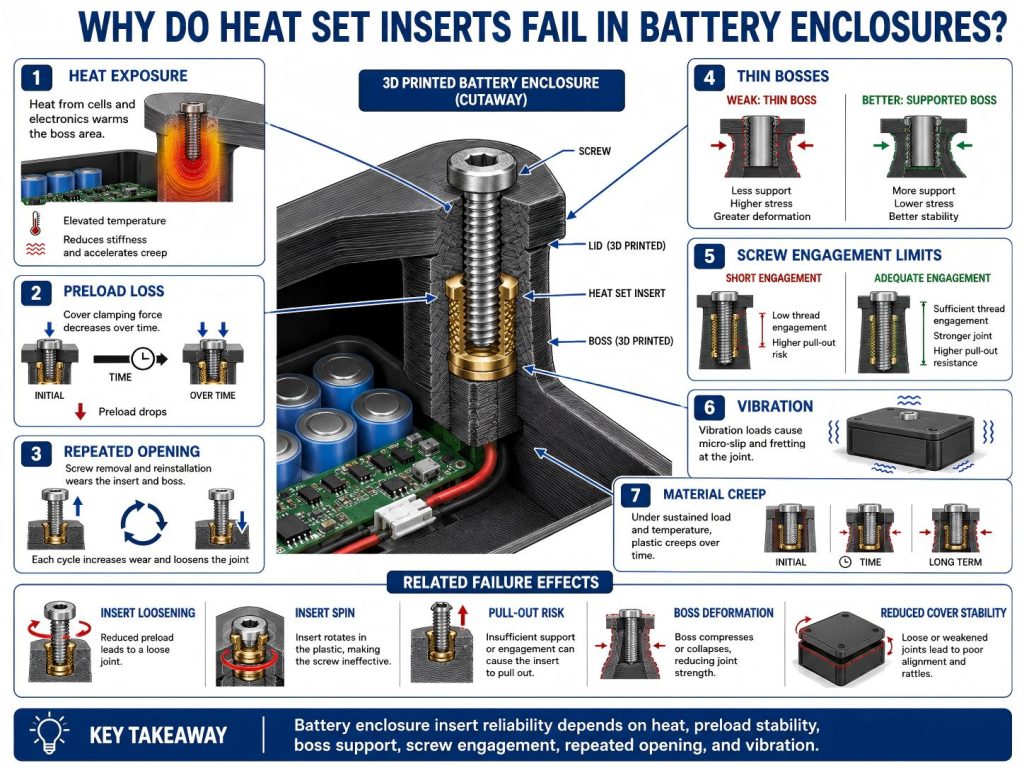
Root Causes
Heat From Batteries and Electronics
Battery enclosures may operate near warm cells, power electronics, charging circuits, motors, or enclosed spaces with limited airflow.
Heat can reduce the stiffness of printed plastics and increase creep under screw preload. PETG and similar materials may slowly relax when exposed to sustained clamping load and elevated temperature.
The part does not need to melt for failure to happen. Even moderate heat can reduce preload stability and make the boss around the insert more likely to deform.
Preload Loss From Cover Clamping
Battery enclosures often use screws to clamp a lid, cover, gasket, or internal retention structure.
That clamping force depends on the printed boss and surrounding plastic staying dimensionally stable. If the boss compresses, creeps, or deforms, screw preload drops.
Once preload drops, the cover may feel loose, the enclosure may lose sealing pressure, or the insert joint may become more sensitive to vibration and repeated opening.
Repeated Opening and Service Access
Battery enclosures are often opened for inspection, charging access, wiring changes, cell replacement, or maintenance.
Each screw removal and reinstallation transfers torque into the insert and the printed boss. Over many cycles, the plastic-to-insert interface can weaken, especially if the boss wall is thin or the screw is over-tightened.
A heat set insert helps with repeated assembly, but it does not make the surrounding printed plastic immune to service-cycle damage.
Thin Enclosure Walls and Bosses
Battery enclosures are often designed to save space and weight.
Thin walls, compact bosses, shallow insert depth, or bosses placed near edges can reduce support around the insert. Under screw preload or enclosure flexing, the boss may deform or crack.
If the boss cannot maintain radial support, the insert may loosen, spin, or pull out even when the initial installation looked clean.
Vibration and Movement
Battery enclosures used in robotics, drones, RC vehicles, tools, or mobile equipment may be exposed to vibration and impact.
Vibration can accelerate preload loss if the insert joint is already weakened by heat, creep, repeated assembly, or poor boss support. Small movements at the screw or insert interface can grow over time.
Vibration rarely acts alone. It usually reveals weaknesses in material choice, boss geometry, screw engagement, or torque control.
Insufficient Screw Engagement
Short screw engagement can reduce reliability in battery enclosure joints.
If the screw engages too few insert threads, load is concentrated over a shorter region. This can reduce preload stability and increase local stress in the boss.
Battery enclosures that need sealing pressure or repeated service access should use enough screw engagement length to distribute load through the insert and printed structure.
Poor Installation Temperature Control
Heat set insert installation temperature matters because the insert relies on controlled plastic flow.
If the insert is installed too cold, the plastic may not flow properly around the knurling. If the insert is installed too hot, the boss may collapse, soften excessively, or lose structural support.
Both conditions can reduce long-term enclosure reliability, especially when the part later sees heat, preload, or repeated opening.
Layer Orientation and Enclosure Load Path
FDM printed parts are directionally strong.
If the enclosure cover load, screw preload, or battery retention load acts across weak layer lines, the boss or wall may separate around the insert. This can reduce pull-out strength and sealing stability.
For battery enclosures, the insert load path should be aligned with stronger printed material paths whenever possible.
Related Engineering Variables
Heat set insert reliability in battery enclosures depends on several connected variables:
- Operating temperature
- Battery heat exposure
- Screw preload
- Cover clamping force
- Gasket compression
- Screw engagement length
- Boss wall thickness
- Boss height
- Pilot hole size
- Insert depth
- Material creep
- Installation temperature
- Repeated opening cycles
- Vibration
- Layer adhesion
- Print orientation
- Enclosure wall stiffness
These variables should be evaluated together. A battery enclosure insert joint may work at room temperature during assembly but lose preload after heat exposure, vibration, or repeated service.
Battery enclosure fastening is not only about thread durability. It is about maintaining clamping force and structural support over time.
Engineering Interpretation
Heat set insert failure in battery enclosures is usually a preload, heat, and serviceability problem.
The failure may appear as:
- Cover screws becoming loose
- Insert loosening from preload loss
- Insert spin during screw removal
- Boss deformation from heat and clamping load
- Pull-out under cover or retention force
- Layer separation near screw bosses
- Reduced sealing or cover stability
These failure modes often overlap.
For example, a PETG battery enclosure may hold screws well at first. After heat exposure and repeated cover removal, the boss may creep, preload may drop, and the insert may begin to loosen or spin.
This is why battery enclosure insert joints should be designed for heat, access, and clamping load from the beginning.
How to Reduce the Risk
To reduce heat set insert failure in battery enclosures:
- Use enough boss wall thickness around each insert.
- Avoid very thin, unsupported enclosure bosses.
- Use the correct pilot hole size for the insert and material.
- Control installation temperature carefully.
- Avoid overheating the boss during insertion.
- Use enough screw engagement length.
- Avoid excessive screw torque.
- Consider operating temperature near batteries and electronics.
- Choose material based on heat, creep, and enclosure load.
- Design for repeated opening if the enclosure will be serviced.
- Use ribs or surrounding structure to support screw bosses.
- Improve print orientation around loaded bosses.
- Reduce vibration exposure where possible.
- Avoid relying on high preload in thin printed walls.
A reliable battery enclosure insert joint must hold more than a screw. It must maintain cover clamping, preload stability, and boss support under real operating conditions.
Related InsertGuide Pages
- Why Does Screw Preload Drop in 3D Printed Insert Joints?
- Why Do Heat Set Inserts Become Loose Over Time?
- Why Do Heat Set Inserts Fail Under Vibration?
- Why Does PETG Lose Screw Torque Over Time?
- Why Does Repeated Assembly Weaken Heat Set Inserts?
- Screw Engagement Length for Heat Set Inserts in 3D Printed Parts
- Heat Set Insert Installation Temperature for 3D Printed Parts
- How to Design Bosses for Heat Set Inserts
- Layer Adhesion and Heat Set Insert Strength in 3D Printed Parts
FAQ
Are heat set inserts good for 3D printed battery enclosures?
Yes. Heat set inserts are useful for battery enclosures that need repeated opening, stronger threads, or better cover fastening. However, the boss, material, screw engagement, and heat exposure must be considered.
Why do battery enclosure screws become loose over time?
Battery enclosure screws can become loose when printed plastic creeps under preload, the boss deforms from heat or clamping force, the enclosure is opened repeatedly, or vibration reduces joint stability.
Does battery heat affect heat set insert joints?
Yes. Battery or electronics heat can reduce plastic stiffness and increase creep. This can reduce screw preload and make the insert joint more likely to loosen, deform, or lose support over time.