
3D Printed Fastening Applications
Explore common application areas where heat set inserts, threaded inserts, boss design, hole tolerance control, and fastening structures are used in 3D printed parts.
Fastening decisions are not only about choosing an insert or screw size. In real printed assemblies, the application affects hole size, boss geometry, material choice, installation method, load direction, and long-term reliability.
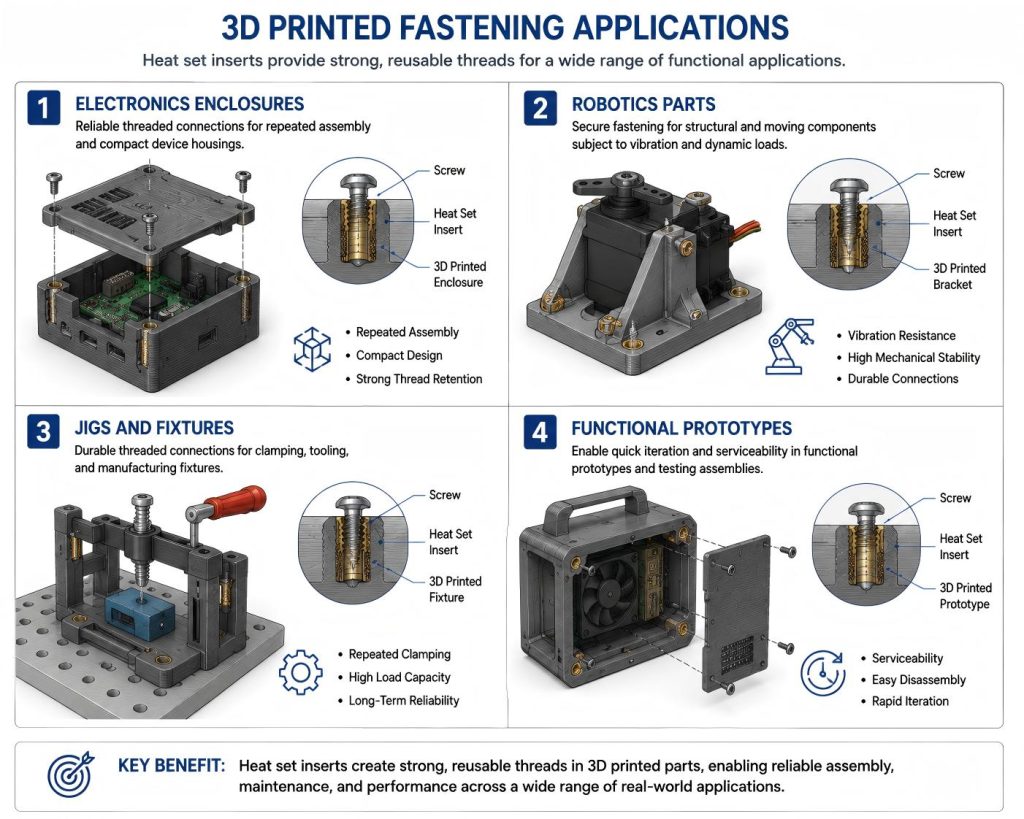
This page organizes real 3D printed fastening applications by assembly type, material behavior, serviceability, vibration, load transfer, and repeated screw use. Use these application guides to understand how heat set inserts behave in robotics assemblies, drone frames, RC car parts, industrial fixtures, electronics mounting systems, sensor brackets, battery enclosures, and modular 3D printed structures.
Application Conditions and Engineering Variables
Motion assemblies often include limit switch mounts, adjustable stop blocks, cable chain mounting brackets, and hinged covers where alignment, vibration, and service cycles change insert requirements.
Different 3D printed fastening applications create different mechanical, thermal, and structural loading conditions.
High-vibration assemblies may require stronger boss support, improved torque resistance, and better thread retention.
Repeated assembly structures may require optimized screw engagement length, reduced material creep, and stable insert retention over multiple maintenance cycles.
Electronics enclosures and battery systems often prioritize removable access panels, cable routing stability, internal clearance, and long-term fastening reliability.
Industrial fixtures and CNC fixture plates may experience repeated clamp loading, structural stress concentration, alignment requirements, and localized pull-out forces.
Material selection, print orientation, hole tolerance, installation temperature, and boss geometry should always be evaluated in the context of the real application environment.
Motion and Vibration Assemblies
Voron 3D Printer Assemblies
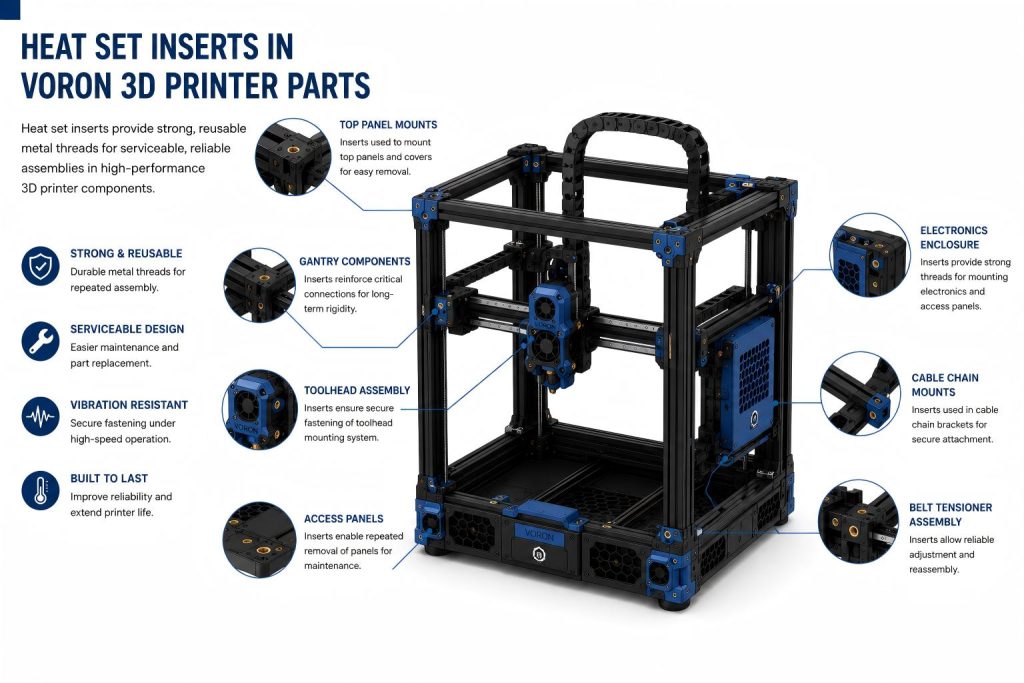
Heat set inserts are widely used in Voron printer frames, electronics mounts, enclosure panels, and serviceable mechanical assemblies exposed to vibration and thermal cycling.
Failure path: why heat set inserts fail in Voron 3D printer assemblies.
Robot Joint Service Panels
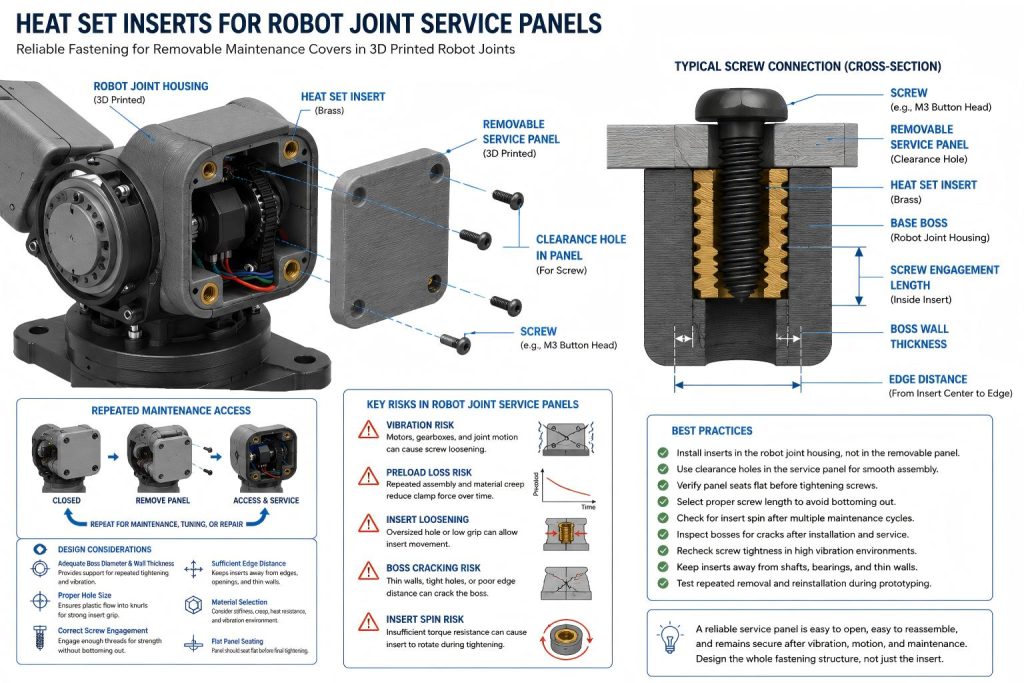
Heat set inserts for removable robot joint service panels, repeated maintenance access, screw engagement, vibration exposure, preload loss, boss design, and long-term fastening reliability in 3D printed robotics assemblies.
View robot joint service panel application guide
Robotics Assemblies
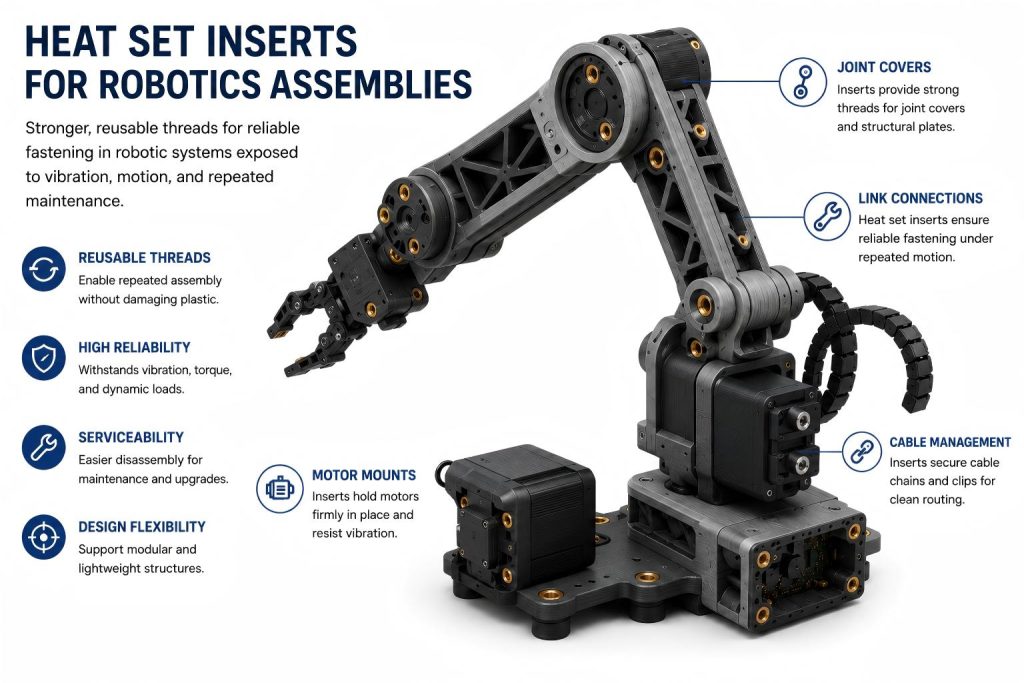
Heat set inserts are widely used in robotic arm joints, actuator brackets, servo mounts, and modular assemblies exposed to vibration, repeated motion, and cyclic loading.
Failure path: why heat set inserts fail in robotics assemblies.
High-Vibration Motor Mounting Brackets
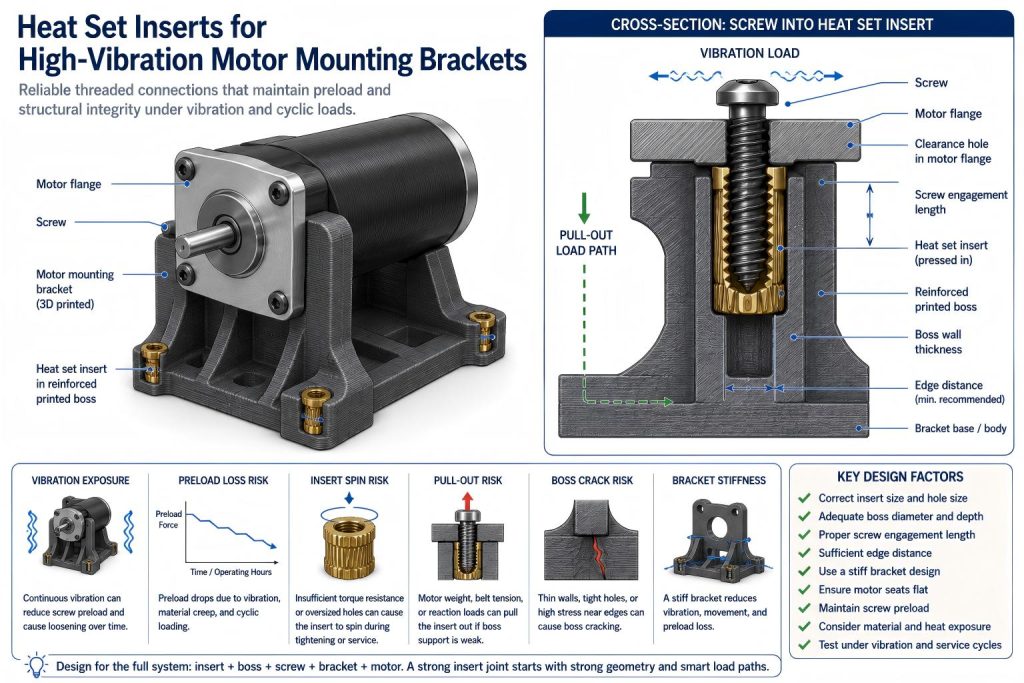
Heat set inserts for vibration-loaded motor mounting brackets, screw preload retention, torque resistance, pull-out strength, boss design, bracket stiffness, and reliable 3D printed motor mount fastening.
View high-vibration motor mounting bracket application guide
RC Car Parts
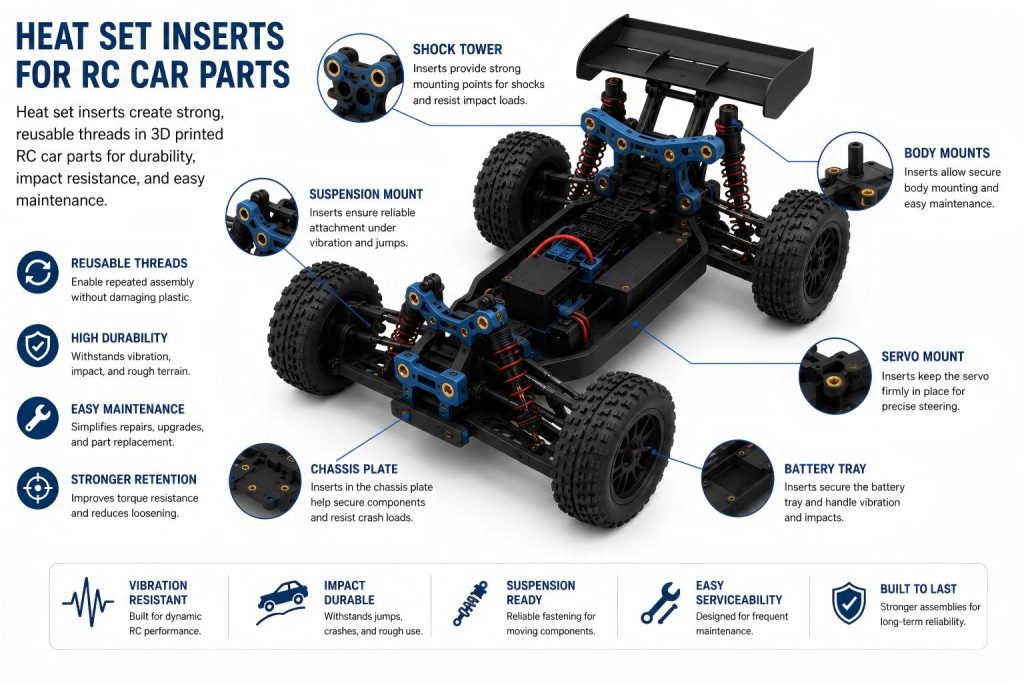
Heat set inserts improve fastening reliability in RC car suspension mounts, chassis assemblies, servo brackets, and impact-loaded printed components exposed to vibration and repeated crashes.
Failure path: why heat set inserts fail in RC car parts.
Drone Frames
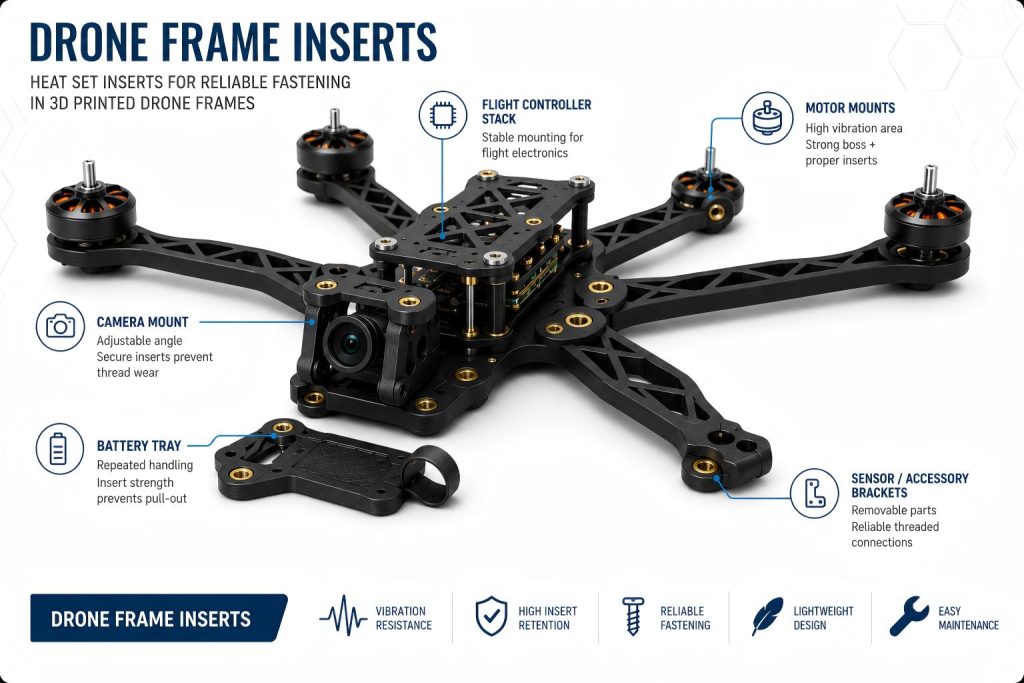
3D printed drone frames use threaded inserts for motor mounts, battery trays, flight controller stacks, and removable covers. Insert strength depends on vibration loads, boss geometry, material stiffness, and screw engagement length.
Failure path: why heat set inserts fail in drone parts.
Drone Battery and Electronics Access Panels
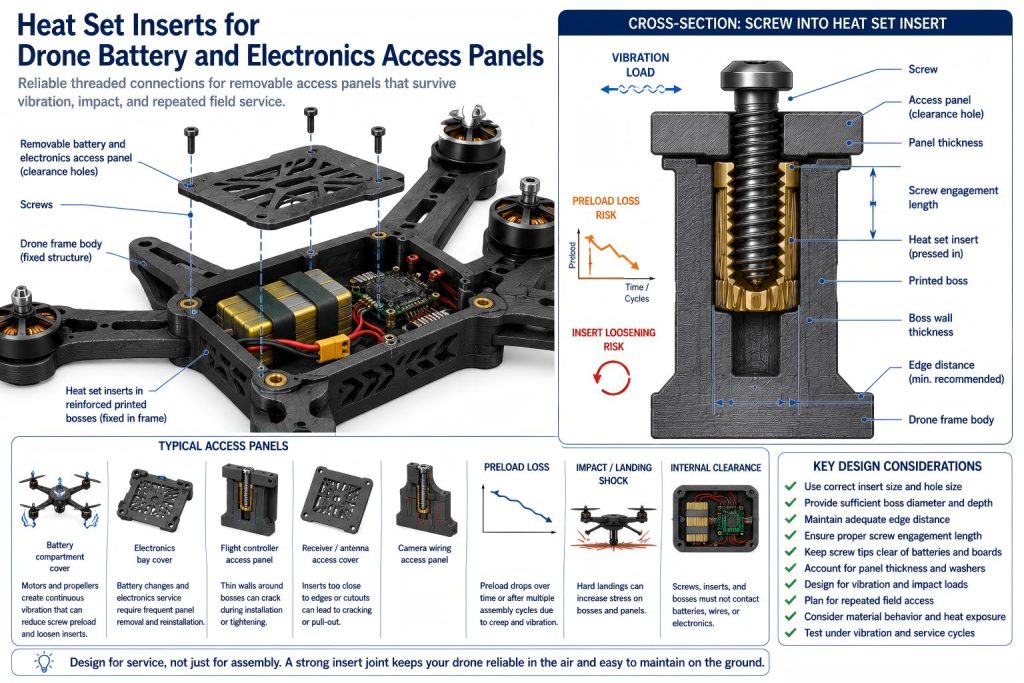
Heat set inserts for removable drone battery and electronics access panels, repeated field service, vibration exposure, screw engagement, thin wall design, preload loss, and internal battery or electronics clearance.
View drone access panel application guide
Functional Materials and Manufacturing Tools
Carbon Fiber Nylon Parts
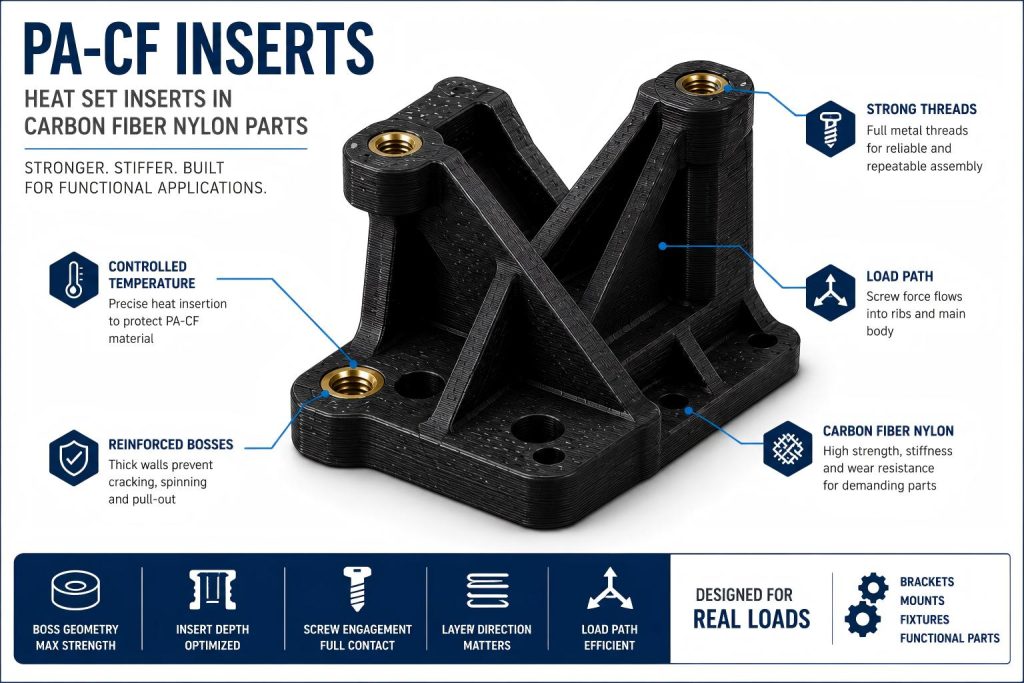
Carbon fiber nylon printed parts are often used for brackets, mounts, fixtures, and high-load functional assemblies. Heat set insert reliability depends on boss geometry, installation temperature, screw engagement, and how the reinforced nylon structure carries load.
Industrial Fixtures
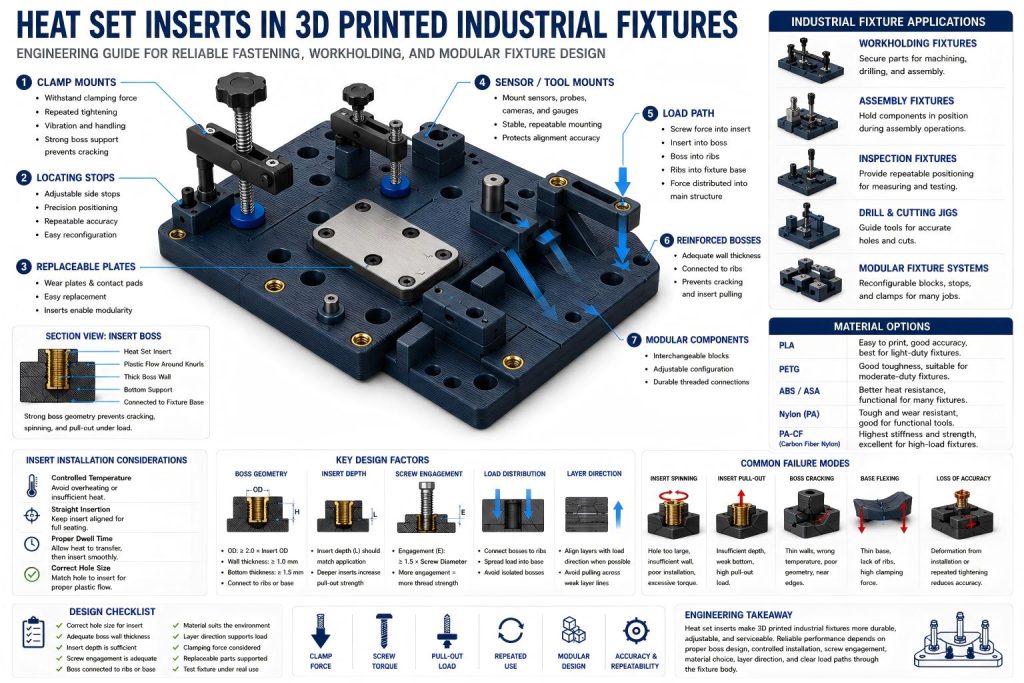
3D printed industrial fixtures use heat set inserts for clamps, locating stops, replaceable plates, sensor mounts, and modular components. Insert reliability depends on boss geometry, screw engagement, material choice, layer direction, and how clamping loads move through the fixture body.
Failure path: why heat set inserts fail in 3D printed fixtures.
Printed Jigs with Replaceable Wear Plates
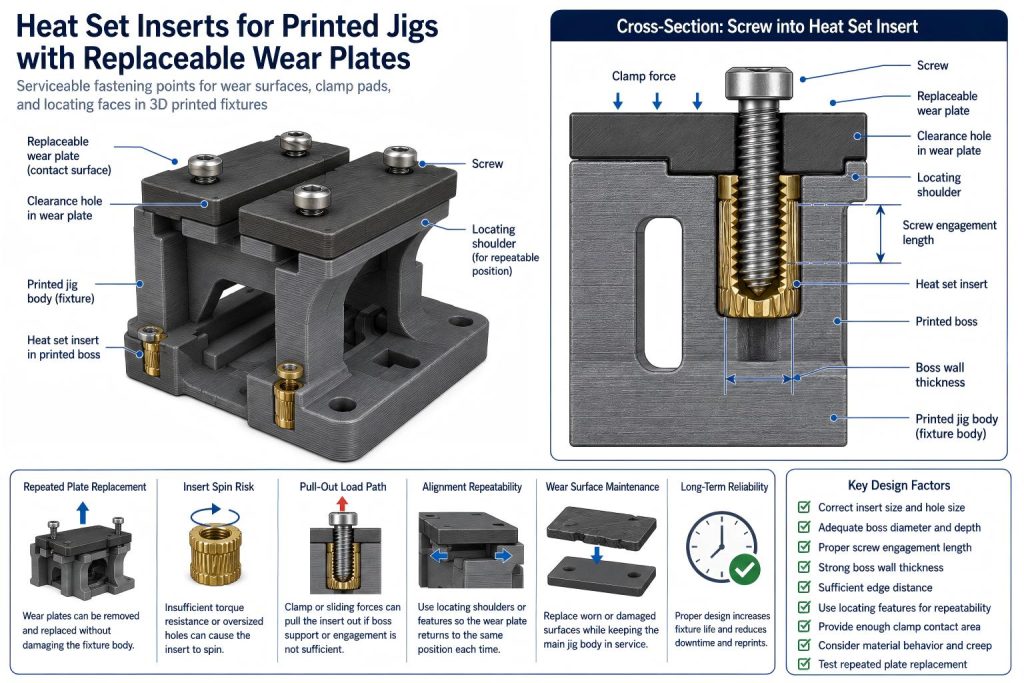
Heat set inserts for serviceable printed jigs, removable wear plates, repeated plate replacement, screw engagement, torque resistance, pull-out strength, and long-term fixture body durability.
View printed jig wear plate application guide
Small Batch Manufacturing
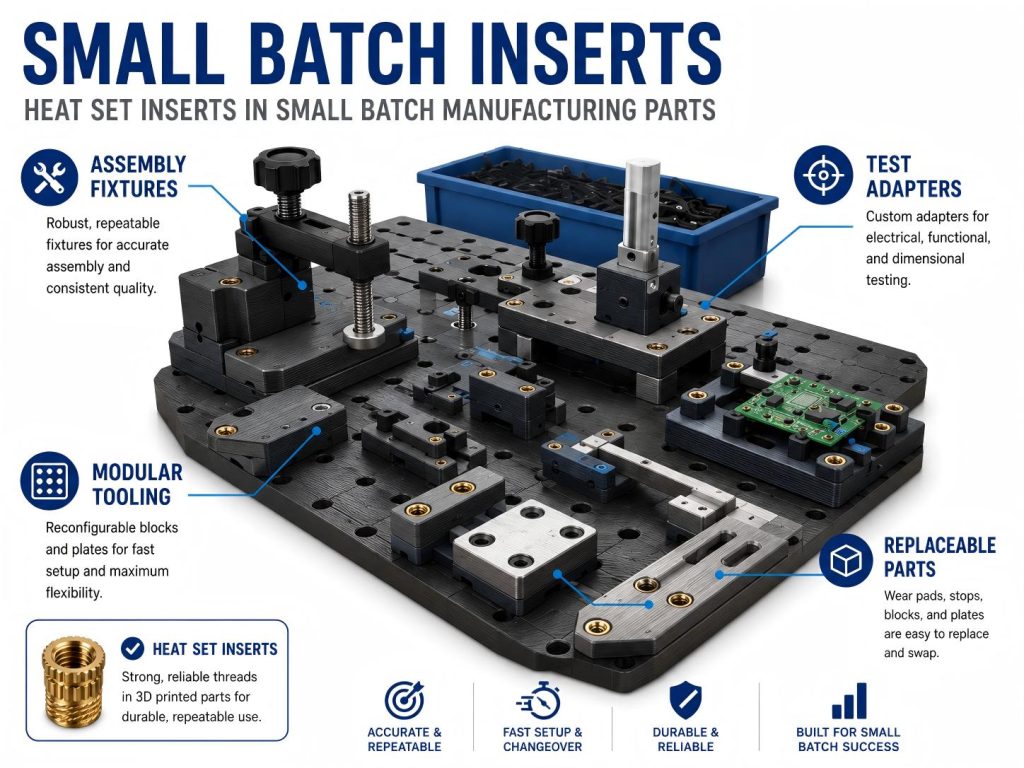
Small batch manufacturing uses 3D printed parts for fixtures, test adapters, modular tooling, replaceable plates, and low-volume components. Heat set insert reliability depends on boss design, screw engagement, installation consistency, material choice, and repeated assembly behavior.
CNC Fixture Plates
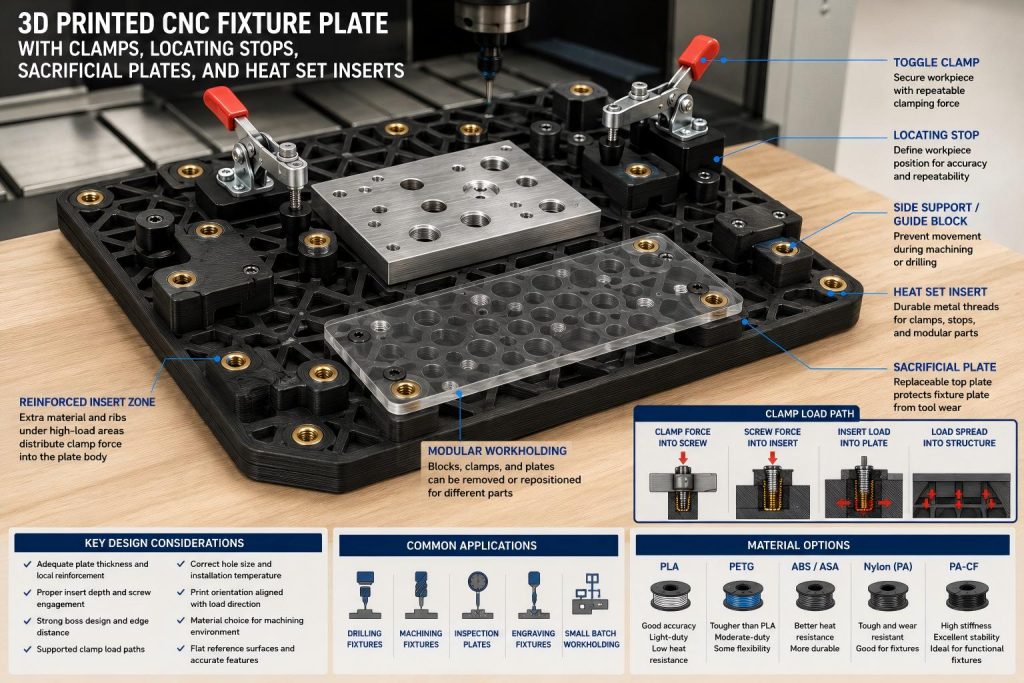
3D printed CNC fixture plates use heat set inserts for clamps, locating stops, sacrificial plates, guide blocks, and modular workholding elements. Insert reliability depends on local plate thickness, screw engagement, material choice, print orientation, and supported clamp load paths.
Failure path: why heat set inserts fail in 3D printed fixtures.
Electronics and Modular Systems
Electronics Mounting Systems
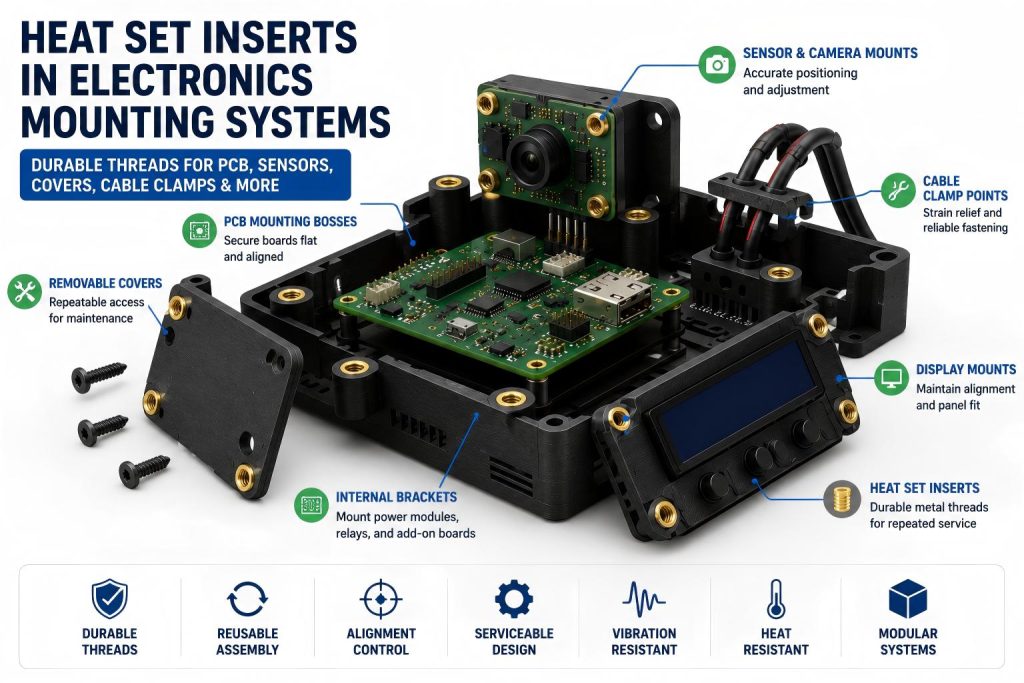
Electronics mounting systems use heat set inserts for PCB bosses, sensor brackets, removable covers, cable clamps, display panels, and serviceable enclosures. Insert reliability depends on boss geometry, alignment control, screw engagement, material behavior, vibration resistance, and avoiding stress on boards and connectors.
Failure path: why heat set inserts fail in electronics enclosures.
Electronics Enclosure Lid Cycling
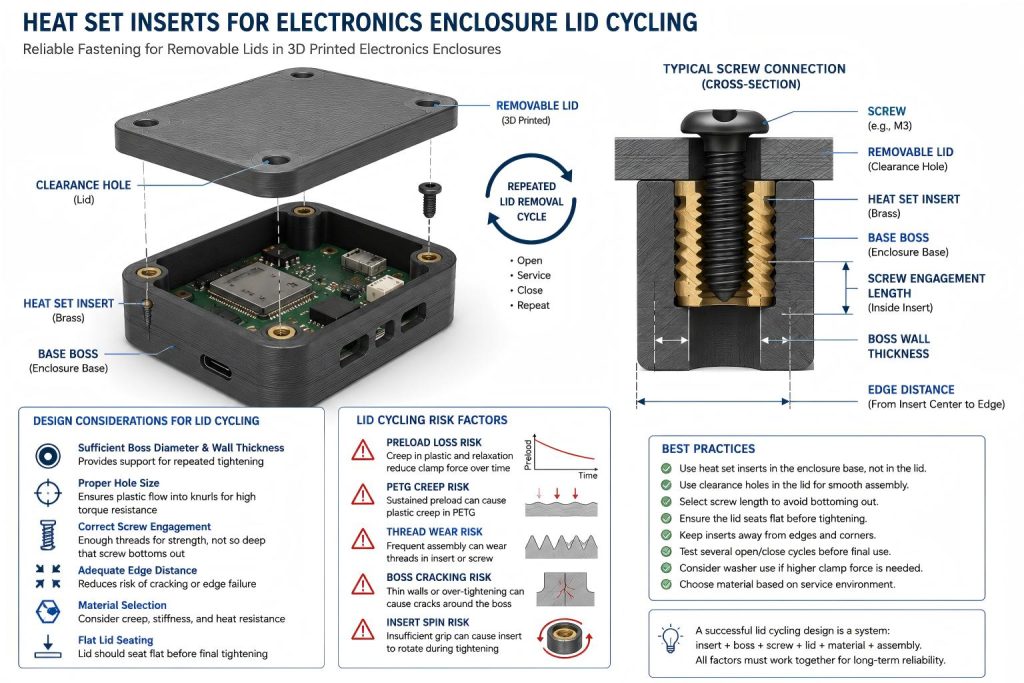
Heat set inserts for removable electronics enclosure lids, repeated screw removal, screw engagement, boss design, preload loss, PETG creep, and long-term fastening reliability in serviceable 3D printed electronics housings.
View electronics enclosure lid cycling application guide
Sensor Brackets
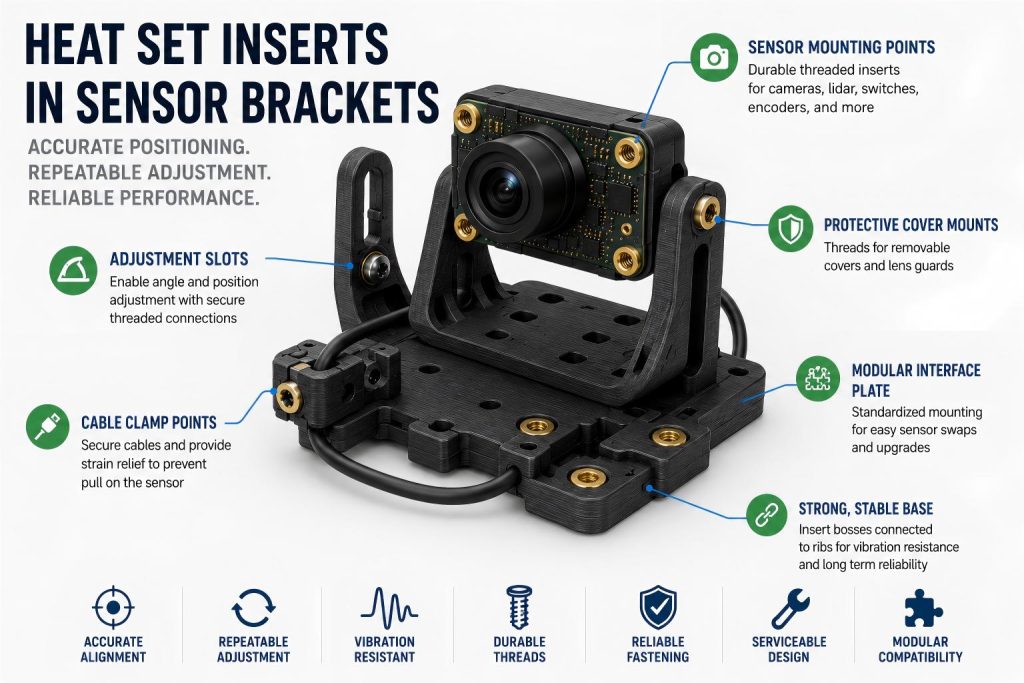
Sensor brackets use heat set inserts for cameras, lidar units, proximity sensors, limit switches, encoder modules, inspection probes, cable clamps, and adjustable mounts. Insert reliability depends on alignment control, boss geometry, screw engagement, cable strain relief, material stiffness, and vibration resistance.
Failure path: why heat set inserts fail in sensor brackets.
Adjustable Camera and Sensor Mounts
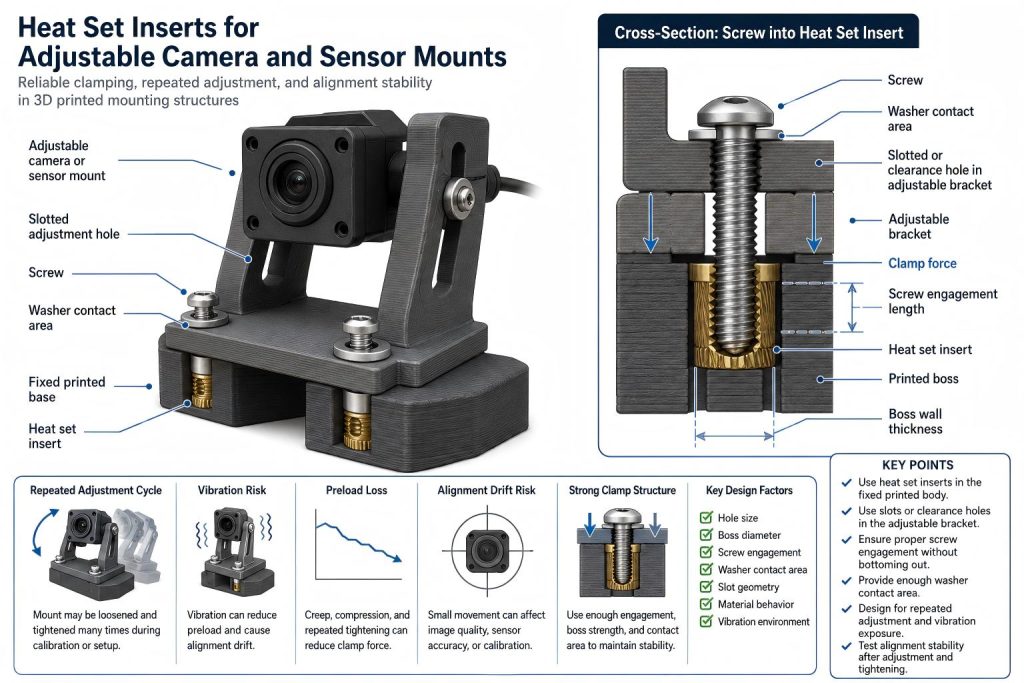
Heat set inserts for adjustable camera and sensor mounts, repeated repositioning, slot-hole clamping, screw engagement, vibration exposure, preload loss, and alignment stability in 3D printed mounting structures.
View adjustable camera and sensor mount application guide
Battery Enclosures
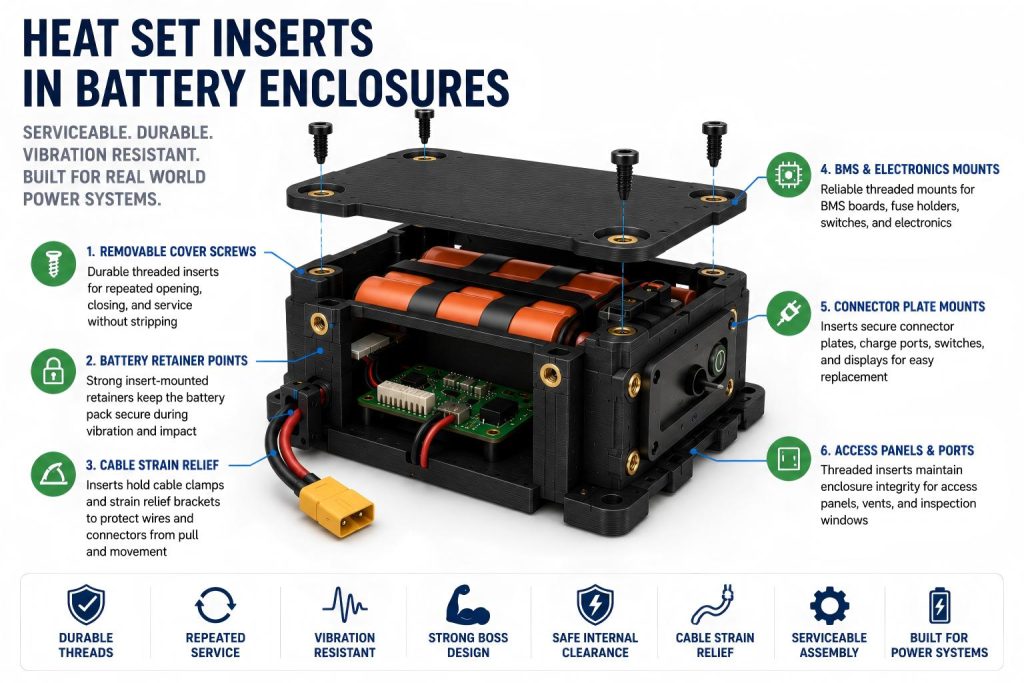
Battery enclosures use heat set inserts for removable covers, battery retainers, cable strain relief brackets, BMS mounts, connector plates, and serviceable access panels. Insert reliability depends on boss geometry, screw engagement, internal clearance, vibration resistance, material choice, and protection of wiring and battery components.
Failure path: why heat set inserts fail in battery enclosures.
Battery Pack Service Covers
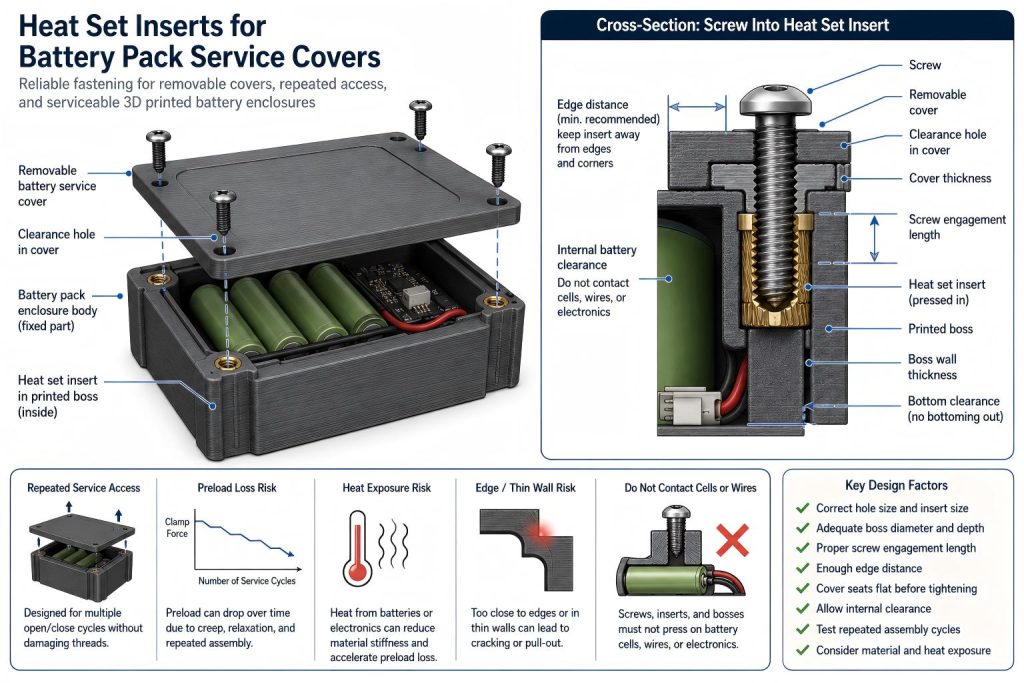
Heat set inserts for removable battery pack service covers, repeated access, screw engagement, boss design, preload loss, heat exposure, PETG creep, and fastening reliability in 3D printed battery enclosure assemblies.
View battery pack service cover application guide
Modular Prototype Assemblies
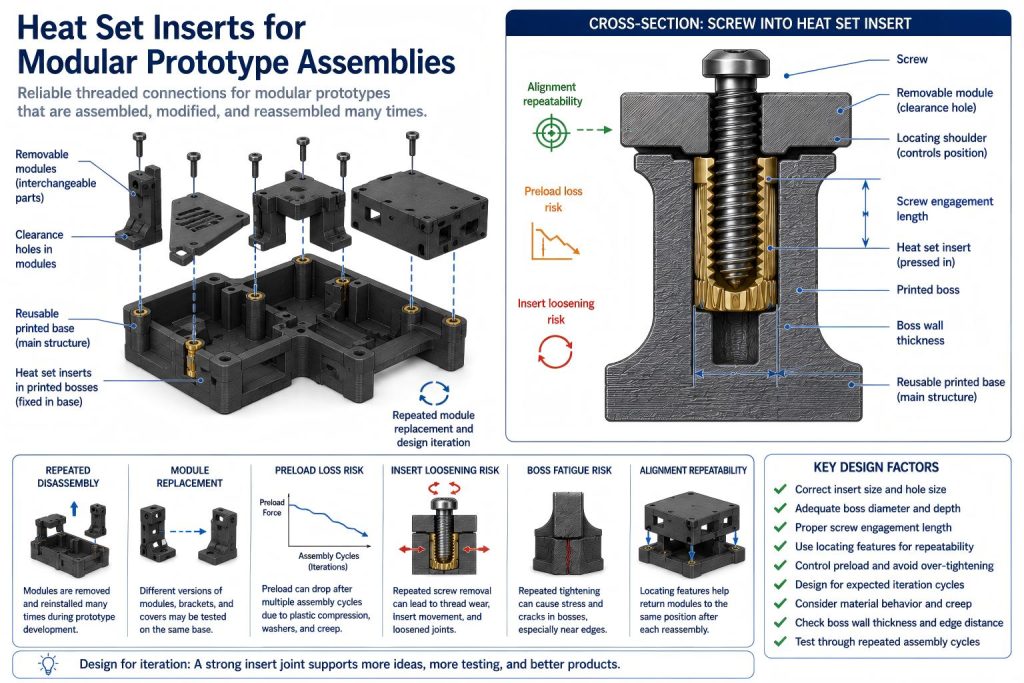
Heat set inserts for modular prototype assemblies, removable modules, repeated design iteration, screw engagement, preload loss, insert loosening, boss design, and reliable 3D printed prototype fastening.
View modular prototype assembly application guide
Design Considerations Across Applications
Use the Engineering Knowledge Map to trace each application back to the matching design variables and reference pages.
Different applications may require different fastening decisions.
An electronics enclosure may prioritize serviceability and clean assembly. A robotics bracket may need torque resistance and vibration stability. A jig or fixture may need clamping strength. A functional prototype may need repeatable testing. A small batch product may need consistent installation quality.
Across these applications, the most important design factors include:
insert size and geometry
pilot hole size
printed hole tolerance
boss wall thickness
insert depth
material behavior
print orientation
screw load
installation temperature
long-term assembly use
Application-to-Design Variable Relationships
Motion and vibration systems
→ torque resistance
→ thread loosening
→ repeated assembly durability
Electronics enclosures
→ screw engagement length
→ removable access stability
→ cable strain relief
Industrial fixtures
→ pull-out strength
→ clamp load distribution
→ boss reinforcement
Battery enclosures
→ thermal behavior
→ removable covers
→ fastening stability
Carbon fiber nylon structures
→ thermal expansion behavior
→ stiffness
→ insert installation control
Repeated assembly structures
→ material creep
→ insert retention
→ long-term reliability
Related Engineering Guides
- How to Choose Heat Set Inserts for 3D Printed Parts
- Heat Set Insert Hole Size Guide
- How to Design Bosses for Heat Set Inserts
- PLA vs PETG vs ABS for Threaded Inserts
- Why Heat Set Inserts Fail in 3D Printed Parts
- Pull-Out Strength of Heat Set Inserts in 3D Printed Parts
- Torque Resistance of Heat Set Inserts in 3D Printed Parts
- Layer Adhesion and Heat Set Insert Strength in 3D Printed Parts
- Heat Set Insert Installation Temperature for 3D Printed Parts
- Screw Engagement Length for Heat Set Inserts in 3D Printed Parts