
Heat set inserts for drone battery and electronics access panels are used when a 3D printed drone frame, fuselage, electronics bay, or battery compartment needs removable covers that can be opened for charging access, battery replacement, flight controller service, wiring inspection, or field repair.
This application is different from a general drone frame. A drone access panel is usually thin, lightweight, exposed to vibration, and often placed near batteries, wires, flight electronics, or compact frame geometry. The insert joint must survive repeated removal, screw preload changes, vibration, impact, edge stress, and material behavior in a weight-sensitive structure.
For broader drone frame context, see Heat Set Inserts 3D Printed Drone Frames.
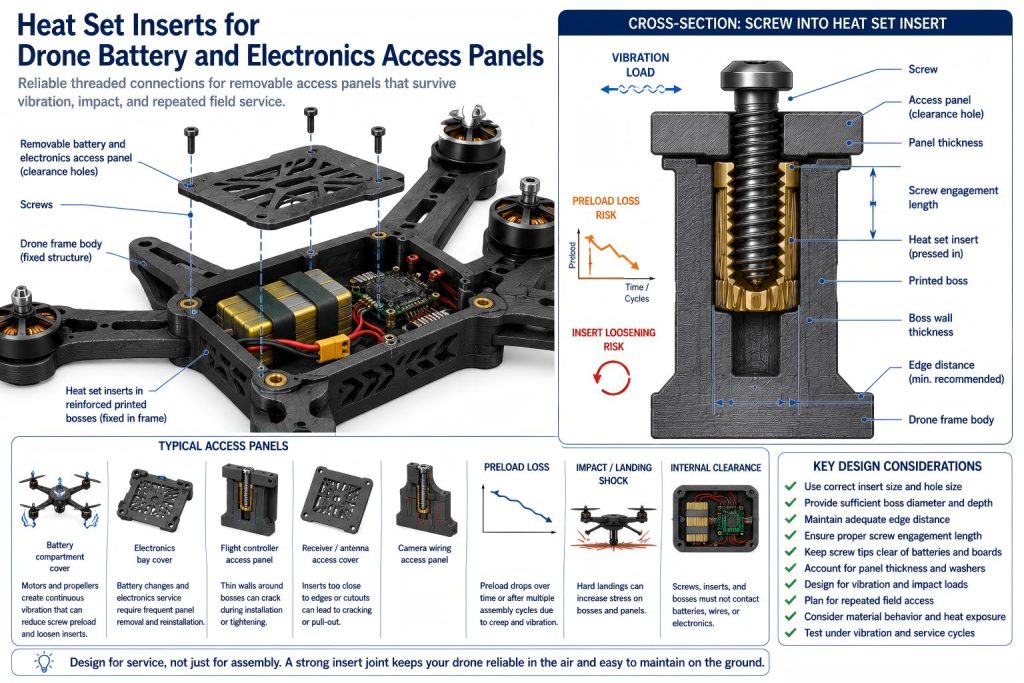
Why Drone Access Panels Need a Specific Insert Design Approach
Drone battery and electronics access panels are often opened more frequently than other frame parts. A battery cover may be removed between flights. An electronics bay cover may be opened for flight controller access, receiver wiring, GPS module changes, camera wiring, ESC inspection, or troubleshooting.
This makes the fastening structure different from a static frame joint. The insert must support service access while keeping the printed frame light and compact.
A drone access panel insert joint may need to handle:
- repeated battery or electronics access
- vibration from motors and propellers
- impact or landing shock
- screw preload loss after repeated removal
- thin wall and edge constraints
- limited boss diameter because of weight limits
- heat from electronics or battery operation
- alignment changes after field service
For this reason, drone battery and electronics access panels should be designed as lightweight repeated-service fastening structures, not just as small printed covers with screws.
Typical Drone Access Panel Use Cases
Heat set inserts may be useful in 3D printed drone assemblies when access panels need to be removed without damaging printed plastic threads.
Common examples include:
- removable battery covers
- electronics bay lids
- flight controller access panels
- receiver and antenna covers
- camera wiring access covers
- GPS module access plates
- ESC inspection covers
- charging connector service panels
- field repair access panels
- prototype drone module covers
In these applications, the insert helps create reusable fastening points while avoiding repeated damage to printed plastic threads.
Main Failure Modes in Drone Battery and Electronics Access Panels
Insert Loosening from Vibration
Drones generate vibration through motors, propellers, frame resonance, and landing impact. If the insert joint has poor preload retention, weak boss support, or low torque resistance, the screw or insert may loosen during use.
See also: Why Do Heat Set Inserts Fail Under Vibration?
Thin Wall Failure Around Access Panels
Drone frames are often designed to be light, which can leave limited wall thickness around insert bosses. If the boss is too thin or too close to a cutout, the surrounding plastic may crack during installation or repeated tightening.
See also: Why Do Heat Set Inserts Fail in Thin Wall 3D Printed Parts?
Edge or Corner Failure
Access panels are often placed near frame edges, battery openings, electronics cutouts, or curved shell geometry. If an insert is too close to an edge, the load path may be too weak to resist repeated screw tightening or vibration.
See also: Why Do Heat Set Inserts Fail Near Edges or Corners?
Screw Preload Drop After Field Service
A drone access panel may be removed and reinstalled many times during field testing or battery changes. Each cycle can slightly change screw seating, plastic compression, and clamp force.
See also: Why Does Screw Preload Drop in 3D Printed Insert Joints?
Drone-Specific Insert Failure
Drone parts combine vibration, weight reduction, thin walls, impact, and repeated service. An insert that works in a static enclosure may fail in a drone if the boss, screw engagement, material, and access panel geometry are not designed together.
See also: Why Do Heat Set Inserts Fail in Drone Parts?
Design Variables for Drone Access Panels
A reliable drone access panel should be designed around the full lightweight fastening structure, not only around the insert size.
| Design Variable | Why It Matters in Drone Access Panels |
|---|---|
| Insert size | Affects screw engagement, torque resistance, pull-out strength, and boss geometry. |
| Hole size | Controls insert fit, plastic flow, installation stress, and long-term retention. |
| Boss diameter | Determines how much material supports the insert while keeping weight low. |
| Boss depth | Helps prevent proud inserts, shallow support, and screw bottoming. |
| Screw engagement length | Controls clamp stability without bottoming out inside the insert or frame. |
| Panel thickness | Affects screw length, panel stiffness, and clamp force distribution. |
| Edge distance | Reduces cracking risk near battery openings, electronics bays, and thin frame edges. |
| Vibration exposure | Can reduce preload and loosen screws or inserts during flight. |
| Material behavior | PLA, PETG, ABS, nylon, and carbon fiber nylon behave differently under vibration, heat, impact, and creep. |
For general hole design, see the Heat Set Insert Hole Size Guide. For boss geometry, see How to Design Bosses for Heat Set Inserts.
Recommended Fastening Structure
For drone battery and electronics access panels, heat set inserts are usually best installed in the fixed frame, battery bay wall, electronics compartment, or reinforced printed boss. The removable access panel should normally use clearance holes.
A typical drone access panel fastening structure includes:
- heat set inserts installed in reinforced bosses in the fixed drone frame
- clearance holes in the removable battery or electronics panel
- enough boss diameter to resist tightening and vibration
- enough boss depth for full insert seating
- controlled screw engagement length
- adequate edge distance from battery cutouts and electronics openings
- a panel that seats flat before screw tightening
The screw should clamp the panel into a stable frame structure. It should not be used to pull a warped or misaligned drone cover into position.
Weight Reduction Without Weakening the Insert Joint
Drone parts are often weight-sensitive, but removing too much material around the insert can make the fastening structure unreliable. A lightweight access panel still needs enough boss wall thickness, edge distance, and screw engagement to survive repeated service.
Weight reduction should avoid:
- thin unsupported bosses
- inserts placed too close to large cutouts
- sharp internal corners near access panels
- bosses without enough material below the insert
- panel screws located at weak frame edges
A small amount of extra material around the insert can protect the entire access panel from cracking, loosening, or pulling out during flight and maintenance.
Screw Engagement and Access Panel Reliability
Screw engagement length should be long enough to support repeated access and vibration exposure, but not so long that the screw bottoms out inside the insert or below the boss.
Drone access panels may be removed frequently for battery changes, electronics access, or field repair. A screw that is too short may not hold preload. A screw that is too long may create false tightening resistance, damage the insert joint, or contact internal components.
When checking screw engagement, consider:
- access panel thickness
- washer thickness, if used
- insert thread depth
- boss depth
- clearance below the insert
- vibration exposure during flight
- internal clearance to batteries, wires, boards, and connectors
For deeper reference, see Screw Engagement Length for Heat Set Inserts in 3D Printed Parts.
Battery and Electronics Clearance
An access panel insert should not create a screw path that can contact internal components. The screw tip, insert boss, or displaced plastic should not press into a battery cell, flight controller, ESC, receiver, antenna cable, wiring harness, or connector.
Before finalizing the design, check:
- whether screw tips can contact batteries or electronics
- whether the insert boss intrudes into the electronics bay
- whether wires can be pinched by the cover
- whether the cover compresses foam pads or harnesses unevenly
- whether service access changes wire routing after reassembly
For a related battery enclosure application, see Heat Set Inserts in Battery Enclosures.
Material Behavior in Drone Access Panels
Material choice affects how the insert joint behaves under vibration, heat, impact, and repeated access.
PLA can provide stiffness and good dimensional control, but it may crack around thin bosses or impact-loaded edges. PETG is tougher, but it may creep under sustained screw preload. ABS can tolerate heat better than PLA, but still depends on boss design and hole fit. Nylon and carbon fiber nylon may be useful for tougher drone structures, but printed tolerance, moisture behavior, and local stress concentration still matter.
For material comparison, see PLA vs PETG vs ABS for Threaded Inserts. For stronger printed drone or frame structures, see Heat Set Inserts in Carbon Fiber Nylon 3D Printed Parts.
Repeated Service and Field Repair
If the access panel pivots instead of lifting off, compare the fastening structure with hinged covers.
Drone access panels may be opened during battery changes, tuning, field repair, wiring inspection, or crash inspection. Repeated access can expose weak insert retention or poor screw engagement.
Repeated service can contribute to:
- insert movement inside the boss
- screw preload loss
- thread wear from repeated removal
- boss cracking around access panel screws
- panel misalignment after reassembly
- cover rattle during flight
For broader repeated assembly behavior, see Heat Set Inserts for Repeated Assembly in 3D Printed Parts.
Design Checks Before Using Heat Set Inserts in Drone Access Panels
Before relying on heat set inserts in a drone battery or electronics access panel, check the following:
- Confirm the insert dimensions and recommended printed hole size.
- Print a test coupon using the same material and print settings.
- Check that the access panel seats flat before screw tightening.
- Verify screw engagement without bottoming out.
- Confirm screw tips cannot contact batteries, wires, boards, or connectors.
- Check boss diameter and boss depth around each insert.
- Keep inserts away from thin edges, battery openings, and electronics bay cutouts.
- Test repeated panel removal and reinstallation.
- Check for insert spin after screw tightening.
- Run vibration or flight testing and inspect for preload loss, rattle, or cracking.
When Heat Set Inserts Are a Good Fit
Heat set inserts are a good fit for drone battery and electronics access panels when the design needs:
- reusable metal threads
- frequent battery or electronics access
- better durability than printed plastic threads
- compact service panels
- stable fastening under vibration
- field-repairable covers
- repeatable panel removal without damaging the frame
They are especially useful in prototype drones, robotics drones, camera drones, test platforms, and custom frames that need repeated access to internal components.
When the Design Needs More Caution
Heat set inserts need more caution when:
- the drone frame wall is very thin
- the insert is close to a battery opening or electronics cutout
- the access panel is flexible or warped
- the drone sees strong vibration or impact
- the material is PETG under sustained preload
- the screw may contact batteries, wires, boards, or connectors
- the boss is weakened by aggressive weight-reduction cutouts
If the broader drone frame is the main design question, see Heat Set Inserts 3D Printed Drone Frames.
Practical Summary
Heat set inserts for drone battery and electronics access panels should be designed as lightweight repeated-service fastening points. The insert, screw, boss, access panel, printed material, internal clearance, vibration exposure, and weight-reduction strategy all affect reliability.
A good drone access panel should be removable without damaging the insert joint, cracking the frame, contacting internal components, losing preload, or rattling during flight.
For drone access panels, the key question is not only whether the screw holds the cover once. The more important question is whether the panel remains reliable after battery access, electronics service, vibration, impact, and repeated reassembly.
FAQ
Are heat set inserts useful for drone battery and electronics access panels?
Yes. Heat set inserts are useful when a drone access panel needs repeated removal, stronger threads, and better durability than printed plastic threads.
Should the insert be installed in the access panel or the drone frame?
In most designs, the insert should be installed in the fixed drone frame, battery bay, or electronics compartment. The removable access panel should usually use clearance holes.
Why do inserts fail in drone access panels?
They can fail because of vibration, thin walls, poor edge distance, oversized holes, weak boss geometry, preload loss, impact, or repeated battery and electronics access.
Can PETG be used for drone access panels?
PETG can be used, but it may creep under sustained screw preload. Drone vibration and heat exposure should be tested if the panel must stay tight over repeated use.
What is the main safety concern with drone battery access panel inserts?
The screw tip, insert boss, or cover should not contact battery cells, wires, flight electronics, connectors, or antenna cables. Internal clearance must be checked carefully.
Should drone access panels be tested under vibration?
Yes. Vibration testing or flight testing can reveal preload loss, insert spin, panel rattle, boss cracking, and access panel movement before the design is used in the field.
Related Guides
- Heat Set Inserts 3D Printed Drone Frames
- Why Do Heat Set Inserts Fail in Drone Parts?
- Why Do Heat Set Inserts Fail Under Vibration?
- Heat Set Inserts in Battery Enclosures
- Heat Set Inserts in Electronics Mounting Systems
- Why Do Heat Set Inserts Fail in Thin Wall 3D Printed Parts?
- Why Do Heat Set Inserts Fail Near Edges or Corners?
- PLA vs PETG vs ABS for Threaded Inserts