
Screw engagement length heat set inserts design is an important but often overlooked factor in 3D printed fastening.
A heat set insert may be installed correctly, the boss may be strong, the hole size may be accurate, and the material may be suitable. But if the screw does not engage enough thread inside the insert, the joint may still fail under load.
Engineering Definition
Screw engagement length is the portion of the screw thread that is fully engaged with the internal threads of a heat set insert during fastening.
In 3D printed assemblies, engagement length affects load transfer, clamping stability, thread stress distribution, and long-term fastening reliability.
In 3D printed parts, a threaded connection is not only about the insert. It is also about how the screw, insert, boss, and printed structure work together.
Screw engagement length affects:
- thread stripping resistance
- pull-out performance
- torque transfer
- clamp force stability
- repeated assembly reliability
- risk of bottoming out
- insert loosening
- boss damage
A reliable insert joint requires the screw to engage enough internal thread without overloading or damaging the insert and surrounding printed boss.
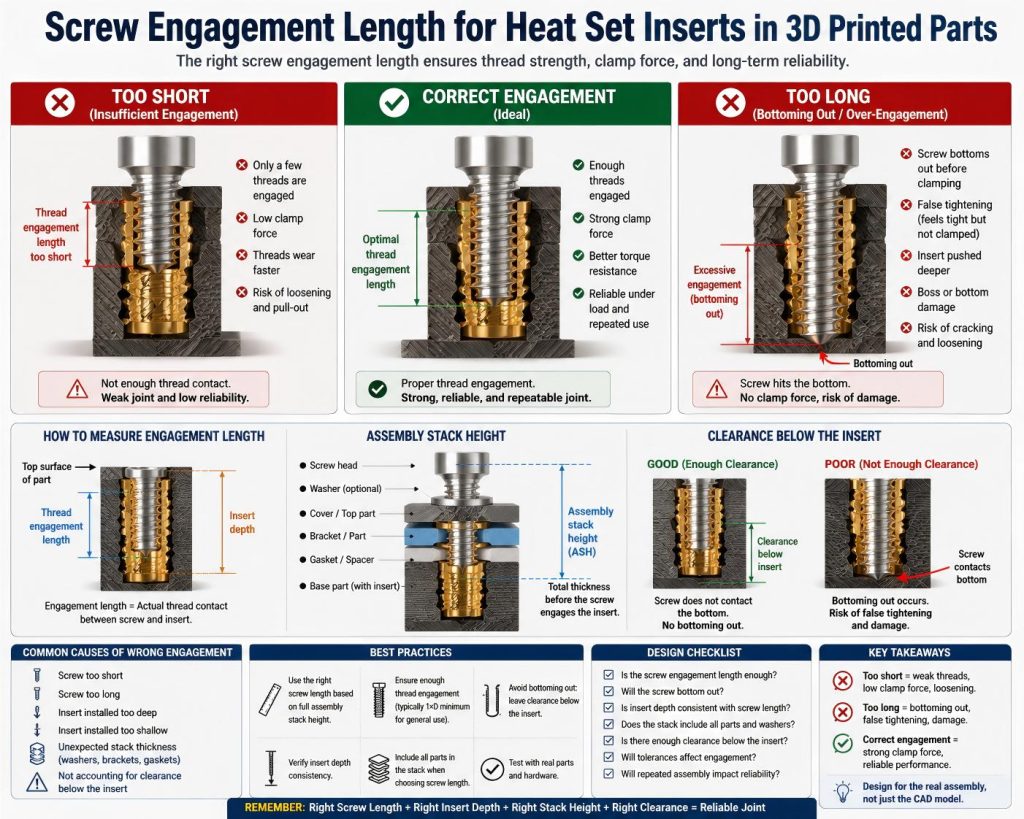
What Screw Engagement Length Means
Screw engagement length is the length of thread contact between the screw and the internal threads of the insert.
In simple terms, it answers one question:
How much of the screw is actually threaded into the insert?
If the screw engagement is too short, only a small number of threads carry the load. This can lead to thread stripping, low clamp force, loosening, or early failure.
If the screw is too long, it may bottom out inside the insert or push against the bottom of the printed hole. This can create false tightening, damage the insert, or apply force into a weak area of the boss.
Good screw engagement is not just about using a longer screw. It is about matching screw length, insert depth, part thickness, and assembly stack height.
Why Engagement Length Matters in 3D Printed Parts
In metal assemblies, thread engagement is often treated as a mechanical design parameter. In 3D printed parts, it becomes even more important because the insert is supported by printed plastic.
When a screw is tightened, the load travels through the screw threads into the insert. The insert then transfers that load into the boss and surrounding printed part.
If the screw engagement is too shallow, the load is concentrated near the top threads of the insert. This can reduce joint strength and increase the risk of loosening.
If the screw bottoms out, the tightening torque may no longer create useful clamp force. Instead, the screw may push into the insert or printed structure.
This can make a joint feel tight while actually being poorly clamped.
A reliable 3D printed fastening design must consider the full load path:
screw → insert threads → insert body → boss → printed part
If screw engagement is wrong, the entire fastening system becomes less reliable.
Short Screw Engagement
Short screw engagement happens when the screw does not enter deeply enough into the insert.
This can happen because:
- the screw is too short
- the assembly stack is too thick
- the insert is installed too deep
- the insert length is too short
- washers or brackets add unexpected thickness
- the designer did not account for thread engagement
- the screw only catches the first few insert threads
Short engagement can cause several problems.
The most common issue is weak thread loading. Only a few threads carry the tightening force, so the joint may loosen or fail earlier.
Short engagement can also reduce clamp force. The screw may appear installed, but the connection may not hold parts together with enough pressure.
For repeated-use assemblies, short engagement increases wear on the top threads of the insert.
In small screws such as M2, M2.5, and M3, this problem becomes more serious because the available thread area is already limited.
Screw Engagement Relationships
| Engineering Factor | Effect on Fastening Performance |
|---|---|
| Thread engagement depth | Improves load transfer and thread stability |
| Screw length | Affects usable engagement inside the insert |
| Insert depth | Influences pull-out resistance and clamping support |
| Clamping force | Determines fastening stability under load |
| Stress concentration | Can increase near shallow engagement regions |
| Material stiffness | Affects long-term retention behavior |
| Repeated assembly cycles | Can accelerate thread wear and loosening |
Screw engagement length affects how mechanical loads are distributed through the screw, insert, and surrounding printed structure during fastening.
Excessive Screw Length
Using a screw that is too long can also cause failure.
A long screw may bottom out inside the insert or contact the bottom of the printed hole below the insert.
When this happens, the screw may stop turning because it has reached the bottom, not because the joint is properly clamped.
This creates false torque feedback.
The user may think the screw is tight, but the assembled parts may not be fully compressed together.
Excessive screw length can also:
- push the insert deeper into the boss
- damage the bottom of the printed hole
- crack thin plastic below the insert
- distort the boss
- reduce clamp force
- create stress concentration
- make disassembly difficult
A longer screw is not automatically stronger. It must fit the insert and assembly depth correctly.
Bottoming Out
Bottoming out is one of the most common screw engagement problems.
It occurs when the screw reaches the end of the insert or the bottom of the hole before the joint is fully clamped.
Bottoming out can be difficult to detect because the screw may feel tight.
However, the tightening force is not being used to clamp the assembly. It is being used to push against the bottom of the insert or printed part.
Signs of bottoming out include:
- screw feels tight but parts remain loose
- insert shifts downward after tightening
- boss cracks near the bottom
- screw cannot tighten further even with visible gaps
- inconsistent clamp force between similar parts
- insert loosens after assembly
To avoid bottoming out, the screw length must be selected based on the full assembly stack and insert depth.
Insert Depth and Screw Length
Insert depth and screw length must be designed together.
If the insert is installed deeper than expected, a screw that should have enough engagement may become too short.
If the insert is installed too shallow, a screw that was expected to fit may bottom out or protrude.
For reliable assembly, the designer should account for:
- insert length
- installed insert depth
- top surface position
- part thickness above the insert
- mating part thickness
- washer thickness
- screw head style
- required clamp distance
- clearance below the insert
Even small depth errors can matter in miniature inserts.
For M2 and M3 joints, a fraction of a millimeter can change engagement quality.
Engagement Length and Pull-Out Strength
Screw engagement length affects pull-out behavior.
If the screw engages only the top portion of the insert, the load may concentrate near the insert entrance.
This can increase the risk of insert lift-out or local plastic damage.
If the screw engages more of the insert body, the load can be distributed through more internal thread contact.
However, increasing screw engagement only helps if the insert and surrounding boss can support the load.
A deep screw in a weak insert joint will not solve poor boss design, incorrect hole size, or weak layer adhesion.
Screw engagement is one part of the strength system, not a replacement for good printed structure.
Engagement Length and Torque Resistance
Screw engagement also affects torque behavior.
If engagement is too short, the screw may not develop stable tightening force before the joint becomes unreliable.
If the screw is over-tightened with limited engagement, the top threads of the insert carry most of the load.
If the screw bottoms out, torque may increase suddenly without increasing clamp force.
This can cause the insert to spin, loosen, or push against the boss.
Good torque resistance requires both:
- the insert locked into the plastic
- the screw properly engaged inside the insert
The screw should tighten the assembly, not fight the geometry of the hole.
Assembly Stack Height
Assembly stack height is the total thickness of all parts clamped by the screw before it reaches the insert.
This may include:
- printed cover
- printed base
- bracket
- washer
- gasket
- spacer
- panel
- mounting plate
A common mistake is choosing screw length based only on the insert depth.
The screw must pass through the entire assembly stack before it engages the insert.
If the stack is thicker than expected, thread engagement becomes too short.
If the stack is thinner than expected, the screw may bottom out.
For functional 3D printed assemblies, screw length should be selected after the full stack height is known.
Clearance Below the Insert
There should be enough clearance below the insert to avoid screw interference.
If the screw extends beyond the insert, it should not press into a thin or unsupported region of the printed part unless the design intentionally allows it.
A blind hole must be deep enough to accept the screw length without bottoming out.
A through-hole design may avoid bottoming out, but it may create other issues such as visible screw tips, reduced appearance quality, or interference with nearby features.
The best choice depends on the assembly.
For many 3D printed parts, a small amount of extra clearance below the insert is useful for assembly tolerance.
Repeated Assembly and Thread Wear
Heat set inserts are often used because 3D printed plastic threads wear out quickly under repeated use.
However, the insert joint can still wear if screw engagement is poor.
Short engagement concentrates force on fewer threads, increasing wear.
Over-tightening can damage the screw, insert threads, or the insert-plastic interface.
Repeated bottoming out can push on the insert and loosen it over time.
For parts that will be opened and closed many times, screw length and engagement should be designed with extra care.
This includes:
- electronics enclosures
- robotics covers
- service panels
- fixtures
- test rigs
- modular assemblies
- consumer product prototypes
A reusable thread still needs a correct screw.
Practical Design Checks
Before finalizing a heat set insert joint, check the screw engagement geometry.
Useful design checks include:
- Does the screw engage enough internal thread?
- Is the screw short enough to avoid bottoming out?
- Is the insert depth consistent with the screw length?
- Does the assembly stack include washers, gaskets, brackets, or covers?
- Is there enough clearance below the insert?
- Will the screw still fit after tolerance variation?
- Does the screw head apply clamp force to the correct surface?
- Is the insert installed flush, below flush, or above flush?
- Will repeated assembly damage the joint?
These checks are simple, but they prevent many real assembly problems.
Testing Screw Engagement
For important joints, screw engagement should be tested with the actual printed parts and hardware.
A useful test can include:
- installing the insert at the intended depth
- assembling the real stack of parts
- checking whether the screw tightens before bottoming out
- verifying that the joint clamps properly
- checking for insert movement
- testing repeated assembly cycles
- testing pull-out or torque behavior if needed
A simple cutaway sample can also help visualize whether the screw reaches the correct depth.
In many failures, the CAD model looks correct, but the printed and assembled part reveals the real problem.
Practical Design Principle
Screw engagement length should not be treated as an afterthought.
It is part of the fastening system.
The insert provides internal threads.
The screw must engage those threads correctly.
The boss supports the insert.
The printed part carries the load.
The assembly stack determines how much screw length is actually available.
A good heat set insert joint is not created by insert installation alone.
It requires the right relationship between:
- screw length
- insert length
- insert depth
- boss depth
- part thickness
- assembly stack height
- clearance below the insert
The key question is not only:
Does the screw fit?
The better question is:
Does the screw engage the insert enough to create clamp force without bottoming out or damaging the printed structure?
That question is where reliable screw engagement design begins.
Related Engineering Factors
Screw engagement length affects how mechanical loads are distributed between the screw, insert, and surrounding printed structure.
Important related engineering factors include:
- thread engagement depth
- screw length selection
- insert depth
- clamping force distribution
- pull-out resistance
- torque loading
- stress concentration near the insert
- boss wall thickness
- material stiffness
- repeated assembly cycles
Insufficient engagement length can reduce fastening strength, increase localized stress, and lead to loosening or thread damage under repeated loading conditions.
Related engineering guides:
- How to Choose Heat Set Inserts for 3D Printed Parts
- How to Design Bosses for Heat Set Inserts
- Pull-Out Strength of Heat Set Inserts in 3D Printed Parts
- Torque Resistance of Heat Set Inserts in 3D Printed Parts
- Why Heat Set Inserts Fail in 3D Printed Parts
- Layer Adhesion and Heat Set Insert Strength in 3D Printed Parts
- Heat Set Insert Installation Temperature for 3D Printed Parts
FAQ
What is screw engagement length for heat set inserts?
Screw engagement length is the length of thread contact between the screw and the internal threads of the heat set insert. It determines how much of the insert is actually used to carry tightening force and assembly load.
What happens if the screw engagement is too short?
If screw engagement is too short, only a few insert threads carry the load. This can reduce clamp force, increase thread wear, cause loosening, and make the joint less reliable under pull-out, torque, vibration, or repeated assembly.
Can a screw be too long for a heat set insert?
Yes. If the screw is too long, it may bottom out inside the insert or press against the bottom of the printed hole. This can create false tightening, damage the boss, push the insert deeper, reduce clamp force, or cause long-term loosening.
How do I prevent screw bottoming out in 3D printed parts?
To prevent bottoming out, choose screw length based on the full assembly stack height, insert depth, insert length, and clearance below the insert. Test with the actual printed part and hardware to make sure the screw clamps the assembly before reaching the bottom.
Does screw engagement affect pull-out strength?
Yes. Poor screw engagement can concentrate load near the top of the insert and reduce joint reliability. However, longer engagement only helps if the insert, boss, hole size, material, and printed structure can support the load.
Related Engineering Guides
- Ngineering Guides for 3D Printed Fastening
- 3D Printing Fastening FAQ
- 3D Printed Fastening Applications
- How to Choose Heat Set Inserts for 3D Printed Parts
- Heat Set Insert Hole Size Guide
- How to Design Bosses for Heat Set Inserts
- PLA vs PETG vs ABS for Threaded Inserts
- Why Heat Set Inserts Fail in 3D Printed Parts
- Pull-Out Strength of Heat Set Inserts in 3D Printed Parts
- Torque Resistance of Heat Set Inserts in 3D Printed Parts
- Layer Adhesion and Heat Set Insert Strength in 3D Printed Parts
- Heat Set Insert Installation Temperature for 3D Printed Parts