
Introduction
3D Printed Fastening Troubleshooting
Fastening failures in 3D printed parts are usually not caused by a single mistake.
A heat set insert may spin because the hole is oversized, the boss wall is too thin, the installation temperature is too high, or the surrounding layers cannot support torque and pull-out forces.
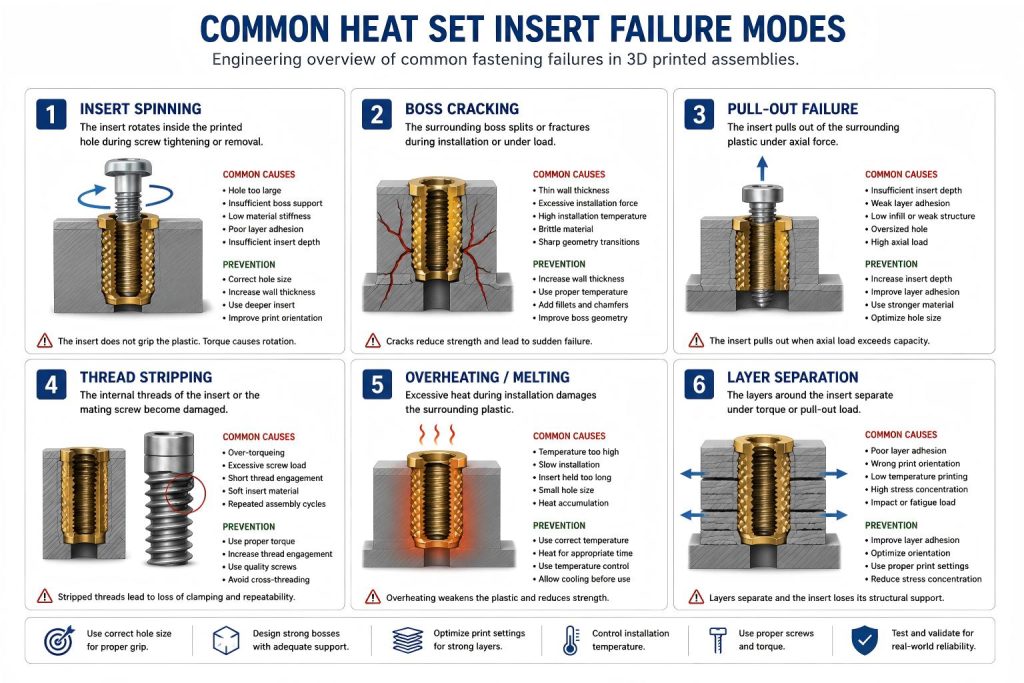
This troubleshooting section organizes common fastening failures found in real 3D printed assemblies, including insert spinning, boss cracking, pull-out failure, thread loosening, overheating, and layer separation.
The goal is not only to identify failure symptoms, but also to explain the engineering factors behind fastening reliability problems.
Troubleshooting Categories
| Failure Type | Typical Problem |
|---|---|
| Rotational Failure | Insert spinning |
| Structural Failure | Boss cracking |
| Axial Failure | Pull-out failure |
| Long-Term Reliability | Thread loosening |
| Interlayer Failure | Layer separation |
Most fastening failures in 3D printed parts involve multiple structural, thermal, and material-related engineering factors working together.
Insert Spinning
The insert rotates inside the printed hole during screw tightening or removal.
Usually related to oversized holes, insufficient boss support, low material stiffness, or poor layer adhesion.
Boss Cracking
The surrounding boss splits or fractures during installation or under load.
Often caused by thin walls, excessive installation pressure, or brittle material behavior.
Pull-Out Failure
The insert pulls out of the surrounding plastic under axial force.
Usually related to insufficient insert depth, weak layer bonding, or inadequate surrounding material volume.
Thread Loosening
Threads lose clamping force after repeated assembly cycles or thermal exposure.
May involve creep behavior, insufficient engagement length, or vibration loading.
Layer Separation
The layers around the insert separate under torque or pull-out load.
Usually related to poor layer adhesion, print orientation, overheating, or weak interlayer bonding.
Engineering Factors Behind Failures
Related Engineering Factors
Most fastening failures are connected to multiple engineering variables working together.
Important related factors include:
- hole tolerance
- boss wall thickness
- insert geometry
- installation temperature
- print orientation
- layer adhesion
- insert depth
- surrounding plastic volume
- screw engagement length
- material stiffness and creep resistance
Reliable fastening depends on balancing these factors as part of a complete fastening structure rather than treating the insert as an isolated component.
Related Engineering Guides
- How to Choose Heat Set Inserts for 3D Printed Parts
- Heat Set Insert Hole Size Guide
- How to Design Bosses for Heat Set Inserts
- PLA vs PETG vs ABS for Threaded Inserts
- Why Heat Set Inserts Fail in 3D Printed Parts
- Pull-Out Strength of Heat Set Inserts in 3D Printed Parts
- Torque Resistance of Heat Set Inserts in 3D Printed Parts
- Layer Adhesion and Heat Set Insert Strength in 3D Printed Parts
- Heat Set Insert Installation Temperature for 3D Printed Parts
- Screw Engagement Length for Heat Set Inserts in 3D Printed Parts
- Heat Set Insert Failure Recovery System