
Introduction
Layer separation is one of the most common structural reliability problems in 3D printed fastening assemblies.
A heat set insert may appear properly installed while the surrounding printed layers gradually split apart under torque, pull-out load, vibration, or thermal stress.
In many cases, the insert itself remains intact.
The failure happens because the surrounding printed layers cannot maintain sufficient interlayer bonding strength.
Layer separation is usually caused by the interaction between weak layer adhesion, poor print orientation, excessive installation stress, thermal damage, and local stress concentration around the insert.
Reliable fastening depends heavily on how well the surrounding printed layers work together as a structural system.
Common Signs of Layer Separation
Typical symptoms include:
- visible layer splitting near insert
- cracks following layer lines
- insert pulling out with surrounding layers
- vertical fractures around boss
- weak torque resistance
- gradual structural loosening
- brittle fracture during installation
In many assemblies, separation begins internally before becoming visible on the outer surface.
Troubleshooting Overview
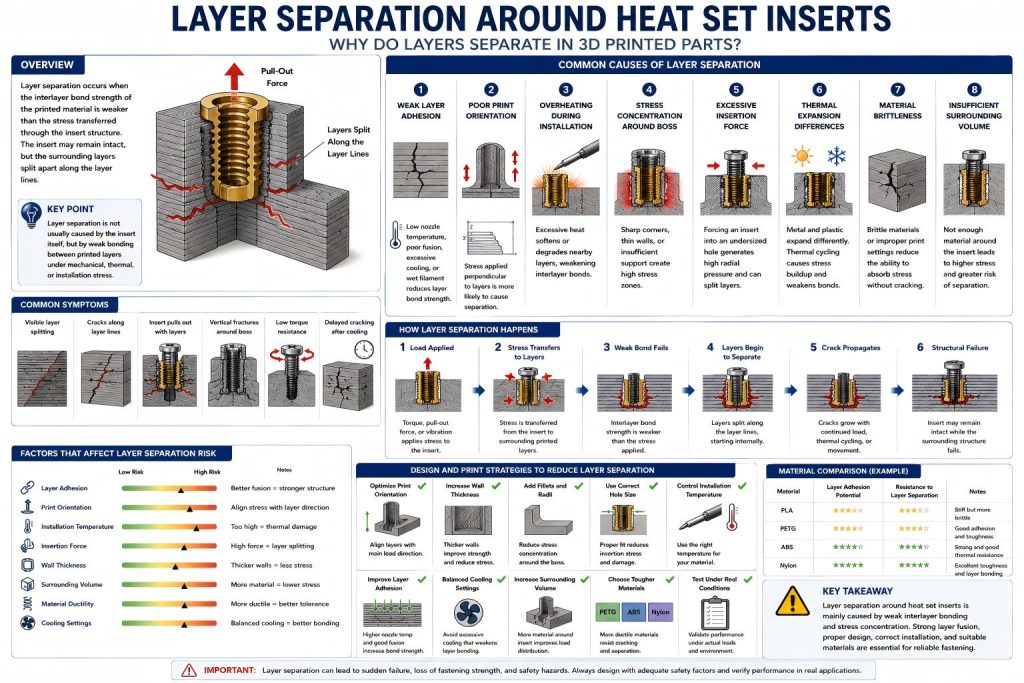
Engineering overview of common causes behind layer separation near heat set inserts in 3D printed assemblies.
Why Layers Separate Around Inserts
Layer separation happens when interlayer bonding strength becomes weaker than the mechanical stress transferred through the insert structure.
The insert transfers torque, pull-out force, vibration, and thermal expansion into the surrounding printed layers.
If layer bonding is weak or stress becomes concentrated along layer lines, the structure may split apart.
Common causes include:
- weak interlayer adhesion
- poor print orientation
- overheating during installation
- insufficient wall thickness
- excessive insertion force
- thermal expansion stress
- low nozzle temperature
- excessive cooling
- insufficient surrounding support
Reliable fastening requires strong layer fusion and balanced structural load distribution.
1. Weak Layer Adhesion
Weak layer bonding is the most common cause of layer separation.
If adjacent printed layers do not properly fuse together, the structure may split under mechanical load.
Common Symptoms
- cracks following layer lines
- brittle vertical splitting
- low torque resistance
- pull-out failure with attached layers
Common Causes
- low nozzle temperature
- insufficient extrusion bonding
- excessive cooling fan speed
- wet filament
- inconsistent extrusion
Strong interlayer fusion significantly improves structural reliability around inserts.
2. Poor Print Orientation
Print orientation strongly affects how force travels through printed layers.
If torque or pull-out force acts perpendicular to weak layer interfaces, separation risk increases dramatically.
Common Symptoms
- vertical layer fractures
- cracking along print lines
- low resistance to pull-out
- structural splitting under load
Engineering Principle
Printed layers are mechanically weaker between layers than within continuous extrusion paths.
Proper orientation helps align stress with stronger structural directions.
3. Overheating During Insert Installation
Excessive installation temperature can damage nearby printed layers.
The surrounding structure may soften unevenly and weaken interlayer bonding.
Common Overheating Symptoms
- glossy melted surfaces
- local deformation
- softened layer structure
- delayed cracking after cooling
Typical Causes
- soldering iron temperature too high
- excessive heating duration
- repeated reheating
- slow insertion process
Controlled installation temperature improves long-term structural stability.
4. Stress Concentration Around the Boss
Stress concentration increases local load near the insert interface.
Sharp transitions and thin surrounding geometry often create weak separation zones.
Common Stress Concentration Conditions
- thin wall sections
- shallow bosses
- sharp corners
- insufficient surrounding volume
- unsupported outer walls
Smooth structural transitions help distribute force more evenly through surrounding layers.
5. Excessive Insertion Force
Forcing an insert into an undersized hole can generate large radial pressure.
The surrounding layers may split apart during insertion.
Common Symptoms
- immediate cracking during installation
- visible layer lifting
- boss expansion
- structural separation near insert
Related Factors
- undersized hole diameter
- oversized insert geometry
- high insertion speed
- low material ductility
Reliable installation requires balanced interference fit and controlled insertion pressure.
6. Thermal Expansion Differences
Heat set inserts introduce metal components into thermoplastic structures.
Metal and plastic expand differently under temperature change.
Repeated thermal cycling may gradually weaken layer bonding near the insert.
Common Thermal Problems
- preload loss
- gradual layer separation
- stress buildup during cooling
- dimensional instability
Thermal expansion effects become more severe in heated environments or repeated temperature cycling conditions.
7. Material Brittleness
Some materials tolerate insert stress poorly.
Stiff but brittle materials may crack more easily along weak layer interfaces.
Material Behavior Examples
PLA
- strong stiffness
- brittle layer behavior
- sensitive to heat buildup
PETG
- improved flexibility
- better crack resistance
- lower brittle fracture risk
ABS
- better thermal resistance
- stronger layer fusion potential
- requires controlled print settings
Material behavior strongly affects long-term layer reliability.
Layer Separation Is a Structural Bonding Problem
Layer separation is rarely caused by the insert alone.
Most failures happen because the surrounding printed layers cannot safely transfer stress through the structure.
Reliable fastening depends on balancing:
- layer adhesion
- print orientation
- boss geometry
- installation temperature
- hole tolerance
- surrounding material volume
- material stiffness
- thermal behavior
The surrounding printed structure must function as one continuous mechanical body.
How to Reduce Layer Separation
Practical engineering improvements include:
- improve nozzle temperature
- optimize print orientation
- reduce excessive cooling
- increase wall thickness
- improve layer bonding
- optimize hole tolerance
- control installation temperature
- increase surrounding material volume
- reduce stress concentration
- test assemblies under real loading conditions
Reliable fastening requires strong interlayer fusion and balanced structural support.
Related Engineering Factors
Important related engineering factors include:
- layer adhesion
- print orientation
- nozzle temperature
- cooling settings
- boss wall thickness
- hole tolerance
- installation temperature
- surrounding material volume
- material stiffness
- thermal expansion behavior
FAQ
Why do layers separate around heat set inserts?
Layer separation usually happens because the surrounding printed layers cannot safely resist mechanical stress transferred through the insert structure.
Does print orientation affect layer separation?
Yes. Poor print orientation can place stress perpendicular to weak layer interfaces and greatly increase separation risk.
Can overheating during installation weaken layers?
Yes. Excessive installation heat may soften surrounding material and weaken interlayer bonding.
Does PLA separate more easily than PETG?
PLA is generally stiffer and more brittle. PETG usually provides better flexibility and lower crack risk under stress.
Does nozzle temperature affect layer bonding?
Yes. Low nozzle temperature often reduces interlayer fusion strength and increases separation risk.
Conclusion
Layer separation around heat set inserts is primarily an interlayer structural bonding problem rather than an insert problem.
Reliable fastening requires strong layer adhesion, proper print orientation, balanced boss geometry, controlled installation temperature, and sufficient surrounding structural support.
Well-designed printed structures distribute stress smoothly through continuous layer bonding instead of concentrating force along weak interfaces.
Related Engineering Guides
- How to Choose Heat Set Inserts for 3D Printed Parts
- Heat Set Insert Hole Size Guide
- How to Design Bosses for Heat Set Inserts
- PLA vs PETG vs ABS for Threaded Inserts
- Why Heat Set Inserts Fail in 3D Printed Parts
- Pull-Out Strength of Heat Set Inserts in 3D Printed Parts
- Torque Resistance of Heat Set Inserts in 3D Printed Parts
- Layer Adhesion and Heat Set Insert Strength in 3D Printed Parts
- Heat Set Insert Installation Temperature for 3D Printed Parts
- Screw Engagement Length for Heat Set Inserts in 3D Printed Parts