
Introduction
Heat set inserts in Voron 3D printer parts are used for structural fastening, removable panels, electronics mounting, frame assemblies, and serviceable printed components. Voron 3D printers rely on these reusable metal threads to improve long-term assembly reliability in high-temperature, vibration-prone, and maintenance-heavy printer environments.
In Voron printers, inserts are commonly installed into ABS, ASA, or other engineering thermoplastics used for high-temperature enclosed printing environments.
Reliable fastening is especially important because Voron assemblies experience:
- repeated maintenance
- vibration
- thermal cycling
- frame movement
- enclosure heat exposure
- repeated disassembly during upgrades
Heat set inserts help maintain structural stability while allowing modular and serviceable printer construction.
For a broader explanation of insert selection, see How to Choose Heat Set Inserts for 3D Printed Parts.
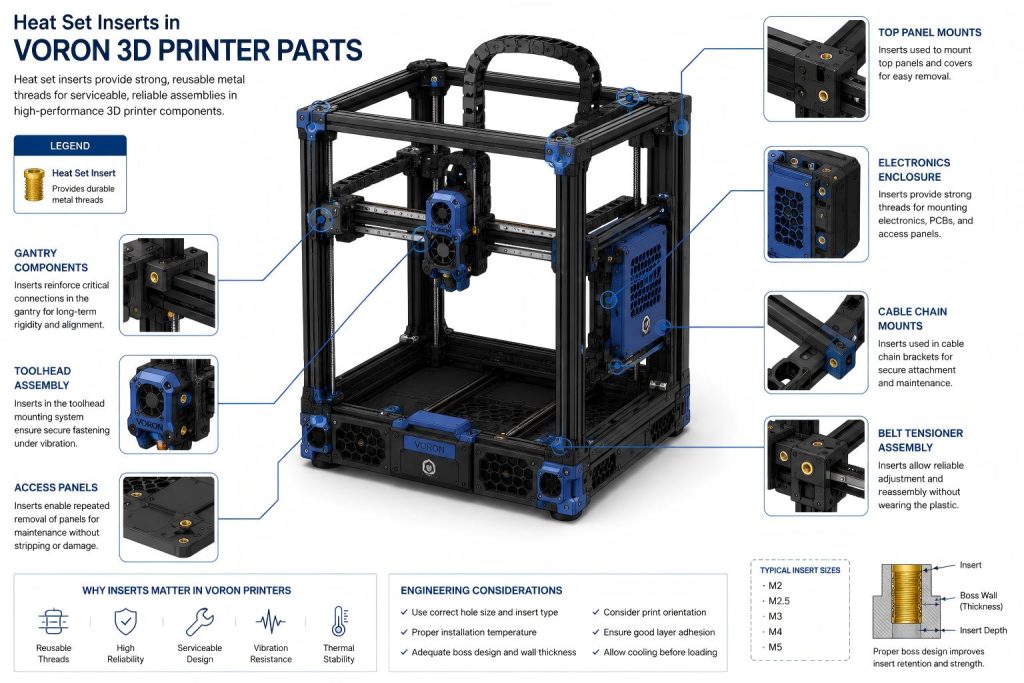
Why Voron Printers Use Heat Set Inserts
Heat set inserts in Voron 3D printer parts are especially useful because many printed components must be assembled, removed, upgraded, or replaced multiple times during the printer’s lifetime.
Voron printers are designed around modularity and serviceability.
Many components must be assembled, removed, upgraded, or replaced multiple times during the printer’s lifetime.
Directly threading screws into printed plastic usually causes rapid wear and poor long-term reliability.
Heat set inserts solve this problem by creating durable reusable threads inside printed parts.
Common advantages include:
- reusable threaded connections
- improved fastening strength
- better maintenance access
- reduced plastic wear
- improved clamp force stability
- cleaner assembly alignment
- easier repeated disassembly
In many Voron assemblies, inserts become part of the printer’s structural design strategy.
Common Voron Parts That Use Inserts
Heat set inserts are widely used throughout Voron printers.
Typical applications include:
- panel mounting brackets
- cable chain mounts
- electronics enclosures
- gantry components
- belt tensioning assemblies
- fan mounts
- hotend mounting systems
- access panels
- enclosure hardware
- toolhead assemblies
Many builders install hundreds of inserts during a complete Voron build.
Why Fastening Reliability Matters in Voron Printers
Voron printers operate under continuous vibration and thermal exposure.
Weak fastening structures may gradually loosen, crack, or deform during long-term operation.
Reliable fastening becomes especially important because many printed components support moving mechanical systems.
Fastening failures may lead to:
- frame instability
- toolhead vibration
- panel rattling
- dimensional inconsistency
- print quality problems
- maintenance difficulties
A properly designed insert structure improves both mechanical reliability and serviceability.
Material Selection for Voron Inserts
Material behavior strongly affects insert reliability.
Voron printers commonly use ABS or ASA because enclosed chambers expose parts to elevated temperature.
ABS
ABS is widely used in Voron builds because it provides:
- good heat resistance
- stable insert retention
- improved toughness
- balanced rigidity and flexibility
ABS generally performs well under repeated thermal cycles.
ASA
ASA behaves similarly to ABS while offering improved environmental stability.
It is often used for:
- exposed panels
- enclosure components
- higher temperature environments
PLA
PLA is usually not recommended for high-temperature Voron components.
For a deeper comparison of material behavior around inserts, see PLA vs PETG vs ABS for Threaded Inserts.
Problems may include:
- heat softening
- creep
- loosening over time
- reduced long-term reliability
Boss Design for Voron Components
Boss geometry strongly affects insert reliability.
Voron parts often experience repeated assembly cycles and vibration loading.
Weak bosses may crack, loosen, or deform over time.
Reliable boss structures generally require:
- sufficient wall thickness
- proper hole tolerance
- smooth stress transitions
- adequate surrounding material volume
- controlled insert depth
Good boss design distributes load into the surrounding printed structure instead of concentrating stress near the insert.
For more detailed boss geometry rules, see How to Design Bosses for Heat Set Inserts.
Insert Installation Best Practices
Proper installation technique significantly improves reliability.
Common recommendations include:
- use controlled installation temperature
- avoid overheating surrounding plastic(For installation temperature details, see Heat Set Insert Installation Temperature for 3D Printed Parts.)
- insert vertically with consistent pressure
- allow cooling before loading
- verify hole dimensions before installation
- test insert retention after cooling
Poor installation often causes:
- boss cracking
- insert spinning
- layer separation
- weak thread retention
Reliable installation depends on balancing heat, pressure, and structural support.
Common Failure Problems in Voron Builds
Several fastening problems appear repeatedly in poorly designed or poorly installed Voron assemblies.
Insert Spinning
Often caused by:
- oversized holes
- weak boss geometry
- overheating
- poor layer adhesion
For fastening behavior under tightening and rotation, see Torque Resistance of Heat Set Inserts in 3D Printed Parts.
Boss Cracking
Common causes include:
- thin walls
- excessive interference fit
- brittle material behavior
- excessive insertion force
Thread Loosening
Usually related to:
- vibration
- creep
- thermal cycling
- insufficient screw engagement
Layer Separation
Often caused by:
- poor print orientation
- weak layer bonding
- thermal damage
- excessive stress concentration
For how print orientation and layer bonding affect insert strength, see Layer Adhesion and Heat Set Insert Strength in 3D Printed Parts.
Why Voron Builders Prefer Serviceable Fastening
Voron printers are highly modular machines.
Builders frequently modify:
- toolheads
- electronics
- panels
- cable routing
- cooling systems
- motion systems
Heat set inserts allow repeated assembly without damaging printed parts.
This serviceability is one of the reasons inserts are widely adopted throughout the Voron ecosystem.
Engineering Factors That Affect Reliability
Important related engineering factors include:
- boss wall thickness
- hole tolerance
- insert depth
- layer adhesion
- print orientation
- installation temperature
- material stiffness
- vibration loading
- thermal cycling
- screw engagement length
Reliable fastening depends on the entire surrounding structure rather than the insert alone.
FAQ
Why are heat set inserts widely used in Voron printers?
Voron printers require modular and serviceable fastening systems. Inserts provide reusable metal threads that improve long-term reliability and repeated maintenance capability.
Is ABS better than PLA for Voron inserts?
Generally yes. ABS provides better heat resistance and improved long-term structural stability inside enclosed printer environments.
Can inserts loosen over time in Voron printers?
Yes. Vibration, thermal cycling, and material creep may gradually reduce fastening stability if the surrounding structure is weak.
Why do inserts spin in Voron parts?
Insert spinning is usually caused by oversized holes, poor boss support, overheating, or weak layer adhesion.
Does print orientation affect insert reliability?
Yes. Poor print orientation may weaken layer bonding around the insert and increase separation risk under load.
Conclusion
Heat set inserts play a major role in the structural reliability and serviceability of Voron 3D printer assemblies.
Reliable insert performance depends on proper boss design, material selection, hole tolerance, installation quality, and surrounding structural support.
Well-designed fastening structures allow Voron printers to remain modular, maintainable, and mechanically stable during long-term operation.
Related Engineering Guides
- How to Choose Heat Set Inserts for 3D Printed Parts
- Heat Set Insert Hole Size Guide
- How to Design Bosses for Heat Set Inserts
- PLA vs PETG vs ABS for Threaded Inserts
- Why Heat Set Inserts Fail in 3D Printed Parts
- Pull-Out Strength of Heat Set Inserts in 3D Printed Parts
- Torque Resistance of Heat Set Inserts in 3D Printed Parts
- Layer Adhesion and Heat Set Insert Strength in 3D Printed Parts
- Heat Set Insert Installation Temperature for 3D Printed Parts
- Screw Engagement Length for Heat Set Inserts in 3D Printed Parts