
Why heat set inserts fail in 3D printed parts is one of the most important engineering questions in additive manufacturing assembly design. Heat set inserts are widely used in 3D printed assemblies because they create reusable metal threads inside plastic parts. In many applications, they provide significantly better durability than directly threading screws into printed material.
However, heat set inserts do not fail because the brass insert itself is weak.
Most failures happen because the surrounding printed structure was not designed correctly.
In real-world assemblies, insert failure is usually a structural problem, not a hardware problem.
Understanding why inserts fail is important for improving fastening reliability, pull-out resistance, assembly lifespan, and overall part performance.
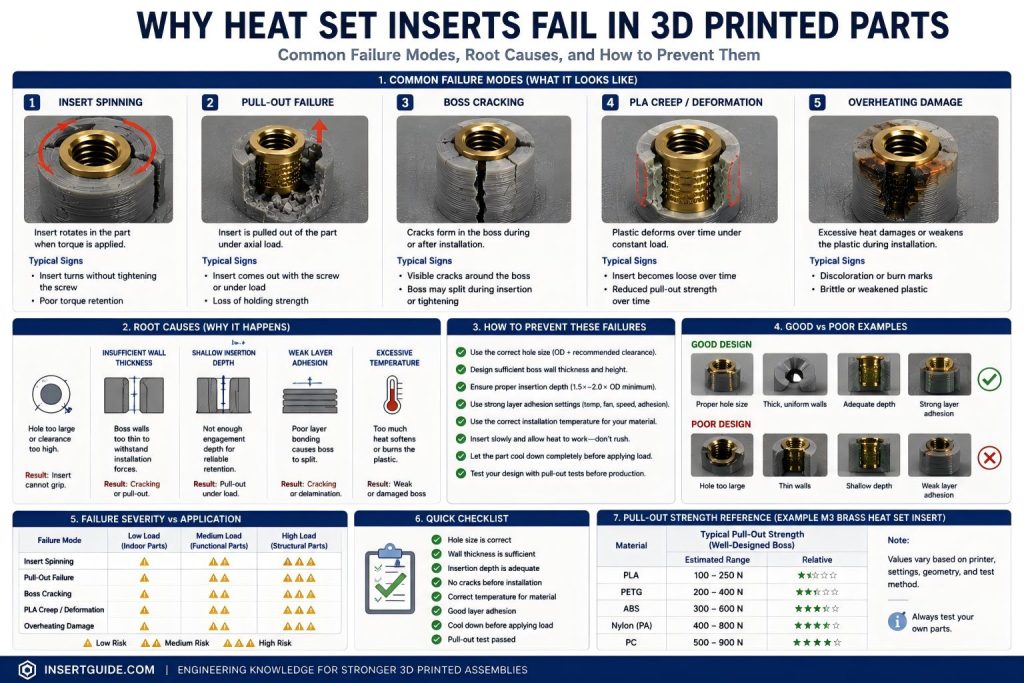
The Most Common Heat Set Insert Failures
Several failure patterns appear repeatedly in 3D printed assemblies.
The most common include:
- Inserts spinning inside the plastic
- Pull-out under axial load
- Boss cracking during installation
- Plastic deformation after heat exposure
- Weak layer adhesion around the insert
- Overheated installation zones
- Insufficient wall thickness
- Incorrect hole diameter
These problems are especially common in PLA parts with thin bosses or poorly controlled installation temperatures.
Inserts Spinning Inside Printed Parts
One of the most common problems is insert rotation after assembly.
This happens when the insert loses its mechanical grip inside the boss structure.
The failure is often caused by:
- Hole diameter too large
- Boss wall thickness too thin
- Insufficient insertion depth
- Low infill density
- Weak layer bonding
- Excessive installation temperature
When the surrounding plastic softens too much during installation, the insert can no longer mechanically lock into the printed structure.
This is particularly common in PLA because PLA becomes soft quickly under localized heat.
Pull-Out Failure Under Load
Pull-out failure occurs when the insert is extracted from the plastic under axial force.
This usually happens because the surrounding material cannot distribute the assembly load correctly.
Common causes include:
- Small boss diameter
- Short insert engagement depth
- Thin surrounding walls
- Weak print orientation
- Poor layer adhesion
- Brittle materials
In many printed parts, the insert itself remains intact while the surrounding plastic fails completely.
This is why boss design is more important than insert selection alone.
A strong insert inside a weak boss still creates a weak fastening system.
Common Failure Relationships
| Failure Type | Possible Engineering Cause |
|---|---|
| Insert spinning | Oversized hole or softened surrounding plastic |
| Boss cracking | Thin wall structure or excessive installation stress |
| Pull-out failure | Weak layer adhesion or insufficient surrounding material |
| Plastic deformation | Excessive installation temperature |
| Loose insert over time | Material creep under repeated load |
| Layer separation | Poor print orientation or weak interlayer bonding |
| Distorted boss geometry | Uneven heating during installation |
Most insert failures are caused by the interaction between material behavior, structural geometry, installation conditions, and long-term mechanical loading rather than a single isolated issue.
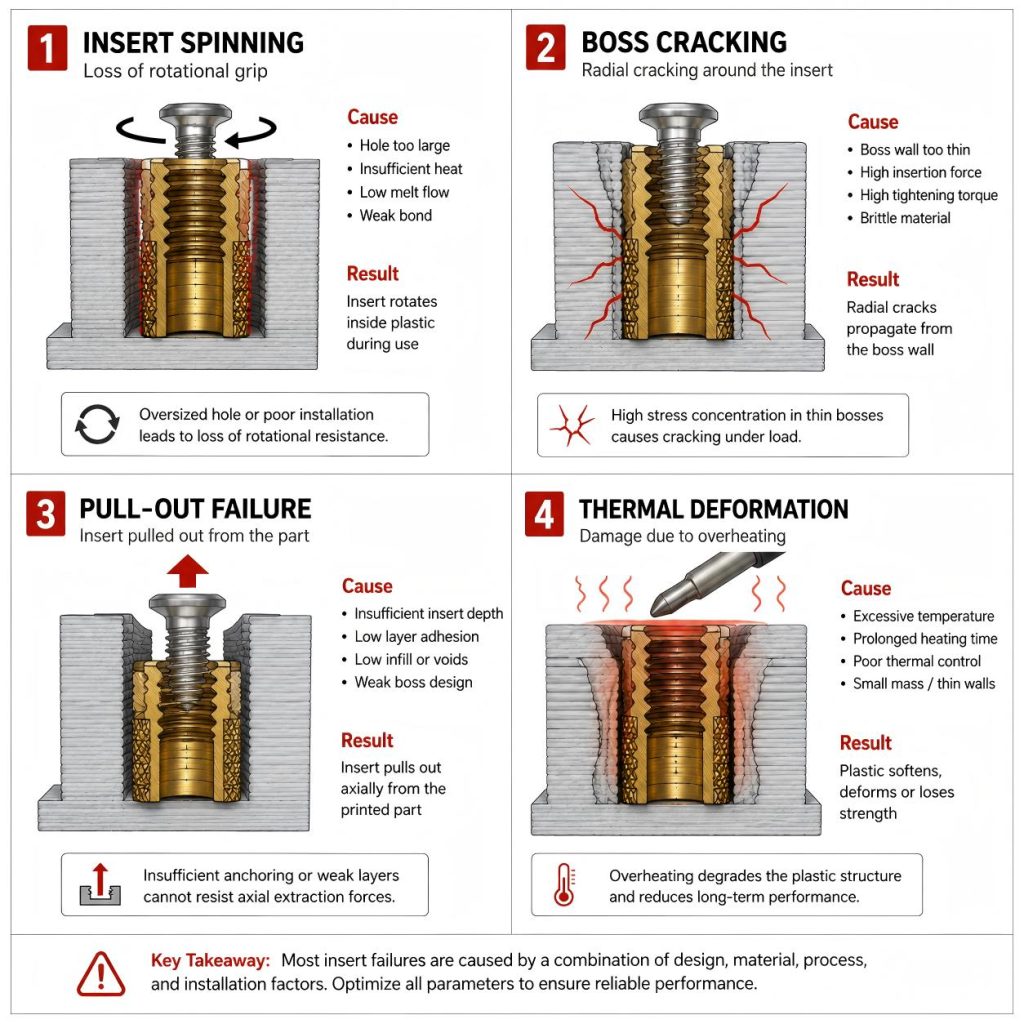
Common Heat Set Insert Failure Diagram
Boss Cracking During Installation
Boss cracking typically happens during heat insertion.
The plastic expands locally while the brass insert transfers heat into the surrounding structure.
If the boss wall thickness is insufficient, the material can split under thermal stress.
This problem becomes more severe when:
- Hole tolerances are too tight
- Inserts are installed too quickly
- Installation temperature is too high
- Printed layers are weak
- Sharp internal corners concentrate stress
ABS and PETG generally tolerate installation stress better than PLA, especially in functional assemblies.
PLA Creep and Long-Term Deformation
PLA is widely used because it prints easily and provides good dimensional accuracy.
However, PLA has relatively poor thermal resistance.
Under continuous load, PLA can slowly deform over time.
This behavior is called creep.
In insert assemblies, creep may cause:
- Gradual loosening
- Reduced clamping force
- Insert movement
- Boss deformation
- Long-term pull-out failure
This becomes especially problematic in:
- Heated environments
- Enclosures
- Automotive interiors
- High-torque assemblies
- Repeated mechanical loading
For long-term engineering applications, PETG, ABS, PA, or reinforced materials often provide better fastening reliability.
Overheating During Installation
Many insert failures begin during installation rather than during final use.
If the soldering iron temperature is too high, the surrounding plastic may degrade.
Overheating can cause:
- Internal voids
- Weak bonding zones
- Melt collapse
- Poor surface contact
- Reduced pull-out strength
For most PLA assemblies, installation temperatures around 180–220°C are usually sufficient.
Higher temperatures often increase failure risk instead of improving retention.
Controlled installation speed is also important.
Pressing too quickly can trap softened plastic and weaken the surrounding structure.
Print Orientation and Layer Adhesion
Layer direction strongly affects insert performance.
If tensile force acts perpendicular to weak layer lines, the boss may split under load.
Better insert strength usually comes from:
- Vertical boss alignment
- Strong perimeter walls
- Increased wall count
- Higher local infill
- Proper layer compression
In many engineering assemblies, print orientation matters more than infill percentage alone.
Why Hole Size Matters
Incorrect hole diameter is one of the biggest reasons for insert instability.
If the hole is too small:
- Excessive stress appears during insertion
- Boss cracking becomes more likely
If the hole is too large:
- Mechanical retention decreases
- Inserts spin more easily
- Pull-out strength drops
Proper hole sizing depends on:
- Insert outer diameter
- Material type
- Print shrinkage
- Printer calibration
- Installation temperature
This is why engineering tolerance matters even in hobby-level 3D printing.
Reliable Insert Design Requires Structural Thinking
Many beginners focus only on insert size.
Real engineering reliability depends on the entire fastening structure.
A successful insert system requires balance between:
- Hole tolerance
- Boss geometry
- Material behavior
- Print orientation
- Installation temperature
- Load direction
- Long-term creep resistance
Heat set inserts work extremely well when the surrounding structure is designed correctly.
Most failures are preventable with proper engineering decisions.
Reality Layer
In many real assemblies, insert failure is blamed on “bad inserts” even though the actual problem is structural design.
Most failures originate from:
- Thin bosses
- Weak print orientation
- Incorrect hole sizing
- Overheated installation
- PLA creep under continuous load
The brass insert itself usually survives while the surrounding printed material fails first.
Related Engineering Factors
For a symptom-based workflow, compare these causes with the troubleshooting failure patterns.
For a size-specific failure node, see M3 heat set insert failure modes.
Heat set insert failures are usually caused by multiple interacting engineering variables rather than a single installation mistake.
Important related engineering factors include:
- incorrect hole size
- weak boss wall structure
- insufficient layer adhesion
- overheating during installation
- low material heat resistance
- insert spinning under torque
- pull-out force concentration
- long-term plastic creep
- print orientation
- repeated assembly stress
Most insert failures originate from the interaction between material behavior, structural geometry, installation conditions, and long-term mechanical loading.
Related engineering guides:
- How to Choose Heat Set Inserts for 3D Printed Parts
- Heat Set Insert Hole Size Guide
- How to Design Bosses for Heat Set Inserts
- PLA vs PETG vs ABS for Threaded Inserts
- Pull-Out Strength of Heat Set Inserts in 3D Printed Parts
- Torque Resistance of Heat Set Inserts in 3D Printed Parts
- Layer Adhesion and Heat Set Insert Strength in 3D Printed Parts
- Heat Set Insert Installation Temperature for 3D Printed Parts
Common Failure Signals
Common real-world failure signals in 3D printed heat set insert assemblies include:
- inserts spinning during screw tightening
- radial cracks around the boss structure
- softened plastic surrounding the insert
- pull-out failure under repeated loading
- loose inserts after thermal cycling
- layer separation near the insert region
- distorted boss geometry after installation
- reduced clamping force over time
Many of these failures originate from the interaction between hole tolerance, boss geometry, material behavior, installation temperature, and long-term mechanical stress.
FAQ
Why do heat set inserts fail in 3D printed parts?
Heat set inserts usually fail because the surrounding printed plastic cannot support the mechanical load. Common causes include incorrect hole size, weak boss design, poor layer adhesion, overheating during installation, insufficient insert depth, material creep, or excessive screw torque.
Why does a heat set insert spin inside a 3D printed part?
A heat set insert may spin when the plastic around the knurled surface does not form a strong mechanical lock. This can happen if the hole is too large, the installation temperature is too low, the boss wall is too thin, or the screw is tightened beyond the strength of the printed structure.
Why does the boss crack around a heat set insert?
Boss cracking usually happens when the boss wall is too thin, the hole is too small, or the material is too brittle. During installation or screw tightening, the insert expands stress into the surrounding plastic. If the boss cannot absorb that stress, it may split or crack along the printed layers.
Can overheating damage heat set inserts in 3D printed parts?
Yes. Overheating can soften too much plastic around the insert, enlarge the hole, deform the boss, or weaken the layer structure. A good heat set installation should soften the plastic enough to flow around the insert, but not so much that the printed boss loses its shape or strength.
How can heat set insert failures be prevented?
Heat set insert failures can be reduced by using the correct hole size, designing a strong boss with enough wall thickness, choosing a suitable material, increasing perimeter count around the insert, controlling installation temperature, aligning print orientation with load direction, and avoiding excessive screw tightening.
Related Engineering Guides
- Ngineering Guides for 3D Printed Fastening
- 3D Printing Fastening FAQ
- 3D Printed Fastening Applications
- How to Choose Heat Set Inserts for 3D Printed Parts
- Heat Set Insert Hole Size Guide
- How to Design Bosses for Heat Set Inserts
- PLA vs PETG vs ABS for Threaded Inserts
- Pull-Out Strength of Heat Set Inserts in 3D Printed Parts
- Torque Resistance of Heat Set Inserts in 3D Printed Parts
- Layer Adhesion and Heat Set Insert Strength in 3D Printed Parts
- Heat Set Insert Installation Temperature for 3D Printed Parts
- Screw Engagement Length for Heat Set Inserts in 3D Printed Parts