
Choose Your Heat Set Insert Path
Start by choosing the situation that matches your printed assembly. The path is: Step 1 – understand the problem, Step 2 – choose the installation or repair path, Step 3 – compare suitable tools, Step 4 – verify the result on the printed part.
| Intent | Choose This Path When | Next Step |
|---|---|---|
| Beginner | You are choosing your first safe setup or checking basic questions. | Start with beginner setup questions |
| Repair / Fix | You are diagnosing pull-out, cracking, or depth failure before buying tools. | Choose the repair path |
| Installation | You need tool control for heat, depth, alignment, or repeatability. | Review installation tool selection |
| Recommended path: Professional | You are planning repeated assemblies, fixtures, or production-like workflows. | Use the professional workflow path |
Engineering Guides for 3D Printing Fastening
These engineering guides explain how heat set inserts behave in 3D printed parts under torque loading, pull-out force, repeated assembly, thermal stress, and long-term fastening conditions.
The guides connect hole size, boss geometry, material behavior, installation temperature, and load path relationships in 3D printed fastening structures.
This section is designed as a technical knowledge map. It helps engineers, makers, and product designers understand how hole size, boss design, material behavior, installation quality, screw engagement, and load direction affect fastening reliability.
The guides are grouped by engineering relationships rather than marketing categories. Each topic connects to a design variable, material behavior, failure mode, or real assembly condition.
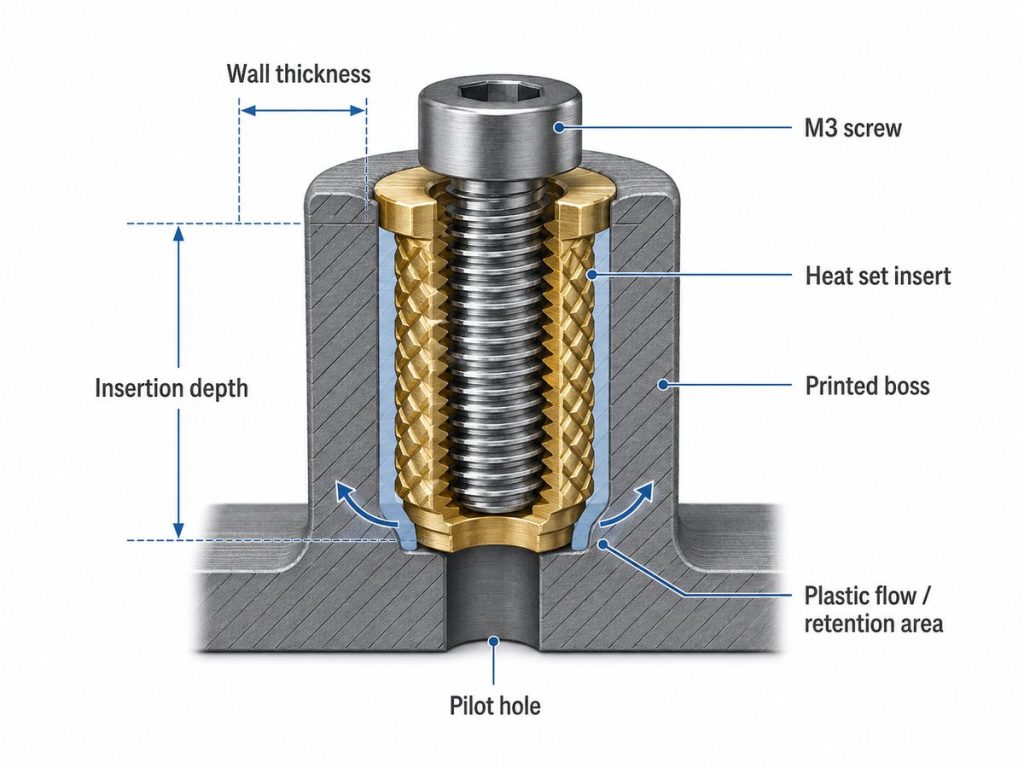
Core Heat Set Insert Guides
These guides cover the main engineering variables that determine whether a heat set insert will hold reliably inside a 3D printed part.
How to Choose Heat Set Inserts for 3D Printed Parts
This guide explains how insert geometry, screw size, material behavior, and application loads affect insert selection.
Heat Set Insert Hole Size Guide
This guide explains how hole diameter, insert outer geometry, print tolerance, and material flow affect installation quality.
Heat Set Insert Installation Temperature for 3D Printed Parts
This guide explains how installation temperature affects plastic flow, boss deformation, layer adhesion, and insert retention.
Pull-Out Strength of Heat Set Inserts in 3D Printed Parts
This guide explains how boss geometry, insert depth, material strength, and print orientation affect pull-out resistance.
Torque Resistance of Heat Set Inserts in 3D Printed Parts
This guide explains how knurling, hole fit, boss wall thickness, and material behavior affect rotational stability.
Screw Engagement Length for Heat Set Inserts in 3D Printed Parts
This guide explains how screw engagement length affects clamp force, thread contact, bottoming out, and assembly reliability.
Layer Adhesion and Heat Set Insert Strength in 3D Printed Parts
This guide explains how print orientation, wall count, layer bonding, and thermal stress affect fastening strength.
Boss Design and Structural Support
A correct hole size alone does not guarantee a reliable insert. The surrounding boss geometry determines how load is transferred into the printed part.
Boss wall thickness, support ribs, insert depth, stress concentration, and layer orientation all affect whether the insert remains stable under torque, pull-out force, vibration, and repeated assembly cycles.
How to Design Bosses for Heat Set Inserts
This guide explains how boss geometry affects insert stability, stress distribution, and long-term fastening reliability.
M3 Heat Set Insert Boss Design for 3D Printed Parts
This guide focuses on M3-specific boss dimensions, wall thickness, and structural reinforcement strategies.
Boss cracking is usually caused by thin walls, weak layer adhesion, stress concentration, overheating during installation, or insufficient reinforcement around the insert cavity.
Pull-Out Strength of Heat Set Inserts in 3D Printed Parts
This guide explains how boss geometry, insert engagement depth, and print structure affect pull-out resistance.
Heat Set Insert Hole Size Guide
This guide explains how incorrect hole sizing changes plastic flow and increases local stress around the boss structure.
Material Behavior and Compatibility
Different materials respond differently to insert installation temperature, torque loading, creep, repeated tightening, and long-term structural stress.
Material selection affects plastic flow during installation, insert retention strength, thermal stability, vibration resistance, and repeated assembly durability.
PLA vs PETG vs ABS for Threaded Inserts
This guide compares how PLA, PETG, and ABS behave under fastening loads, thermal stress, and repeated assembly conditions.
PLA vs PETG Fastening Behavior for Heat Set Inserts
This guide explains how PLA and PETG differ in stiffness, creep resistance, deformation behavior, and insert retention stability.
Heat Set Insert Torque Resistance in PETG vs PLA Parts
This guide explains how PETG and PLA respond differently to tightening force, rotational stress, and long-term torque loading.
Recommended M3 Heat Set Inserts for PETG
This guide explains which insert geometries and installation approaches work best for PETG structures.
Engineering-grade materials such as reinforced nylon and fiber-filled polymers introduce additional fastening variables, including thermal expansion differences, layer bonding changes, and altered stress transfer behavior around the insert cavity.
Troubleshooting and Failure Modes
Most fastening failures in 3D printed parts are not caused by a single variable. Insert instability usually results from a combination of hole tolerance, boss geometry, material behavior, print orientation, installation temperature, and assembly loading conditions.
These troubleshooting guides focus on identifying root causes rather than only describing visible symptoms.
Why Heat Set Inserts Fail in 3D Printed Parts
This guide explains the most common failure mechanisms found in heat set insert structures, including spinning, pull-out, boss deformation, layer separation, and thread loosening.
Common failure patterns in heat set insert structures include:
- insert spinning caused by oversized holes or weak plastic flow
- pull-out failures caused by shallow engagement or weak boss geometry
- boss cracking caused by stress concentration and insufficient wall thickness
- layer separation caused by weak interlayer bonding and thermal stress
- thread loosening caused by vibration, repeated tightening, and material creep
Most troubleshooting work should begin by identifying the dominant failure mode before modifying hole size, installation temperature, or boss geometry.
Common Fastening Failure Questions
These engineering FAQ pages explain common fastening failure patterns found in 3D printed heat set insert structures, including insert spin, boss cracking, preload loss, material creep, vibration failure, and repeated assembly instability.
- Why do heat set inserts spin in 3D printed parts?
- Why do bosses crack around heat set inserts?
- Why do heat set inserts loosen in PETG but crack in PLA?
- Why do heat set inserts fail near edges or corners?
- Why do heat set inserts fail in motor mounts?
How to Use These Guides
For the complete hub view across guides, references, FAQ, and applications, return to the Engineering Knowledge Map.
If you are designing a new 3D printed fastening structure:
- Start by selecting the appropriate insert type and screw size.
- Verify the recommended hole diameter for the material and insert geometry.
- Design the boss structure to support torque and pull-out loading.
- Consider print orientation, layer adhesion, and installation temperature.
- Evaluate pull-out strength, torque resistance, and repeated assembly requirements.
- Review common failure modes before finalizing the design.
If you are troubleshooting an existing fastening problem:
Compare the failure against known troubleshooting patterns.
Identify the dominant failure mode.
Check hole tolerance and insert fit.
Inspect boss wall thickness and surrounding support structure.
Review print orientation and material behavior.
Verify installation temperature and screw engagement length.
Suggested Knowledge Paths
New Insert Design Path
How to Choose Heat Set Inserts for 3D Printed Parts
Heat Set Insert Hole Size Guide
How to Design Bosses for Heat Set Inserts
Heat Set Insert Installation Temperature for 3D Printed Parts
Pull-Out Strength of Heat Set Inserts in 3D Printed Parts
Repeated Assembly Path
Screw Engagement Length for Heat Set Inserts in 3D Printed Parts
Torque Resistance of Heat Set Inserts in 3D Printed Parts
Heat Set Inserts for Repeated Assembly in 3D Printed Parts
Recommended Fastening Structure for Repeated Assembly PETG Parts
Heat Set Insert Failure Modes in Repeated Assembly Structures
Material Selection Path
PLA vs PETG vs ABS for Threaded Inserts
PLA vs PETG Fastening Behavior for Heat Set Inserts
Heat Set Insert Torque Resistance in PETG vs PLA Parts
Recommended M3 Heat Set Inserts for PETG
M3 Design Reference Path
M3 Heat Set Insert Hole Size for 3D Printed Parts
M3 Heat Set Insert Dimensions Reference
M3 Heat Set Insert Boss Design for 3D Printed Parts
M3 Heat Set Insert Pull-Out Strength for 3D Printed Parts
Troubleshooting Path
Why Heat Set Inserts Fail in 3D Printed Parts
Heat Set Insert Failure Modes in Repeated Assembly Structures
Pull-Out Strength of Heat Set Inserts in 3D Printed Parts
Layer Adhesion and Heat Set Insert Strength in 3D Printed Parts
Torque Resistance of Heat Set Inserts in 3D Printed Parts
InsertGuide organizes fastening knowledge by engineering relationships rather than isolated topics.
Each guide connects to a specific design variable, structural behavior, material characteristic, assembly condition, or failure mechanism found in real 3D printed fastening systems.
The goal is to help engineers, makers, and product designers build fastening structures that remain reliable under installation heat, torque loading, vibration, repeated assembly, and long-term mechanical stress.
Professional Tool Selection Path
Professional visitors are routed toward press systems, fixtures, and repeatable process control after the engineering requirement is established.
Decision Table
| Professional Intent | Problem Understanding | Tool Recommendation | Next Decision Step |
|---|---|---|---|
| Primary path: batch installation | Many inserts or repeatable assembly work. | Primary recommendation: press system and installation tools | Professional → press systems |
| Precision assemblies | Alignment-sensitive or serviceable parts where screw fit must remain repeatable. | Secondary recommendation: press-vs-soldering-iron method decision | Professional → method comparison |
| Industrial or serviceable parts | Parts need inspection, documentation, and consistent operator workflow. | Optional reference: inspection and workflow tools | Professional → process control |
Tool Selection Block
| Recommendation Level | Tool or Item | Problem – Tool Mapping | Selection Guidance |
|---|---|---|---|
| Primary recommendation | Professional insert press system | Controls axis, depth, and repeatability across many inserts. | Best for: batch installation and production-like workflows. Recommended for: teams standardizing insert installation. Optimized for: press-system revenue path. Recommended Tools: View professional insert press. |
| Secondary recommendation | Press method comparison | Helps choose whether a simple iron method is enough or a guided press is justified. | Best for: users comparing speed, precision, and repeatability. Recommended for: alignment-sensitive assemblies. Optimized for: professional tool evaluation. Recommended Tools: View 600-piece insert and tool set. |
| Optional reference | Inspection tools and process sheet | Supports validation when multiple operators install inserts. | Best for: QC and documented workflows. Recommended for: teams validating repeatability. Optimized for: workflow add-ons. Recommended Tools: View M2–M8 heat-set tip kit. |
Use-Case Mapping
| Use Case | Recommended Path | Best for |
|---|---|---|
| Primary path: small-batch manufacturing | Professional → press systems | Best for: repeatability, consistent height, and faster installation. |
| Robotics and fixtures | Professional → method comparison | Best for: load-sensitive assemblies where alignment affects service life. |
| Engineering validation | Professional → process control | Best for: separating geometry, material, and installation variables. |