
Heat set insert failure modes in repeated assembly structures are strongly influenced by material behavior, boss geometry, repeated tightening stress, and long-term fastening conditions in 3D printed parts.
In engineering assemblies, fastening failures rarely result from insert geometry alone.
Most failures occur because the surrounding printed structure gradually weakens under repeated mechanical loading.
Repeated assembly conditions often introduce:
- cyclic torque stress
- pull-out loading
- boss deformation
- layer fatigue
- creep behavior
- insert retention loss
Understanding common fastening failure modes helps engineers design more durable and serviceable 3D printed assemblies.
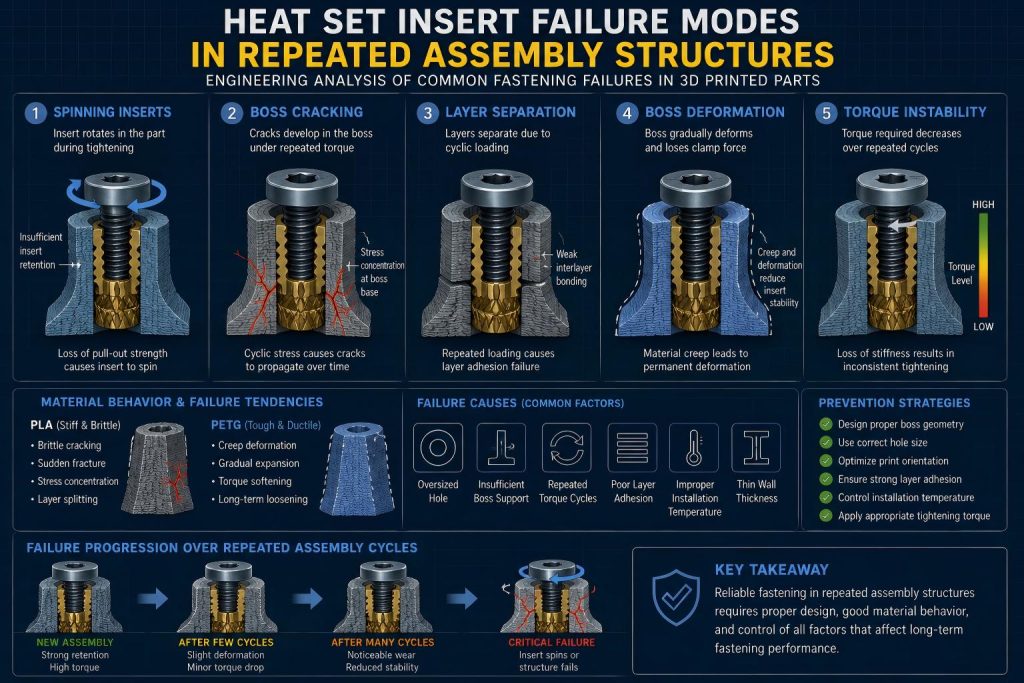
Why Repeated Assembly Causes Failures
Repeated tightening and loosening cycles gradually increase stress inside the surrounding boss structure.
Over time, the printed material may experience:
- deformation
- fatigue damage
- layer weakening
- reduced torque consistency
- insert instability
Assemblies that initially appear stable may eventually fail after repeated maintenance or service access cycles.
Long-term fastening reliability depends on the interaction between insert retention, material behavior, and structural load distribution.
Common Failure Modes
Spinning Inserts
Spinning inserts are one of the most common fastening failures in repeated assembly structures.
For PETG repeated-use parts, spinning inserts are often linked to gradual deformation around the insert rather than a single installation mistake.
This failure usually occurs when insert retention weakens over time.
Typical causes include:
- oversized holes
- weak boss support
- repeated torque cycling
- insufficient pull-out resistance
Once the surrounding material loses retention strength, the insert may rotate during screw tightening.
Related Guide:
M3 Heat Set Insert Pull-Out Strength for 3D Printed Parts
Boss Cracking
Boss cracking often occurs when fastening loads concentrate near thin unsupported structures.
Repeated tightening gradually increases stress around the insert base.
PLA structures are especially sensitive to:
- brittle fracture
- stress concentration
- layer cracking
PETG structures may better tolerate cyclic loading but can still deform under sustained stress conditions.
Related Guide:
M3 Heat Set Insert Boss Design for 3D Printed Parts
Layer Separation
Layer separation occurs when cyclic loading weakens interlayer bonding near the insert region.
This failure mode is strongly affected by:
- print orientation
- layer adhesion quality
- installation temperature
- operational loading direction
Weak layer bonding may significantly reduce both torque resistance and pull-out stability.
Boss Deformation
Boss deformation is more common in flexible materials such as PETG.
Repeated tightening may gradually expand the surrounding boss structure and reduce insert stability.
Typical symptoms include:
- reduced tightening stiffness
- inconsistent screw engagement
- loosening during repeated use
Long-term creep behavior often contributes to this failure mode. This is why PETG fastening behavior should be evaluated through creep, torque softening, and long-term service loading rather than stiffness alone.
Torque Instability
Repeated tightening may gradually reduce fastening consistency.
The insert may remain physically installed while the surrounding structure slowly loses stiffness and load support.
Torque instability often appears before complete structural failure occurs.
Related Guide:
Heat Set Insert Torque Resistance in PETG vs PLA Parts
Material Behavior and Failure Risk
Different materials fail differently under repeated assembly conditions.
PLA
Common failure tendencies:
- brittle cracking
- sudden fracture
- layer splitting
- stress concentration failure
PETG
Common failure tendencies:
- creep deformation
- gradual boss expansion
- torque softening
- long-term loosening
Material selection strongly affects long-term fastening reliability and maintenance durability.
Related Guide:
PLA vs PETG Fastening Behavior for Heat Set Inserts
Preventing Repeated Assembly Failures
Reliable fastening structures typically include:
- balanced boss geometry
- proper hole sizing
- stable layer orientation
- controlled installation temperature
- sufficient wall thickness
- balanced torque loading
Repeated assembly reliability improves when fastening structures distribute stress evenly into the surrounding printed material.
In repeated assembly applications, failure prevention should start from the fastening structure itself, including insert depth, boss support, screw engagement, and load direction.
Failure Analysis Is Part of Engineering Design
Failure modes should not be treated as isolated defects.
Reliable fastening systems require understanding the interaction between:
- material behavior
- boss structure
- pull-out stability
- torque resistance
- layer adhesion
- operational loading conditions
Engineering reliability improves when fastening systems are designed around long-term service behavior rather than initial installation performance alone.
Conclusion
Heat set insert failure modes in repeated assembly structures are strongly affected by cyclic loading, boss geometry, insert retention, and long-term material behavior.
Spinning inserts, boss cracking, layer separation, deformation, and torque instability are all common failure patterns in 3D printed fastening systems.
Reliable engineering assemblies require fastening structures designed for long-term durability rather than short-term installation success.
Related Engineering Guides
- How to Choose Heat Set Inserts for 3D Printed Parts
- Heat Set Insert Hole Size Guide
- How to Design Bosses for Heat Set Inserts
- PLA vs PETG vs ABS for Threaded Inserts
- Why Heat Set Inserts Fail in 3D Printed Parts
- Pull-Out Strength of Heat Set Inserts in 3D Printed Parts
- Torque Resistance of Heat Set Inserts in 3D Printed Parts
- Layer Adhesion and Heat Set Insert Strength in 3D Printed Parts
- Heat Set Insert Installation Temperature for 3D Printed Parts
- Screw Engagement Length for Heat Set Inserts in 3D Printed Parts