
Engineering guides, fastening design principles, heat set insert references, assembly structures, and real-world 3D printing fastening knowledge.
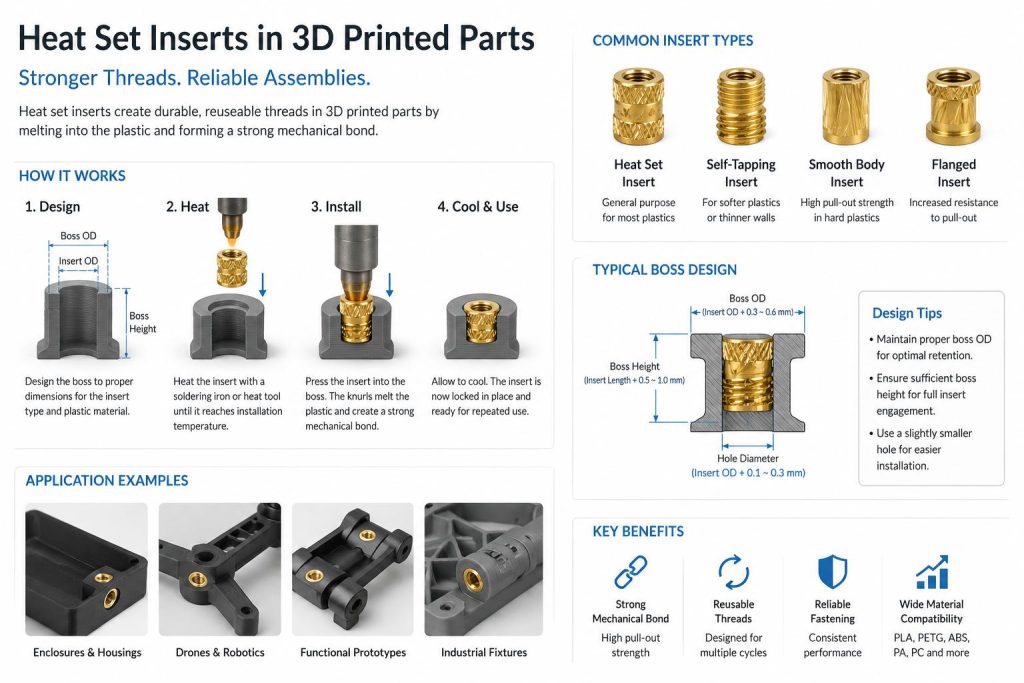
InsertGuide is a 3D printing fastening knowledge hub for heat set inserts, threaded inserts, boss design, hole tolerances, fastening applications, product references, and real-world 3D printed assembly reliability.
Engineering Knowledge Map
Use this map as the starting hub for size clusters, troubleshooting paths, FAQ decisions, and application-specific fastening cases.
Explore InsertGuide’s structured map of heat set inserts, boss design, material behavior, fastening failures, engineering references, and real-world 3D printed assembly applications.
Explore the Full Knowledge Map →
Featured Engineering Guides
Core engineering references for heat set inserts, fastening structures, boss design, pull-out strength, and 3D printed assembly behavior.
M3 Heat Set Insert Boss Design for 3D Printed Parts
Engineering guide covering wall thickness, load paths, layer adhesion, and structural stability for M3 insert bosses in 3D printed assemblies.
M3 Heat Set Insert Pull-Out Strength for 3D Printed Parts
Engineering analysis of pull-out force behavior, insert retention, and fastening durability for M3 heat set inserts in functional 3D printed assemblies.
Heat Set Inserts for Repeated Assembly in 3D Printed Parts
Engineering guide for designing durable heat set insert structures that withstand repeated assembly and long-term service cycles in 3D printed parts.
PLA vs PETG Fastening Behavior for Heat Set Inserts
Engineering comparison of PLA and PETG fastening behavior for heat set inserts, including rigidity, creep resistance, repeated assembly durability, and long-term fastening stability.
Heat Set Insert Torque Resistance in PETG vs PLA Parts
Engineering comparison of torque resistance behavior in PETG and PLA fastening structures, including boss deformation, repeated tightening durability, and long-term fastening stability.
Heat Set Insert Failure Modes in Repeated Assembly Structures
Engineering analysis of common heat set insert failure modes in repeated assembly structures, including spinning inserts, boss cracking, deformation, and torque instability.
Heat Set Insert Hole Size Guide
Engineering reference for insert hole dimensions, material behavior, and fastening stability in 3D printed parts.
How to Design Bosses for Heat Set Inserts
Engineering guide for boss wall thickness, structural load distribution, and insert retention behavior.
Pull-Out Strength of Heat Set Inserts in 3D Printed Parts
Engineering analysis of insert retention forces, material behavior, and fastening load paths.
Recommended M3 Heat Set Inserts for PETG
Engineering recommendations for stable M3 insert selection in PETG assemblies with repeated fastening conditions.
Core Engineering Structure
Engineering Recommendations
Engineering-based insert selection guides for 3D printed fastening structures, focusing on material behavior, installation stability, repeated assembly, and long-term structural performance.
Recommended M3 Heat Set Inserts for PETG
Recommended Fastening Structure for Repeated Assembly PETG Parts
Engineering recommendations for designing stable fastening structures in repeated assembly PETG assemblies with long-term serviceability requirements.
M3 Heat Set Insert Dimensions Reference
Reference data for M3 heat set insert dimensions, including outer diameter, insert length, recommended hole size, boss diameter, and material compatibility.
Core Knowledge Areas
Engineering Quick Reference
Typical Hole Sizes
M3 insert → ~4.2 mm hole
M4 insert → ~5.6 mm hole
Common Failure Signals
Insert spinning
Boss cracking
Pull-out failure
Material Behavior
PLA → rigid but brittle
PETG → flexible
ABS → heat stable
Structural Design
Boss wall thickness
Layer adhesion
Stress distribution
Common Fastening Failure Questions
Engineering troubleshooting questions related to insert spin, boss cracking, preload loss, vibration, material creep, and repeated assembly behavior.
Why do heat set inserts spin in 3D printed parts?
Insert spin is usually related to oversized holes, weak plastic flow around the knurl, insufficient boss support, or torque loads that exceed the surrounding printed structure.
Why do bosses crack around heat set inserts?
Boss cracking often comes from undersized holes, thin boss walls, excessive radial stress, poor edge distance, or installation conditions that overload the surrounding plastic.
Why do heat set inserts loosen in PETG but crack in PLA?
PETG and PLA fail differently because PETG tends to creep and lose preload over time, while PLA is more likely to crack under radial stress around the insert.
Why do heat set inserts fail near edges or corners?
Edge and corner failures are often caused by limited surrounding material, weak load paths, stress concentration, and insufficient boss geometry around the insert.
Why do heat set inserts fail in motor mounts?
Motor mount failures often involve vibration, preload loss, cyclic loading, torque resistance limits, and repeated screw movement around the insert joint.
Explore the full Engineering FAQ Hub
Latest Engineering Guides
How to Choose Heat Set Inserts for 3D Printed Parts
Engineering guide covering insert size selection, boss design, hole tolerances, material behavior, and fastening reliability for 3D printed assemblies. → Read Guide
Heat Set Insert Hole Size Guide
Engineering guide covering pilot hole sizing, printed hole tolerances, insert fit, material behavior, and installation reliability for heat set inserts in 3D printed parts. → Read Guide
How to Design Bosses for Heat Set Inserts
Engineering guide covering boss wall thickness, boss depth, insert support, ribs, edge distance, material behavior, and fastening reliability for heat set inserts in 3D printed parts. → Read Guide
PLA vs PETG vs ABS for Threaded Inserts
Engineering guide comparing PLA, PETG, and ABS material behavior around threaded inserts, including heat softening, plastic flow, boss support, pull-out strength, torque resistance, and assembly reliability. → Read Guide
Torque Resistance Heat Set Inserts in 3D Printed Parts
Torque resistance determines whether a heat set insert stays locked in place or spins during screw tightening. This guide explains how hole size, insert knurling, boss design, material behavior, installation temperature, and screw torque affect threaded insert reliability in 3D printed parts.→ Read Guide
Why InsertGuide Exists
InsertGuide is built to organize fastening knowledge for engineers, designers, and 3D printing users. Instead of acting like a traditional industrial catalog, the platform focuses on engineering structure, real-world assembly problems, and long-term technical knowledge.
✓ Heat Set Inserts
✓ Brass Threaded Inserts
✓ Boss Design
✓ Hole Tolerances
✓ Pull-Out Testing
✓ Torque Resistance
✓ Assembly Structures
✓ PLA / PETG / ABS Compatibility
Learn more about why InsertGuide exists.
Common Engineering Questions
What insert type works best for PLA?
Heat set brass inserts generally provide the best balance between pull-out strength and repeatability for PLA assemblies.
Why do inserts spin inside printed parts?
This usually happens when the hole diameter is too large or the surrounding wall thickness is insufficient.
What temperature should be used for heat set insert installation?
Installation temperature depends on insert size and material, but most PLA assemblies work well around 180–220°C.
How InsertGuide Is Organized
InsertGuide is organized around connected engineering sections. Guides explain design principles for heat set inserts, threaded inserts, boss design, hole tolerances, material behavior, and fastening reliability. FAQ pages answer common engineering questions. Applications connect fastening decisions to real printed assemblies such as electronics enclosures, robotics parts, jigs, fixtures, and functional prototypes. Products provide reference information for insert types, sizes, and selection factors.