
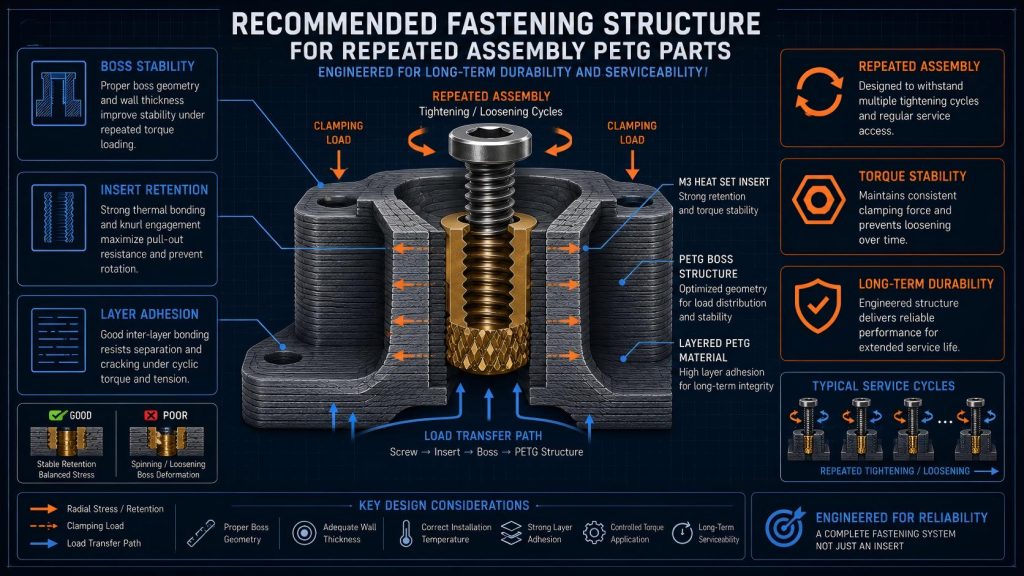
Recommended fastening structure for repeated assembly PETG parts should prioritize insert retention, boss stability, torque consistency, and long-term fastening durability.
In PETG parts that require repeated screw installation and maintenance access, fastening performance depends on more than insert selection alone.
A stable fastening structure must consider:
- insert geometry
- boss design
- pull-out resistance
- torque stability
- material creep behavior
- layer adhesion
- repeated loading conditions
Engineering reliability comes from treating the insert and surrounding structure as a complete fastening system.
Why PETG Requires a Different Fastening Strategy
Compared with PLA, PETG behaves differently under repeated assembly loading.
PETG is generally:
- more flexible
- more impact resistant
- more sensitive to deformation under sustained load
- more prone to creep over time
In repeated assembly, PETG’s tendency to creep under clamping load can gradually reduce screw preload, which is one reason threads may become loose even when the insert itself remains seated. This makes torque resistance a long-term service issue rather than only an installation result. As preload stability decreases, fastening consistency may gradually degrade during long-term service cycles. For more detail, see our troubleshooting guide on why threads become loose in heat set inserts.
This means fastening systems that appear stable during initial installation may gradually loosen after repeated maintenance cycles.
A fastening structure designed for PETG should prioritize long-term stability rather than maximum tightening force alone.
Recommended Insert Structure for PETG Repeated Assembly
For repeated assembly applications, stable insert performance usually benefits from:
- moderate knurl aggressiveness
- balanced outer diameter
- controlled installation temperature
- stable boss geometry
- sufficient surrounding wall thickness
Excessively aggressive insert geometries may overstress softer PETG structures during installation.
Stable load distribution is generally more important than maximum insertion force.
Related Guide:
Recommended M3 Heat Set Inserts for PETG
Recommended Fastening Structure for Repeated Assembly PETG Parts
Recommended fastening structure for repeated assembly PETG parts depends on balanced boss geometry, stable insert retention, controlled torque loading, and reliable PETG material behavior.
Recommended Boss Strategy
Boss geometry strongly affects repeated assembly durability.
Recommended PETG boss structures often include:
- balanced wall thickness
- gradual load transfer
- support near the insert base
- resistance to radial expansion
- stable layer orientation
Thin unsupported bosses may eventually weaken through repeated tightening cycles.
Related Guide:
M3 Heat Set Insert Boss Design for 3D Printed Parts
Pull-Out Stability in PETG Assemblies
Repeated assembly gradually increases stress around the insert retention area.
Repeated screw removal and re-tightening can create small axial loading events around the insert, so pull-out stability should be considered together with torque behavior in repeated-use PETG assemblies. Over multiple maintenance cycles, localized deformation around the insert cavity may gradually reduce retention strength and increase pull-out risk. See our guide on pull-out strength of heat set inserts in 3D printed parts.
Weak pull-out stability may eventually lead to:
- spinning inserts
- reduced retention force
- deformation near the boss opening
- loosening during service cycles
Pull-out resistance becomes especially important in:
- electronics enclosures
- battery covers
- robotics systems
- modular fixtures
Related Guide:
M3 Heat Set Insert Pull-Out Strength for 3D Printed Parts
Torque Behavior and Serviceability
Repeated tightening cycles introduce cyclic torque stress into the surrounding PETG structure.
Overtightening may gradually damage:
- boss geometry
- layer bonding
- insert alignment
- fastening consistency
Controlled torque behavior improves long-term serviceability and maintenance reliability.
Related Guide:
Heat Set Inserts for Repeated Assembly in 3D Printed Parts
Common PETG Repeated Assembly Failure Cases
Spinning Inserts
In PETG parts, insert spinning often appears after repeated torque cycles because the surrounding plastic can gradually lose anti-rotation support.
Often caused by weak retention geometry or oversized holes.
Boss Deformation
Repeated tightening may slowly deform unsupported PETG bosses over time.
Layer Separation
Cyclic loading may weaken interlayer bonding near the insert base.
Fastening Instability
Repeated service cycles may gradually reduce torque consistency and insert retention reliability.
A Fastening Structure Is More Important Than a Single Insert
Successful repeated assembly performance in PETG parts depends on the interaction between:
- insert geometry
- boss structure
- pull-out stability
- torque loading
- layer adhesion
- installation behavior
- material creep characteristics
Reliable fastening systems are designed as complete engineering structures rather than isolated insert installations.
Conclusion
Repeated assembly in PETG 3D printed parts requires fastening systems designed for long-term durability rather than short-term installation success.
Stable insert retention, balanced boss geometry, controlled torque behavior, and proper load distribution all contribute to long-term fastening reliability.
In functional engineering assemblies, fastening structure design is often more important than insert selection alone.
Related Engineering Guides
- How to Choose Heat Set Inserts for 3D Printed Parts
- Heat Set Insert Hole Size Guide
- How to Design Bosses for Heat Set Inserts
- PLA vs PETG vs ABS for Threaded Inserts
- Why Heat Set Inserts Fail in 3D Printed Parts
- Pull-Out Strength of Heat Set Inserts in 3D Printed Parts
- Torque Resistance of Heat Set Inserts in 3D Printed Parts
- Layer Adhesion and Heat Set Insert Strength in 3D Printed Parts
- Heat Set Insert Installation Temperature for 3D Printed Parts
- Screw Engagement Length for Heat Set Inserts in 3D Printed Parts
Related Decision Resources
For insert selection, tool choice, and supplier comparison, use these decision-focused references after the engineering requirements are defined.