
Introduction
Thread loosening is one of the most common long-term reliability problems in 3D printed fastening assemblies.
A heat set insert may initially feel secure and stable but gradually lose clamping force after repeated use, vibration, thermal cycling, or mechanical loading.
In many assemblies, the insert itself does not fail immediately.
Instead, the surrounding structure slowly loses its ability to maintain consistent thread engagement and clamp force over time.
Thread loosening is usually caused by the interaction between material creep, vibration, insufficient engagement length, weak boss support, repeated assembly cycles, and thermal expansion behavior.
Reliable fastening depends not only on initial installation quality but also on long-term structural stability.
Common Signs of Thread Loosening
Typical symptoms include:
- screws backing out over time
- reduced clamping force
- movement during vibration
- repeated need for retightening
- insert rotation after repeated use
- rattling assemblies
- unstable fastening after thermal cycling
In many cases, loosening develops gradually before becoming a complete structural failure.
Troubleshooting Overview
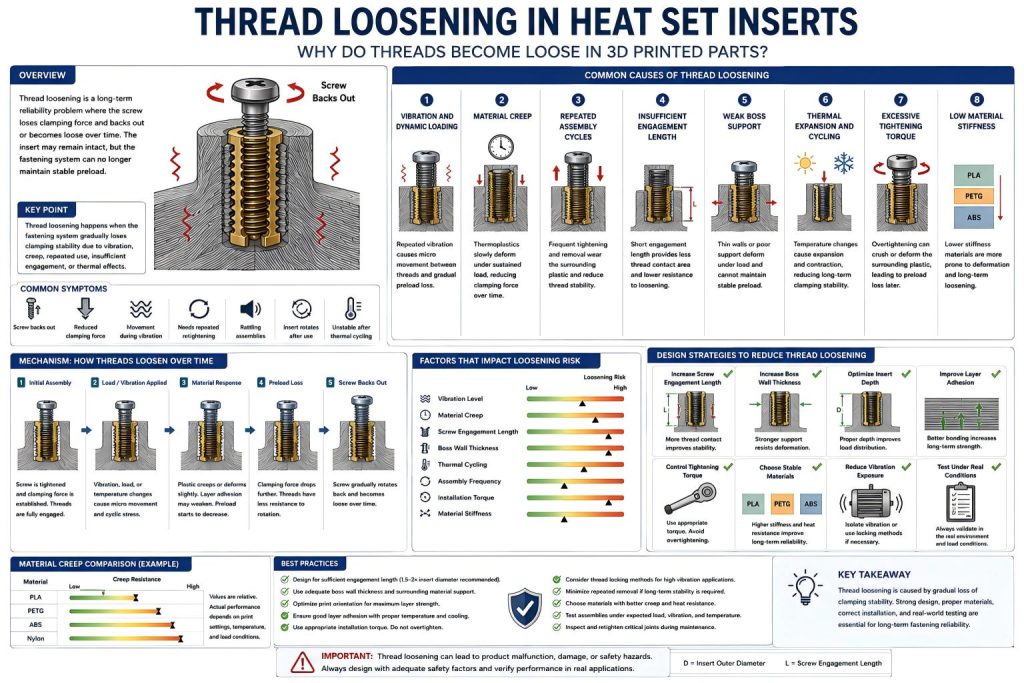
Why Threads Become Loose
Thread loosening happens when the fastening system can no longer maintain stable clamping force.
The insert, screw, boss, and surrounding printed material must work together as one mechanical system.
If any part of the structure gradually deforms or loses stiffness, the joint may loosen over time.
Common causes include:
- vibration
- material creep
- repeated tightening cycles
- insufficient screw engagement
- weak boss support
- thermal expansion
- poor layer adhesion
- excessive torque
- low material stiffness
Reliable fastening depends on maintaining stable force transfer through the entire structure.
1. Vibration and Dynamic Loading
Repeated vibration slowly reduces clamping stability.
Small movements between the screw, insert, and surrounding material gradually weaken thread retention.
Common Symptoms
- screws backing out during operation
- rattling assemblies
- gradual loss of preload
- loosening after transport or motion
Engineering Notes
Vibration affects printed plastic structures more than rigid metal assemblies because thermoplastics deform more easily under cyclic loading.
Applications involving robotics, motors, moving brackets, or portable equipment are especially vulnerable.
2. Material Creep
Thermoplastics slowly deform under sustained load.
This behavior is called creep.
Over time, the surrounding material relaxes and loses the compression needed to maintain stable thread engagement.
Common Creep Symptoms
- reduced clamp force
- loosening after weeks or months
- deformation near insert
- screw movement under constant load
Material Behavior
PLA
- stiff initially
- may creep under heat exposure
PETG
- more flexible
- greater long-term deformation risk
ABS
- better heat stability
- improved long-term dimensional stability
Material creep becomes more severe at elevated temperature.
3. Repeated Assembly Cycles
Repeated tightening and removal gradually wear the surrounding printed structure.
The insert itself may remain undamaged while the surrounding boss loses stiffness and dimensional accuracy.
Common Symptoms
- reduced screw resistance
- increasing insert movement
- loss of thread stability
- weakening retention after maintenance
Related Factors
- low wall thickness
- shallow insert depth
- soft surrounding material
- excessive tightening torque
Assemblies designed for frequent serviceability require stronger boss structures and improved surrounding support.
4. Insufficient Screw Engagement Length
Short engagement length reduces the available thread contact area.
Insufficient thread contact lowers clamp force stability and increases loosening risk.
Common Symptoms
- weak screw retention
- unstable preload
- fast loosening under vibration
- reduced torque consistency
Engineering Principle
Longer engagement generally improves thread stability by increasing load distribution across more thread surfaces.
5. Weak Boss Support
Boss geometry strongly affects long-term fastening reliability.
Weak surrounding structures deform under repeated load cycles and gradually reduce thread stability.
Signs of Weak Boss Design
- wall deformation
- insert movement
- cracking near insert
- reduced clamping stability
Common Causes
- thin boss walls
- shallow geometry
- insufficient surrounding material
- unsupported outer edges
Reliable fastening requires sufficient surrounding structural support.
6. Thermal Expansion and Cycling
Temperature changes create expansion and contraction inside the fastening structure.
Repeated thermal cycling may slowly weaken clamping stability.
Common Thermal Effects
- preload loss
- insert movement
- gradual loosening
- dimensional variation
Common Causes
- heat exposure
- repeated cooling cycles
- high installation temperature
- mismatch between metal and plastic expansion behavior
Thermal cycling becomes more severe in assemblies exposed to outdoor environments, motors, electronics, or heated enclosures.
7. Excessive Tightening Torque
Excessive tightening force can permanently deform the surrounding printed structure.
Over time, the material may relax and lose clamping stability.
Common Symptoms
- boss deformation
- insert movement
- thread instability
- material compression damage
Engineering Notes
More torque does not always improve fastening reliability.
Overtightening often reduces long-term structural stability in printed thermoplastics.
Thread Loosening Is a System-Level Problem
Thread loosening is rarely caused by the insert alone.
Reliable fastening depends on the interaction between:
- screw engagement
- insert geometry
- boss support
- material stiffness
- creep behavior
- vibration loading
- thermal cycling
- installation quality
The entire fastening structure must resist gradual relaxation over time.
How to Reduce Thread Loosening
Practical engineering improvements include:
- increase screw engagement length
- improve boss wall thickness
- optimize insert depth
- improve layer adhesion
- reduce excessive torque
- improve print orientation
- select more stable materials
- reduce vibration exposure
- control installation temperature
- test assemblies under real operating conditions
Reliable fastening requires long-term structural stability rather than high initial tightening force alone.
Related Engineering Factors
Important related engineering factors include:
- screw engagement length
- boss wall thickness
- insert depth
- layer adhesion
- vibration loading
- thermal expansion
- material creep
- installation temperature
- print orientation
- surrounding material stiffness
FAQ
Why do threads become loose in heat set inserts?
Thread loosening usually happens because the surrounding printed structure gradually loses clamping stability under vibration, creep, thermal cycling, or repeated assembly.
Does vibration cause thread loosening?
Yes. Repeated vibration slowly reduces preload and weakens thread stability over time.
Does PLA loosen over time?
PLA may maintain strong initial stiffness but can slowly deform under heat or sustained load conditions.
Does screw engagement length matter?
Yes. Longer thread engagement generally improves load distribution and long-term fastening stability.
Can excessive torque cause loosening later?
Yes. Excessive tightening may permanently deform the surrounding plastic and reduce long-term clamp force stability.
Conclusion
Thread loosening in heat set inserts is primarily a long-term mechanical stability problem rather than an immediate installation problem.
Reliable fastening requires balanced screw engagement, strong boss geometry, stable material behavior, controlled installation force, and resistance to vibration and thermal cycling.
Well-designed fastening structures maintain consistent load transfer over repeated use instead of gradually losing clamping force.
Related Engineering Guides
- How to Choose Heat Set Inserts for 3D Printed Parts
- Heat Set Insert Hole Size Guide
- How to Design Bosses for Heat Set Inserts
- PLA vs PETG vs ABS for Threaded Inserts
- Why Heat Set Inserts Fail in 3D Printed Parts
- Pull-Out Strength of Heat Set Inserts in 3D Printed Parts
- Torque Resistance of Heat Set Inserts in 3D Printed Parts
- Layer Adhesion and Heat Set Insert Strength in 3D Printed Parts
- Heat Set Insert Installation Temperature for 3D Printed Parts
- Screw Engagement Length for Heat Set Inserts in 3D Printed Parts