
Layer adhesion heat set insert strength is one of the most important hidden factors in reliable 3D printed fastening.
A heat set insert may look properly installed, the hole size may be correct, and the boss may appear thick enough. But if the printed layers around the insert are weak, the joint can still fail under pull-out force, torque, vibration, or repeated assembly.
Engineering Definition
Layer adhesion is the bonding strength between adjacent printed layers in a 3D printed structure.
For heat set insert assemblies, layer adhesion affects how mechanical loads are transferred through the surrounding plastic during pull-out loading, torque loading, vibration, and repeated assembly cycles.
In 3D printed parts, insert strength is not only determined by the metal insert. It is also determined by how well the surrounding printed layers act as one structure.
A heat set insert transfers load into the plastic around it. That plastic is not a uniform block. It is made of deposited lines, perimeters, infill, and layer bonds.
If those layers separate, the insert loses support.
For functional parts, layer adhesion should be treated as part of the fastening design.
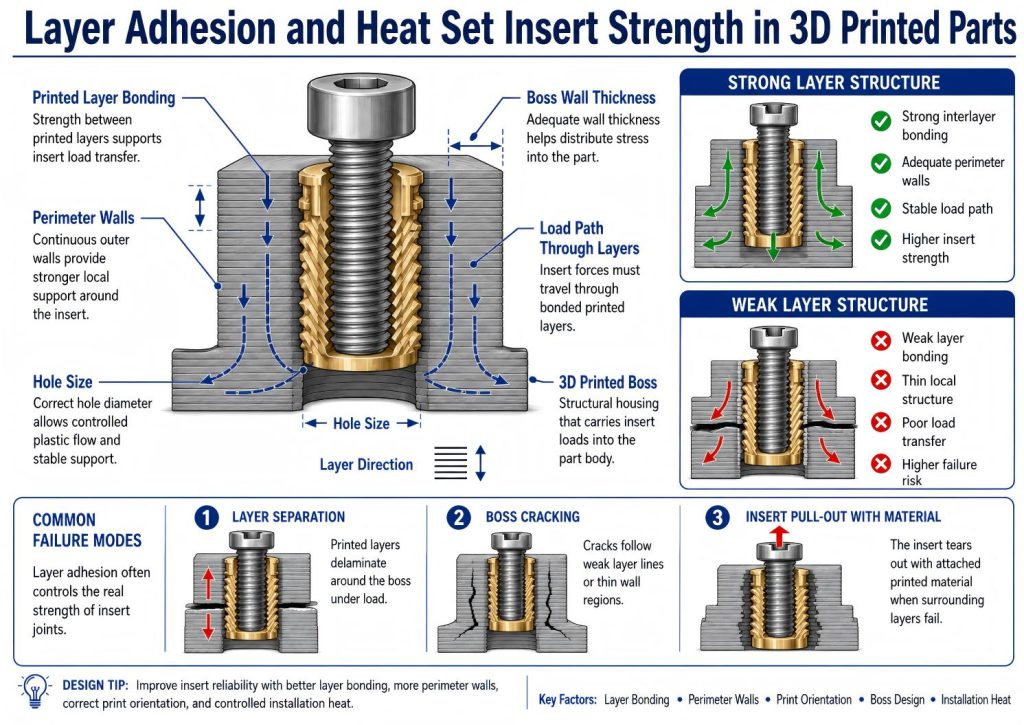
Why Layer Adhesion Matters for Heat Set Inserts
Heat set inserts create strong internal threads in plastic parts. But the insert itself does not carry the load alone.
When a screw is tightened or pulled, the insert transfers force into the printed boss. The boss then transfers that force into the larger printed part.
This load path depends on layer adhesion.
If the printed layers are well bonded, the boss behaves more like a solid structure. The insert can transfer load through the boss wall and into the surrounding part.
If the layers are poorly bonded, the boss may split, delaminate, or tear along layer lines.
This is why two parts with the same insert, same hole size, and same boss geometry can perform very differently. The difference may be in the quality of the layer bonding.
How Heat Set Inserts Load the Printed Layers
A heat set insert applies several types of stress to the printed structure.
During installation, the heated insert softens the surrounding plastic. The material flows around the insert knurls and then cools into a mechanical lock.
During screw tightening, the insert transfers torque into the boss wall.
During pull-out loading, the insert transfers axial force into the surrounding plastic.
During repeated assembly, the insert area experiences small cycles of stress, compression, and relaxation.
All of these forces pass through the printed layers.
If the layer bonds are weak, the load may not spread through the structure. Instead, stress concentrates at the layer lines around the insert.
This can lead to early failure even when the insert appears correctly installed.
Common Layer-Related Insert Failures
1. Layer Separation Around the Boss
This happens when the boss splits along horizontal layer lines.
The insert may remain inside the boss, but the printed structure around it separates.
This failure often appears under pull-out force, especially when the screw load acts across the Z direction of the print.
Possible causes include:
- weak interlayer bonding
- low nozzle temperature
- poor material fusion
- high layer height
- insufficient wall count
- poor print orientation
- excessive pull-out load
This type of failure is not only an insert problem. It is a printed structure problem.
2. Boss Cracking Along Layer Lines
Boss cracking can happen when torque or installation pressure creates stress that the printed layers cannot absorb.
A crack may start near the insert and travel along the layer structure.
This is common when:
- the boss wall is too thin
- the hole is too small
- the material is brittle
- the insert is overheated or forced in
- layer adhesion is weak
If the crack follows the layer pattern, the failure is strongly related to print structure.
3. Insert Pull-Out with Printed Material Attached
Sometimes the insert does not pull out cleanly. Instead, it tears out a plug or shell of printed material.
This can happen when the insert grips the local plastic well, but the surrounding layers cannot hold together.
In this case, the insert-plastic interface may be stronger than the layer adhesion of the printed boss.
The failure happens outside the insert surface, inside the printed structure.
4. Insert Loosening After Repeated Assembly
Poor layer adhesion may not cause immediate failure.
A joint can look stable after installation and first tightening, but loosen after repeated screw cycles.
Each tightening cycle transfers small stresses into the printed boss. If the layer bonds are weak, those stresses can slowly grow into cracks or delamination.
This is especially important for enclosures, robotics, fixtures, brackets, and serviceable parts that are opened and closed many times.
Layer Adhesion Relationships
| Engineering Factor | Effect on Insert Strength |
|---|---|
| Print orientation | Changes load transfer across printed layers |
| Interlayer bonding | Affects resistance to pull-out and cracking |
| Nozzle temperature | Influences layer fusion quality |
| Cooling behavior | Can weaken bonding between layers |
| Perimeter wall count | Improves surrounding structural support |
| Layer separation | Reduces long-term fastening reliability |
| Repeated loading cycles | Can accelerate structural fatigue in weak layer regions |
Layer adhesion affects how mechanical loads are distributed through the printed structure surrounding the insert, especially under repeated stress and rotational loading conditions.
Print Orientation and Layer Adhesion
Print orientation strongly affects insert strength.
The same boss can behave differently depending on how it is printed.
If the insert load pulls across weak layer lines, the part may fail earlier.
If the load is transferred through continuous perimeters and stronger printed paths, the insert joint can perform better.
For example, a vertically printed boss may have circular perimeter walls around the insert, but pull-out force may still act against layer bonding. A horizontally printed feature may shift the weak direction, but it may introduce other geometric or support issues.
There is no universal best orientation for every insert design.
The correct orientation depends on:
- expected pull-out direction
- screw tightening direction
- boss geometry
- part shape
- layer path around the insert
- required strength direction
- support and surface quality constraints
For functional parts, print orientation should be chosen based on load path, not only print convenience.
Perimeters Matter More Than Infill Around Inserts
For heat set inserts, local wall structure is usually more important than overall infill percentage.
A boss with strong continuous perimeters around the insert can resist load better than a boss with high infill but weak outer walls.
The insert primarily transfers load into nearby material. If the nearby material is mostly thin walls and sparse infill, the joint may fail early.
Increasing the number of perimeters around the boss helps create a stronger local shell.
Useful strategies include:
- increasing wall count
- using local reinforcement around bosses
- designing thicker boss walls
- avoiding inserts in thin unsupported walls
- using solid or near-solid regions around insert features
- adding fillets at the boss base
The goal is to give the insert a strong printed structure to push against.
Nozzle Temperature and Layer Bonding
Nozzle temperature affects how well each layer bonds to the previous one.
If the nozzle temperature is too low, the filament may not fuse properly with the layer below. The part may look acceptable, but the layer adhesion may be weak.
This can reduce heat set insert strength, especially under pull-out and torque loads.
A slightly higher temperature can improve layer bonding for many materials, but excessive temperature can also create problems such as poor dimensional accuracy, stringing, material degradation, or over-softened features.
For insert-bearing parts, the print settings should balance:
- layer bonding
- dimensional accuracy
- hole precision
- boss shape stability
- material behavior
- surface quality
Strong insert joints require both accurate geometry and strong layer fusion.
Layer Height and Insert Strength
Layer height can affect insert performance because it changes how many layer interfaces exist around the boss.
Thicker layers may reduce print time, but they can also change bonding quality and stress distribution.
Smaller layer heights can sometimes create more uniform geometry around small insert features, especially for M2, M2.5, and M3 inserts.
However, layer height alone does not guarantee strength. It must work together with nozzle temperature, extrusion quality, wall count, material choice, and print orientation.
For critical insert joints, test parts should be printed with the same layer height planned for the final part.
Material Choice and Layer Adhesion
Different materials have different layer bonding behavior.
PLA is easy to print and dimensionally stable, but it can be brittle and may fail by cracking along the boss or layer structure.
PETG often provides better toughness and layer adhesion, but it may deform or creep under long-term load.
ABS can perform well in functional parts, especially where heat resistance matters, but it requires controlled printing conditions to avoid warping and weak bonding.
Nylon can provide strong and tough insert joints, but it is sensitive to moisture, print temperature, and dimensional control.
The best material for insert strength is not always the stiffest material. It is the material that creates a stable combination of layer bonding, toughness, heat resistance, and dimensional control.
Installation Heat and Layer Damage
Heat set insert installation also affects the printed layers.
If the insert is installed too cold, the plastic may not flow into the knurls. This creates weak mechanical locking.
If the insert is installed too hot, the surrounding plastic can over-soften. The boss may deform, the hole may enlarge, and the nearby layers may lose structure.
Overheating can weaken the same layers that are supposed to support the insert.
A good installation process should soften the plastic only enough to flow around the insert geometry.
The insert should enter slowly and vertically. The boss should not collapse, bulge excessively, or split during insertion.
After installation, the part should be allowed to cool before screw tightening.
How to Improve Layer Adhesion Around Inserts
Layer adhesion cannot be fixed by the insert alone. It must be addressed through printing and design.
Practical improvements include:
- print insert-bearing parts with appropriate nozzle temperature
- avoid under-extrusion around bosses
- increase perimeter count around insert locations
- choose print orientation based on load direction
- use sufficient boss wall thickness
- add fillets where bosses meet the main part
- avoid placing inserts in thin vertical walls
- use materials with stable layer bonding
- control cooling settings for better interlayer fusion
- avoid excessive installation temperature
- test functional joints in the final print orientation
The key is to make the boss behave like a unified structure, not a stack of weak planes.
Layer Adhesion Is Part of the Fastening System
A heat set insert creates metal threads, but the printed layers decide how well those threads are supported.
The insert may be strong.
The screw may be strong.
The boss may look large enough.
But if the layers separate, the joint fails.
This is why heat set insert design should not stop at hole size or insert selection.
Reliable threaded connections in 3D printed parts require a complete fastening system:
- insert geometry
- hole size
- boss design
- material behavior
- layer adhesion
- print orientation
- installation control
- screw loading
Layer adhesion is the invisible structure behind visible insert strength.
For functional 3D printed parts, the important question is not only:
Will the insert fit?
The better question is:
Can the printed layers around the insert carry the load together?
That is where reliable fastening design begins.
Related Engineering Factors
Layer adhesion plays a critical role in how mechanical loads are transferred through 3D printed parts containing heat set inserts.
Important related engineering factors include:
- interlayer bonding strength
- print orientation
- perimeter and wall count
- stress distribution around the insert
- pull-out force transfer
- torque resistance
- thermal bonding during printing
- nozzle temperature
- cooling behavior
- layer separation under repeated loading
Weak layer adhesion can significantly reduce insert retention strength, especially under rotational loads, repeated assembly cycles, or long-term mechanical stress.
Related engineering guides:
- How to Choose Heat Set Inserts for 3D Printed Parts
- How to Design Bosses for Heat Set Inserts
- Pull-Out Strength of Heat Set Inserts in 3D Printed Parts
- Torque Resistance of Heat Set Inserts in 3D Printed Parts
- PLA vs PETG vs ABS for Threaded Inserts
- Why Heat Set Inserts Fail in 3D Printed Parts
- Heat Set Insert Installation Temperature for 3D Printed Parts
FAQ
Why does layer adhesion affect heat set insert strength?
Layer adhesion affects heat set insert strength because the insert transfers pull-out and torque loads into the printed boss. If the printed layers are weak, the boss may split, delaminate, or crack even when the insert and hole size are correct.
Can a heat set insert fail because of poor layer bonding?
Yes. A heat set insert can fail when the surrounding printed layers separate under load. In this case, the insert may remain locked into local plastic, but the boss or surrounding printed structure fails along weak layer lines.
Does print orientation affect heat set insert performance?
Yes. Print orientation affects how pull-out and torque loads travel through the printed layers. If the insert load acts across weak layer adhesion, the joint may fail earlier. Orientation should be chosen based on load path, not only print convenience.
Are more perimeters better for heat set insert bosses?
More perimeters around insert bosses usually improve strength because the insert transfers load into nearby wall structure. Strong continuous perimeters often matter more than high overall infill percentage for insert performance.
How can I improve layer adhesion around heat set inserts?
Layer adhesion around heat set inserts can be improved by using suitable nozzle temperature, avoiding under-extrusion, increasing wall count, choosing a better print orientation, using adequate boss wall thickness, controlling cooling, and avoiding excessive installation heat.
Related Engineering Guides
- Ngineering Guides for 3D Printed Fastening
- 3D Printing Fastening FAQ
- 3D Printed Fastening Applications
- How to Choose Heat Set Inserts for 3D Printed Parts
- Heat Set Insert Hole Size Guide
- How to Design Bosses for Heat Set Inserts
- PLA vs PETG vs ABS for Threaded Inserts
- Why Heat Set Inserts Fail in 3D Printed Parts
- Pull-Out Strength of Heat Set Inserts in 3D Printed Parts
- Torque Resistance of Heat Set Inserts in 3D Printed Parts
- Heat Set Insert Installation Temperature for 3D Printed Parts
- Screw Engagement Length for Heat Set Inserts in 3D Printed Parts