
Introduction
PLA vs PETG vs ABS for threaded inserts is one of the most important engineering considerations in 3D printed fastening design. The same threaded insert design does not behave the same in PLA, PETG, and ABS.
A heat set insert may install cleanly in one material, feel loose in another, and crack the boss in a third. This happens because threaded insert performance depends not only on the metal insert, but also on how the printed plastic softens, flows, grips, cools, and supports the load after installation.
For 3D printed parts, material choice affects hole tolerance, boss design, installation temperature, insert retention, pull-out strength, torque resistance, and repeated assembly reliability.
PLA, PETG, and ABS are all commonly used for printed parts with heat set inserts, but they behave differently around fastening features. A design that works well in PLA should not be copied blindly into PETG or ABS without testing.
This guide compares PLA, PETG, and ABS for threaded inserts in 3D printed parts, with a focus on practical fastening behavior rather than only material labels.
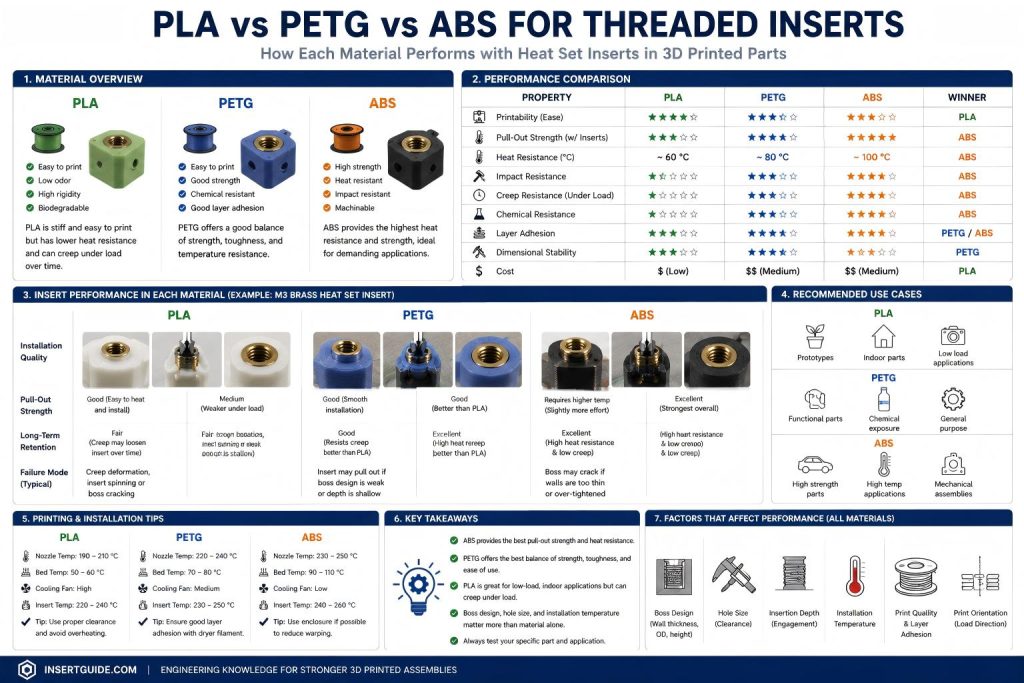
Why Material Choice Matters for Threaded Inserts
A threaded insert is only one part of the fastening system.
The complete joint includes:
- the metal insert
- the printed hole
- the surrounding boss
- the plastic material
- the screw
- the installation temperature
- the direction of the load
- the number of assembly cycles
When a heat set insert is installed, the plastic around the insert softens and moves around the knurls or outer geometry. After cooling, that plastic helps hold the insert in place.
This means the material must do two things at the same time:
- Soften enough during installation to allow the insert to seat properly.
- Stay strong enough after cooling to resist screw torque, pull-out force, and repeated use.
PLA, PETG, and ABS each balance these differently.
PLA is stiff and easy to print, but it softens quickly under heat. PETG is tougher and more flexible, but it can flow and deform more during installation. ABS is more heat tolerant, but print quality and layer adhesion strongly affect insert performance.
So the question is not simply:
“Which material is strongest?”
The better question is:
“Which material gives the best combination of print quality, boss support, heat behavior, and assembly reliability for this specific part?”
Direct Answer: Which Material Works Best?
There is no single best material for all threaded insert applications.
PLA can work well for low-heat, low-to-medium load parts when the boss is well designed and installation heat is controlled.
PETG can work well when toughness and impact resistance matter, but the boss and hole must account for greater plastic flow and flexibility.
ABS is often better for parts exposed to heat or repeated use, but it requires good printing conditions, strong layer bonding, and controlled installation.
A practical comparison:
- PLA: easiest to print, stiff, but heat sensitive.
- PETG: tougher and less brittle, but can deform or flow around inserts.
- ABS: more heat tolerant, but depends heavily on print quality and layer adhesion.
For reliable threaded insert performance, material choice should always be considered together with hole size, boss wall thickness, insert depth, and expected load.
PLA with Threaded Inserts
PLA is one of the most common materials used with heat set inserts because it is easy to print and dimensionally stable in many desktop 3D printers.
Its stiffness can help support an insert under light or moderate screw loads. PLA often produces clean holes and consistent dimensions, which can make insert installation predictable.
However, PLA softens at relatively low temperatures compared with ABS. This makes installation easier, but it also increases the risk of overheating the boss.
Common PLA behavior around threaded inserts:
- softens quickly during installation
- may deform if the insert is overheated
- can crack if the boss wall is too thin
- holds inserts well in low-temperature applications
- may lose strength if exposed to heat after assembly
PLA is usually suitable for:
- electronics enclosures used at room temperature
- light brackets
- covers
- prototypes
- low-load assemblies
- parts that are not exposed to heat or vibration
PLA is less suitable for:
- parts near motors or hot components
- outdoor or high-temperature use
- high-torque fastening
- thin boss structures
- assemblies that need frequent disassembly under load
For PLA, installation control matters. Too much heat or pressure can soften the boss beyond the insert area, causing bulging, tilt, or weak retention.
A PLA boss should not be too thin. The surrounding plastic must have enough volume to support the insert after cooling.
PETG with Threaded Inserts
PETG behaves differently from PLA. It is generally tougher and less brittle, which can help reduce cracking. However, PETG is also more flexible and can show more plastic flow during heat set insert installation.
This can be helpful when the insert needs to seat smoothly, but it can also create problems if the hole is too tight, the insert is overheated, or the boss is unsupported.
Common PETG behavior around threaded inserts:
- tougher than PLA
- less likely to crack suddenly
- may deform more under pressure
- can produce more plastic flow during installation
- may allow insert movement if the boss is too flexible
PETG is usually suitable for:
- functional prototypes
- brackets
- tool holders
- fixtures
- parts needing more impact resistance
- assemblies that may see mild flexing or handling
PETG is less ideal when:
- the boss is very thin
- high screw torque is required
- insert alignment must be extremely rigid
- the part sees sustained load or creep
- installation heat is poorly controlled
PETG bosses may need more surrounding support than expected. Because PETG can flex, a boss that looks strong in CAD may still allow small insert movement under torque.
For PETG, the goal is not only to avoid cracking. The goal is to prevent the insert from rotating, tilting, or loosening over repeated assembly cycles.
ABS with Threaded Inserts
ABS is often a strong candidate for heat set inserts because it handles heat better than PLA and can support functional assemblies when printed well.
During insert installation, ABS usually tolerates heat better and may allow a more controlled seating process. This makes it useful for parts that may experience higher temperatures or repeated use.
However, ABS is more demanding to print. Warping, poor layer adhesion, and inconsistent dimensions can reduce insert performance.
Common ABS behavior around threaded inserts:
- better heat tolerance than PLA
- suitable for more functional assemblies
- can support repeated use when printed well
- may fail if layer adhesion is weak
- requires controlled printing conditions
ABS is usually suitable for:
- functional mechanical parts
- enclosures near warm electronics
- assemblies with repeated screw use
- small batch printed components
- parts requiring better heat resistance than PLA
ABS is less suitable when:
- print quality is poor
- layer bonding is weak
- the part warps around boss features
- the printer cannot control ABS shrinkage
- dimensional accuracy is inconsistent
For ABS, the material itself is not enough. The printed structure must be strong and consistent. A poorly printed ABS boss can fail faster than a well-printed PLA or PETG boss.
ABS works best when boss geometry, hole sizing, and print settings are controlled together.
PLA vs PETG vs ABS Comparison
| Material | Main Advantage | Main Risk | Insert Behavior |
|---|---|---|---|
| PLA | Stiff, easy to print, dimensionally stable | Heat sensitivity and cracking | Can hold inserts well in low-heat, low-to-medium load parts |
| PETG | Tough, impact resistant, less brittle | Plastic flow, flexibility, possible deformation | Can work well with good boss support and controlled torque |
| ABS | Better heat tolerance, functional use | Printing difficulty, shrinkage, layer adhesion issues | Often strong for inserts when printed well |
This table should not be treated as a universal comparison order.
A good PLA design can outperform a poor ABS design. A well-supported PETG boss can work better than a thin ABS boss. Material choice only works when the surrounding fastening structure is designed correctly.
Material Behavior Comparison
| Material | Heat Resistance | Creep Resistance | Torque Stability | Installation Behavior |
|---|---|---|---|---|
| PLA | Low | Poor over time | High initially but brittle | Easy installation but sensitive to overheating |
| PETG | Medium | Moderate | Flexible but may loosen under repeated load | Softer during installation |
| ABS | High | Good | Stable under heat and repeated tightening | More temperature tolerant |
Material behavior can significantly affect insert retention, torque resistance, thermal stability, and long-term fastening reliability in 3D printed assemblies.
Design Considerations Across Materials
Hole Size
Hole size should not be copied blindly between PLA, PETG, and ABS.
Printed holes can vary because of shrinkage, extrusion behavior, slicer settings, and material flow. Even if the CAD hole is the same, the printed hole may not be.
PLA often prints cleaner and more dimensionally stable holes.
PETG may produce more stringing or surface irregularity inside holes.
ABS may shrink or warp depending on print conditions.
For critical insert joints, print a test coupon before finalizing the hole size.
Boss Wall Thickness
Boss wall thickness becomes more important as material behavior becomes less predictable.
PLA needs enough wall thickness to resist cracking.
PETG needs enough wall thickness and support to resist deformation and insert movement.
ABS needs enough surrounding structure and strong layer bonding to resist torque and pull-out loads.
A correct hole size cannot compensate for a weak boss wall.
Installation Temperature
Each material responds differently to heat.
PLA softens quickly, so too much heat can deform the boss.
PETG needs careful control because excess heat and pressure can create unwanted plastic flow.
ABS usually tolerates heat better, but overheating can still damage the printed structure or weaken the surrounding plastic.
The installation tool should be hot enough to seat the insert, but not so hot that it destroys the boss geometry.
Pull-Out Strength
Pull-out strength depends on insert depth, boss geometry, material strength, layer adhesion, and load direction.
PLA may perform well in stiff, low-temperature parts but can lose strength under heat.
PETG may absorb impact better, but flexibility can reduce retention if the boss is weak.
ABS can offer better heat resistance, but only if the print has strong layer bonding.
Pull-out behavior should be tested for functional assemblies.
Torque Resistance
Torque resistance depends on how well the plastic grips the insert geometry.
If the plastic does not flow into the knurls properly, the insert may spin. If the boss wall is too weak, the insert may rotate under tightening force.
PLA can grip well when installed carefully, but cracking is a risk.
PETG may resist cracking, but boss flexibility can reduce torque stability.
ABS can perform well, but weak layer adhesion or poor print quality can reduce torque resistance.
Common Failure Patterns
PLA Boss Deforms During Installation
This usually happens when the insert is overheated, the installation pressure is too high, or the boss wall is too thin. The insert may seat below the surface, tilt, or create visible bulging.
PETG Insert Spins Under Torque
This can happen when PETG flows too much during installation or when the boss is too flexible to resist screw tightening. The insert may look installed correctly but rotate when the screw is tightened.
ABS Insert Pulls Out Because of Weak Layers
ABS can work well with heat set inserts, but poor layer adhesion can cause the boss to split or the insert to pull out under load. In this case, the problem is not only the material, but the print quality.
Same Hole Size Fails Across Materials
A hole size that works well in PLA may be too tight, too loose, or behave differently in PETG or ABS. Insert testing should be done with the actual material and print settings.
Engineering Notes
- PLA, PETG, and ABS do not behave the same around threaded inserts.
- A threaded insert joint depends on both the metal insert and the surrounding printed plastic.
- PLA is stiff and predictable, but heat sensitive.
- PETG is tough and less brittle, but can deform or allow insert movement if the boss is weak.
- ABS handles heat better, but print quality and layer adhesion are critical.
- Hole size should be tested in the actual material.
- Boss wall thickness and insert depth matter as much as material choice.
- A correct insert size cannot fix weak geometry.
- Repeated assembly, torque load, and pull-out force should be considered before choosing a material.
- Material comparison should always be connected to real assembly use.
Related Engineering Factors
Material behavior plays a major role in the long-term performance of heat set inserts in 3D printed parts.
Important related engineering factors include:
- material heat resistance
- thermal softening behavior
- long-term creep deformation
- layer adhesion strength
- insert retention stability
- boss cracking resistance
- pull-out strength
- torque resistance
- installation temperature
- print orientation and cooling behavior
Different plastics respond differently to heat, pressure, and repeated assembly loads, which can significantly affect insert reliability over time.
Related engineering guides:
- How to Choose Heat Set Inserts for 3D Printed Parts
- Heat Set Insert Hole Size Guide
- How to Design Bosses for Heat Set Inserts
- Pull-Out Strength of Heat Set Inserts in 3D Printed Parts
- Torque Resistance of Heat Set Inserts in 3D Printed Parts
- Heat Set Insert Installation Temperature for 3D Printed Parts
FAQ
Is PLA good for heat set inserts?
PLA can work well for heat set inserts in low-temperature, low-to-medium load parts. However, it softens quickly, so installation heat and boss design must be controlled.
Is PETG better than PLA for threaded inserts?
PETG is tougher and less brittle than PLA, but it can flex and flow more around the insert. It may be better for impact resistance, but it still needs good boss support.
Is ABS better for heat set inserts?
ABS often performs well with heat set inserts because it has better heat tolerance than PLA. However, ABS must be printed well, with good layer adhesion and stable dimensions.
Can I use the same insert hole size for PLA, PETG, and ABS?
Not always. The same CAD hole may print differently in each material. Hole size should be tested with the actual material, printer, and insert.
Which material gives the best pull-out strength?
Pull-out strength depends on material, insert depth, boss design, layer direction, and print quality. ABS may perform well when printed properly, but a well-designed PLA or PETG part may outperform a poorly printed ABS part.
Why do inserts spin in PETG?
Inserts may spin in PETG if the hole is too large, the boss is too flexible, or the plastic does not grip the insert geometry strongly enough after cooling.
Why do PLA bosses crack around inserts?
PLA bosses may crack when the wall is too thin, the hole is too small, the insert is forced in, or the material becomes stressed during installation.
Should I test threaded inserts in each material?
Yes. If the part is functional or load-bearing, insert fit, torque resistance, pull-out behavior, and repeated assembly should be tested in the actual printed material.
Conclusion
PLA, PETG, and ABS can all be used with threaded inserts, but they do not behave the same.
PLA is stiff and easy to print, but sensitive to heat. PETG is tougher and less brittle, but more flexible and prone to plastic flow. ABS has better heat tolerance, but requires strong print quality and layer bonding.
For reliable 3D printed fastening, material choice must be connected to boss design, hole size, insert geometry, installation temperature, and real assembly load.
Do not choose a material only by name. Choose it by how the complete fastening structure behaves.
For general insert selection, see our guide on how to choose heat set inserts for 3D printed parts.
For hole diameter and fit behavior, see the heat set insert hole size guide.
For structural support around inserts, see our guide on how to design bosses for heat set inserts.
For more common engineering questions, see the 3D Printing Fastening FAQ.
Related Engineering Guides
- Ngineering Guides for 3D Printed Fastening
- 3D Printing Fastening FAQ
- 3D Printed Fastening Applications
- How to Choose Heat Set Inserts for 3D Printed Parts
- Heat Set Insert Hole Size Guide
- How to Design Bosses for Heat Set Inserts
- Why Heat Set Inserts Fail in 3D Printed Parts
- Pull-Out Strength of Heat Set Inserts in 3D Printed Parts
- Torque Resistance of Heat Set Inserts in 3D Printed Parts
- Layer Adhesion and Heat Set Insert Strength in 3D Printed Parts
- Heat Set Insert Installation Temperature for 3D Printed Parts
- Screw Engagement Length for Heat Set Inserts in 3D Printed Parts
Related Decision Resources
For insert selection, tool choice, and supplier comparison, use these decision-focused references after the engineering requirements are defined.