
Pull-out strength heat set inserts design is one of the most important factors in reliable 3D printed fastening.
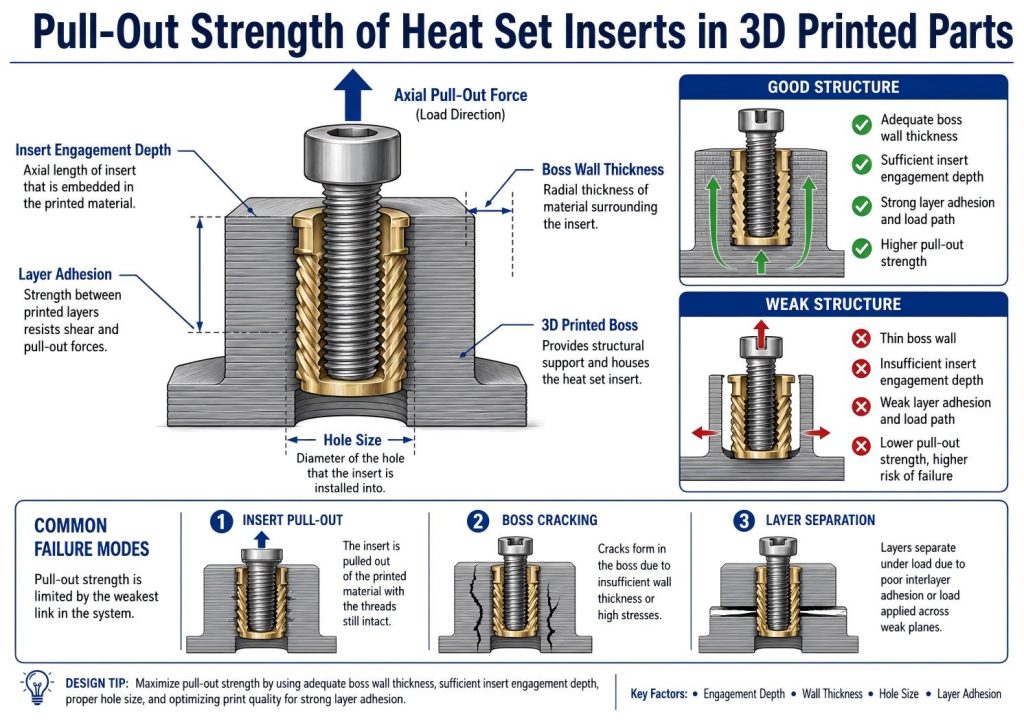
A heat set insert does not only need to stay in place during installation. It must also resist the axial force that tries to pull the screw and insert out of the printed boss during assembly, service, vibration, or repeated tightening.
Engineering Definition
Pull-out strength is the resistance of a heat set insert against axial extraction forces that attempt to remove the insert from the surrounding printed structure.
In 3D printed parts, pull-out strength depends on the interaction between insert geometry, surrounding plastic volume, layer adhesion, material behavior, and installation conditions.
Many insert failures are not caused by the insert itself. They happen because the surrounding printed plastic cannot support the load.
In 3D printed parts, pull-out strength is controlled by a system of factors:
- insert geometry
- hole size
- boss wall thickness
- insertion depth
- material type
- print orientation
- layer adhesion
- installation temperature
- screw engagement length
A stronger insert does not automatically create a stronger joint. The insert, boss, and printed material must work together as one load-bearing structure.
What Pull-Out Strength Means
Pull-out strength describes the resistance of an insert against axial force.
In simple terms, it answers one question:
How much force can the insert resist before it is pulled out of the printed part?
This force acts along the screw axis. It is different from torque resistance, which measures how well the insert resists spinning during tightening.
A heat set insert may have good torque resistance but poor pull-out strength if the boss is too shallow, too thin, or poorly bonded between layers.
Pull-out failure usually appears as:
- the insert being pulled out with the screw
- the boss splitting open
- printed layers separating around the insert
- plastic tearing around the knurled surface
- the insert loosening after repeated assembly
For functional 3D printed parts, pull-out strength often matters more than the insert’s nominal size.
Why Pull-Out Strength Is Different in 3D Printed Parts
In injection molded plastic, the material around an insert is usually more uniform.
In 3D printed parts, the structure is different.
The part is built layer by layer. This means the insert is not held by a solid block of plastic in the same way. It is held by:
- printed perimeters
- infill structure
- layer bonding
- local wall thickness
- melted and reformed plastic around the insert
Because of this, pull-out strength depends heavily on how the boss is printed.
A boss that looks strong from the outside may still fail if the insert load is carried by weak layer adhesion or thin outer walls.
This is why heat set insert design in 3D printing should not copy injection molding rules directly. The printed structure must be considered.
Main Factors That Affect Pull-Out Strength
1. Insert Length
Longer inserts usually provide better pull-out strength because they create more contact area with the plastic.
A deeper insert gives the knurled surface more material to grip.
However, a longer insert only helps if the boss is deep enough and the surrounding plastic is strong enough. If the boss bottom is too close to the insert, the heat may soften the end of the boss or create a weak internal zone.
A good design leaves enough plastic below the insert to support the load.
Pull-Out Strength Relationships
| Engineering Factor | Effect on Pull-Out Strength |
|---|---|
| Boss wall thickness | Improves structural support and crack resistance |
| Insert depth | Increases engagement area and load transfer |
| Layer adhesion | Affects resistance to extraction forces |
| Material stiffness | Influences long-term retention stability |
| Hole tolerance | Controls interference fit and insert grip |
| Print orientation | Changes load distribution through printed layers |
| Surrounding plastic volume | Reduces localized stress concentration |
Pull-out performance depends on how mechanical loads are distributed through the insert, surrounding plastic structure, and printed layer geometry.
2. Hole Size
Hole size is one of the most sensitive factors.
If the hole is too large, the insert will not displace enough plastic during installation. The knurls may not fully lock into the printed material.
If the hole is too small, the insert may over-compress the plastic, crack the boss, or create internal stress.
For pull-out strength, the hole should allow the insert to melt and reform the surrounding plastic without destroying the boss structure.
The best hole size is not only about fit. It is about controlled plastic displacement.
3. Boss Wall Thickness
The boss must be thick enough to transfer the insert load into the surrounding part.
If the wall is too thin, pull-out force can split the boss before the insert itself fails.
A weak boss often fails in one of two ways:
- vertical cracking along the boss wall
- radial expansion and layer separation around the insert
For functional parts, the boss should not be treated as a small cylinder around the insert. It should be designed as a structural feature that carries load into the main body of the part.
4. Insert Engagement Depth
The insert should be installed deep enough for the screw load to act through the full insert body.
A shallow insert may look acceptable after installation, but it provides limited gripping area.
If the screw pulls on only the top portion of the insert, the load becomes concentrated near the surface. This increases the risk of local plastic tearing or insert lift-out.
A better design uses enough insertion depth so the load is distributed through a larger plastic volume.
5. Material Type
Different printing materials behave differently under pull-out loads.
PLA is stiff and easy to print, but it can be brittle and may soften under heat or long-term load.
PETG is tougher and more ductile, but it may deform or creep if the boss is under continuous stress.
ABS has better heat resistance than PLA and can perform well with inserts, but it requires better print control and stronger layer bonding.
Nylon can provide strong functional joints, but it is sensitive to moisture, print quality, and dimensional control.
The best material for pull-out strength is not always the stiffest one. The material must combine toughness, heat resistance, and stable layer bonding.
6. Print Orientation
Print orientation can determine whether the pull-out load works with or against the layer structure.
If the insert is pulled in a direction that separates layers, failure may happen earlier.
If the load is transferred through continuous perimeters and stronger layer paths, the joint can perform much better.
For critical insert joints, the insert axis and expected load direction should be considered before printing.
A good insert design can fail if the part is printed in the wrong orientation.
7. Number of Perimeters
Perimeters are usually more important than infill for insert strength.
A boss with more solid perimeter walls around the insert can resist pull-out better than a boss that depends mainly on sparse infill.
Increasing the perimeter count around insert bosses helps create a stronger local structure.
For functional parts, the area around inserts should often be printed with more walls, higher local density, or reinforced geometry.
8. Installation Temperature
Installation temperature affects how the plastic flows around the insert.
If the temperature is too low, the insert may not fully melt into the plastic. This can reduce mechanical locking.
If the temperature is too high, the plastic may over-soften, collapse, or lose structure around the hole.
Good pull-out strength requires controlled heating. The goal is not to force the insert in. The goal is to let the plastic soften, flow, and reform around the insert geometry.
A clean installation often matters as much as the insert specification.
Common Pull-Out Failure Modes
Insert Pulls Out Cleanly
This usually means the insert did not form a strong mechanical lock with the plastic.
Possible causes include:
- hole too large
- installation temperature too low
- insufficient insert length
- weak material flow around knurls
- poor screw engagement
The insert may come out without major damage to the boss, which suggests poor bonding rather than structural cracking.
Boss Cracks During Pull-Out
This usually means the insert grip was stronger than the boss wall.
Possible causes include:
- boss wall too thin
- hole too small
- brittle material
- excessive installation force
- poor boss geometry
In this case, improving the insert alone will not solve the problem. The boss must be redesigned.
Layers Separate Around the Insert
This is common in 3D printed parts when the pull-out load acts across weak layer bonding.
Possible causes include:
- poor print orientation
- low nozzle temperature
- weak layer adhesion
- insufficient perimeters
- high load along the Z direction
This type of failure is a print-structure problem, not only an insert-size problem.
Insert Loosens Over Time
Some inserts do not fail immediately. They loosen after repeated assembly, vibration, heat exposure, or long-term load.
Possible causes include:
- material creep
- thermal cycling
- repeated screw tightening
- insufficient boss support
- low engagement depth
For parts that will be assembled many times, long-term stability is as important as initial pull-out strength.
How to Improve Pull-Out Strength
A stronger insert joint usually comes from better structure, not just a larger insert.
Useful design improvements include:
- use a deeper insert when space allows
- increase boss wall thickness
- add fillets at the boss base
- use more perimeters around insert bosses
- avoid placing inserts too close to thin edges
- select materials with better toughness and heat resistance
- align print orientation with load direction
- control installation temperature and pressure
- leave enough plastic below the insert
- avoid using inserts in unsupported thin walls
The goal is to create a load path.
The screw load should move from the insert into the boss, then from the boss into the main body of the printed part.
If that load path is weak, the insert will eventually fail.
Pull-Out Strength Is a System Property
Pull-out strength should not be understood as a single number from the insert supplier.
In 3D printed parts, the same insert can perform very differently depending on:
- printer settings
- material brand
- layer height
- hole diameter
- boss design
- wall count
- print orientation
- installation method
This is why engineering tests are useful for functional assemblies.
For non-critical parts, design rules and conservative dimensions may be enough. For load-bearing parts, repeated-use joints, fixtures, enclosures, robotics, or mechanical assemblies, test samples should be printed and pulled under realistic conditions.
The test does not need to be complex. Even a simple comparison between different hole sizes, boss thicknesses, and print orientations can reveal large differences in performance.
Practical Design Principle
A heat set insert should not be treated as a metal part added into plastic.
It should be treated as part of a fastening structure.
The insert provides internal threads.
The boss provides load support.
The printed material provides the mechanical foundation.
The screw applies the force.
The print orientation controls how that force travels through the layers.
When these elements are designed together, pull-out strength improves.
When they are designed separately, failure often appears at the weakest point.
For 3D printed parts, the key question is not only:
Which insert should I use?
The better question is:
Can the printed structure around the insert carry the load?
That question is where reliable insert design begins.
Related Engineering Factors
Pull-out strength depends on how mechanical loads are transferred from the insert into the surrounding printed structure.
Important related engineering factors include:
- boss wall thickness
- insert outer diameter
- insert depth
- screw engagement length
- layer adhesion strength
- material stiffness
- creep resistance
- printed hole tolerance
- installation temperature
- local stress concentration
- print orientation
- surrounding material volume
Higher pull-out resistance usually requires a balanced combination of proper insert geometry, strong layer bonding, sufficient surrounding material, and controlled installation conditions.
Related engineering guides:
- How to Choose Heat Set Inserts for 3D Printed Parts
- Heat Set Insert Hole Size Guide
- How to Design Bosses for Heat Set Inserts
- PLA vs PETG vs ABS for Threaded Inserts
- Why Heat Set Inserts Fail in 3D Printed Parts
- Torque Resistance of Heat Set Inserts in 3D Printed Parts
- Layer Adhesion and Heat Set Insert Strength in 3D Printed Parts
FAQ
What does pull-out strength mean for heat set inserts?
Pull-out strength describes how much axial force a heat set insert can resist before it is pulled out of a 3D printed part. It depends on the insert, boss design, hole size, material, print orientation, and installation quality.
Why do heat set inserts pull out of 3D printed parts?
Heat set inserts usually pull out when the surrounding plastic cannot support the load. Common causes include oversized holes, shallow insertion depth, thin boss walls, weak layer adhesion, poor material flow around the insert, or unsuitable print orientation.
Does a longer heat set insert improve pull-out strength?
A longer insert can improve pull-out strength because it creates more contact area with the plastic. However, it only helps if the boss is deep enough and the surrounding printed structure is strong enough to support the load.
Is pull-out strength affected by print orientation?
Yes. Print orientation affects how the load travels through the printed layers. If the pull-out force acts against weak layer adhesion, the insert may fail earlier. Stronger orientation and continuous perimeters can improve insert performance.
How can I improve pull-out strength in 3D printed parts?
Pull-out strength can be improved by using the correct hole size, increasing boss wall thickness, adding more perimeters, selecting tougher materials, controlling installation temperature, using enough insert depth, and aligning print orientation with the expected load direction.
Explore More Engineering References
Explore additional engineering guides, fastening references, insert recommendations, and 3D printed assembly knowledge across the InsertGuide engineering network.
Related Engineering Guides
- Ngineering Guides for 3D Printed Fastening
- 3D Printing Fastening FAQ
- 3D Printed Fastening Applications
- How to Choose Heat Set Inserts for 3D Printed Parts
- Heat Set Insert Hole Size Guide
- How to Design Bosses for Heat Set Inserts
- PLA vs PETG vs ABS for Threaded Inserts
- Why Heat Set Inserts Fail in 3D Printed Parts
- Torque Resistance of Heat Set Inserts in 3D Printed Parts
- Layer Adhesion and Heat Set Insert Strength in 3D Printed Parts
- Heat Set Insert Installation Temperature for 3D Printed Parts
- Screw Engagement Length for Heat Set Inserts in 3D Printed Parts
Related Decision Resources
For engineering decision-making on pull-out strength, evaluate best heat set insert options and short vs long insert length after the boss depth, engagement length, and material flow around the knurls are defined.