
Short vs Long Heat Set Inserts for 3D Printed Parts explains how insert body length affects hole depth, boss height, screw engagement, pull-out strength, seating depth, and assembly reliability.
Heat set inserts with the same thread size can have very different body lengths. A short M3 insert and a long M3 insert both accept an M3 screw, but they do not behave the same inside a 3D printed part. Insert length changes how much plastic surrounds the knurled body, how deep the pilot hole must be, how much screw engagement is possible, and how much load the printed boss must support.
This is an insert type reference, not a purchasing guide. The goal is to explain when short inserts are appropriate, when long inserts are useful, and why longer inserts are not automatically better in printed plastic parts.
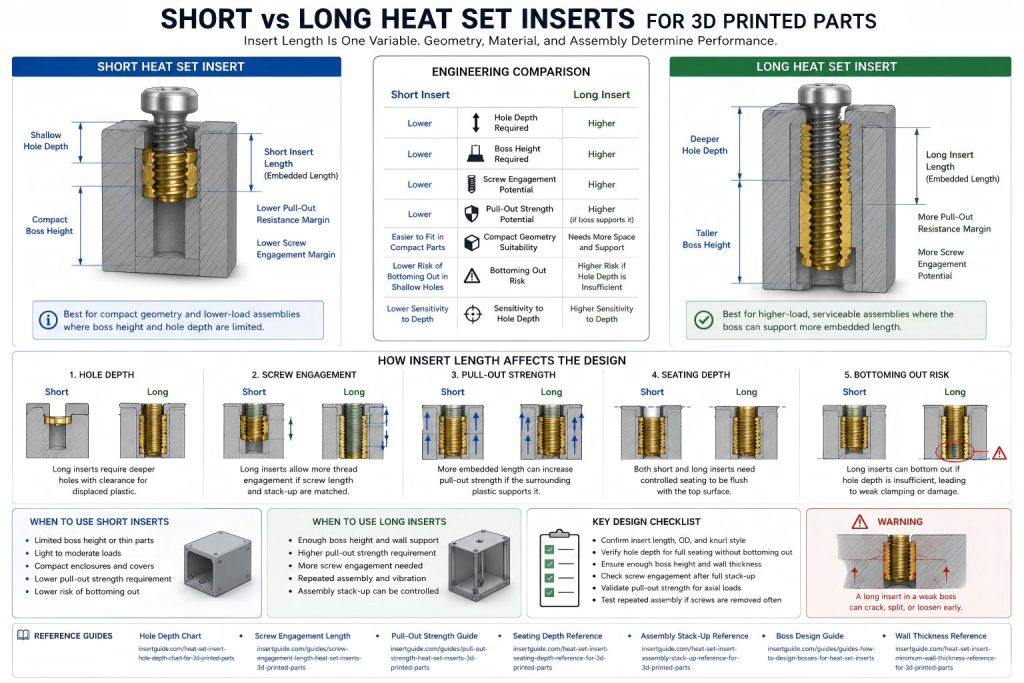
Why Insert Length Matters
The body length of a heat set insert controls how much of the insert is embedded in the printed plastic. A longer insert can provide more thread engagement and more surface area for mechanical retention, but it also requires a taller boss, deeper hole, and more surrounding material.
A short insert is easier to fit into compact parts, but it has less embedded length and usually provides less margin for pull-out strength, screw engagement, and repeated service cycles.
Insert length should be selected together with boss height, hole depth, screw length, material behavior, and expected load. It should not be chosen only by thread size.
Short Heat Set Inserts
Short heat set inserts are useful when the printed part has limited height or compact geometry. They are common in thin covers, small enclosures, sensor brackets, lightweight mounts, and prototype parts where space is limited.
The advantage of a short insert is that it requires less depth and can fit into smaller bosses. The tradeoff is that the insert has less embedded length inside the plastic, which can reduce pull-out resistance and limit usable screw engagement.
| Short Insert Advantage | Design Risk | Best Use Case |
|---|---|---|
| Fits compact geometry | Less pull-out strength margin | Small enclosures and light-duty covers |
| Requires less hole depth | Less thread engagement potential | Thin parts with limited boss height |
| Lower risk of bottoming out in shallow bosses | Less support under repeated service cycles | Low-load assemblies and prototypes |
| Can reduce local material displacement | May loosen faster if preload is high | Compact parts where torque is controlled |
Long Heat Set Inserts
Long heat set inserts can improve engagement length and load distribution when the printed structure can support them. They are often useful in parts that need higher pull-out resistance, better repeated assembly performance, or more thread engagement.
However, a long insert is not automatically safer. If the boss is too short, the hole is too shallow, the wall thickness is limited, or the insert is close to an edge, a longer insert can create new failure risks.
| Long Insert Advantage | Design Risk | Best Use Case |
|---|---|---|
| More embedded length | Requires deeper hole and taller boss | Parts with enough boss height and wall support |
| More screw engagement potential | Can bottom out if hole depth is insufficient | Serviceable assemblies and stronger brackets |
| Better pull-out resistance potential | Can split weak bosses during installation | Moderate-load covers, fixtures, and mounts |
| More stable under repeated assembly | Needs more plastic support around the full insert length | Parts opened and closed many times |
Short vs Long Inserts: Engineering Comparison
| Design Factor | Short Insert | Long Insert |
|---|---|---|
| Required hole depth | Lower | Higher |
| Required boss height | Lower | Higher |
| Pull-out strength potential | Lower | Higher if the boss supports it |
| Screw engagement margin | Lower | Higher if the screw and insert match |
| Risk in thin parts | Often easier to fit | Higher risk of bottoming out or cracking |
| Repeated assembly durability | Lower margin | Better potential with proper geometry |
| Installation sensitivity | Less depth sensitivity | More sensitive to hole depth and seating depth |
Insert Length and Hole Depth
Insert length directly affects the required pilot hole depth. A long insert needs a deeper hole, but the hole also needs extra clearance for displaced plastic during heat installation. If the hole is too shallow, the insert may bottom out before seating properly.
A short insert can fit in a shallow hole more easily, but the shorter embedded length may reduce strength. The correct choice depends on whether the part needs compactness or stronger retention.
For hole depth planning, see Heat Set Insert Hole Depth Chart for 3D Printed Parts.
Insert Length and Screw Engagement
A longer insert can allow more screw engagement, but only if the screw length, seating depth, and assembly stack-up are matched correctly. If the screw is too short, a long insert may not provide any real benefit. If the screw is too long, it may bottom out before clamping the assembly.
A short insert may be acceptable for light loads, but it gives less thread engagement margin. This can matter in repeated service panels, vibration-prone parts, and assemblies where screws are removed often.
For thread engagement design, see Screw Engagement Length for Heat Set Inserts in 3D Printed Parts.
Insert Length and Pull-Out Strength
Longer inserts can increase pull-out strength potential because more of the insert body is embedded in plastic. More embedded length can provide more mechanical grip and more load transfer through the knurled surface.
But this only works if the surrounding plastic can support the insert. A long insert inside a weak, thin, or poorly supported boss may crack the part or create stress along a longer weak path.
For axial load behavior, see Pull-Out Strength of Heat Set Inserts in 3D Printed Parts and M3 Heat Set Insert Pull-Out Strength for 3D Printed Parts.
Insert Length and Boss Geometry
Long inserts need enough boss height, wall thickness, and surrounding support along the full insert body. If the boss only supports the top part of the insert or becomes thin near the bottom, the insert may not perform as expected.
A short insert may be better in compact geometry when the part cannot provide enough depth. In many printed parts, a shorter insert with proper boss support is stronger than a longer insert forced into weak geometry.
For boss design, see How to Design Bosses for Heat Set Inserts, Boss OD Ratio for Heat Set Inserts in 3D Printed Parts, and Heat Set Insert Minimum Wall Thickness Reference for 3D Printed Parts.
Insert Length and Seating Depth
Long inserts are more sensitive to seating depth because they occupy more of the hole. If a long insert is pushed too deep, it may reduce thread access or bottom out. If it is not fully seated, it may sit proud above the surface and interfere with the mating part.
Short inserts are less sensitive to hole depth, but they still need controlled seating. A short insert that sits proud can still create a surface gap and poor clamping.
For seating behavior, see Heat Set Insert Seating Depth Reference for 3D Printed Parts.
Insert Length and Assembly Stack-Up
Insert length affects the full assembly stack-up. The screw must pass through the mating part, washer if used, clearance hole, and printed surface before engaging the insert. If insert length, screw length, and stack height are not matched, the assembly may have weak engagement or false tightness.
For example, a long insert may look stronger, but if the screw bottoms out inside the hole before clamping the cover, the assembly will still be unreliable.
For full stack-up logic, see Heat Set Insert Assembly Stack-Up Reference for 3D Printed Parts.
When to Use Short Inserts
Short heat set inserts are usually appropriate when space is limited and the assembly load is modest. They can be a good choice for compact enclosures, small brackets, lightweight service covers, and prototypes where the main goal is reusable threading rather than maximum strength.
Use short inserts when:
- the printed part has limited boss height
- the part is thin and cannot support a deep insert
- loads are light to moderate
- the screw is not removed frequently
- the assembly does not require high pull-out strength
- bottoming out risk must be minimized in compact geometry
When to Use Long Inserts
Long heat set inserts are usually appropriate when the printed structure can support more embedded length and the assembly needs higher reliability. They are useful when screw engagement, pull-out strength, or repeated assembly performance matters.
Use long inserts when:
- the boss has enough height and wall support
- the part needs stronger axial retention
- the screw will be removed repeatedly
- the assembly sees vibration or handling loads
- the screw length can be matched to the insert and stack-up
- hole depth and seating depth can be controlled
Material Behavior and Insert Length
Material behavior affects whether a short or long insert is safer. Brittle materials may crack if a long insert creates too much installation stress. Creep-prone materials may benefit from more embedded length, but only if the surrounding plastic can maintain preload over time.
| Material | Short Insert Behavior | Long Insert Behavior |
|---|---|---|
| PLA | Easier to fit in compact bosses, but lower strength margin | Can improve engagement, but may crack weak bosses if forced |
| PETG | Useful for light service covers, but preload may relax | Can improve retention, but still needs creep-aware design |
| ABS | Good for compact functional parts if geometry is controlled | Useful when boss support and layer adhesion are strong |
| ASA | Useful in outdoor compact assemblies | Good option when wall support and depth are available |
| Nylon | May move under flexible load if engagement is low | Can help retention, but preload relaxation must be tested |
| Fiber-filled materials | Compact fit, but local brittleness still matters | High retention potential, but installation pressure can create cracks |
For material comparison, see PLA vs PETG vs ABS for Threaded Inserts.
Common Mistakes
Assuming longer inserts are always stronger
A longer insert only helps if the printed boss can support the full insert length. In weak geometry, a longer insert can increase cracking, bottoming out, or installation damage.
Choosing insert length without checking hole depth
Insert length must be matched to hole depth and displaced plastic volume. A hole that is too shallow can prevent proper seating.
Using a short insert with too little screw engagement
Short inserts can work well, but the screw still needs enough thread engagement for the load and service condition.
Changing insert length without changing screw length
A longer insert may require a different screw length or stack-up check. Otherwise, the screw may engage poorly or bottom out.
Ignoring material behavior
The same insert length may behave differently in PLA, PETG, ABS, ASA, nylon, or filled materials because each material responds differently to heat, load, and creep.
Selection Checklist
- Check insert thread size and body length.
- Confirm the boss has enough height for the insert.
- Confirm hole depth allows full seating without bottoming out.
- Check screw engagement after assembly stack-up is included.
- Use short inserts for compact, lower-load geometry.
- Use long inserts only when the surrounding plastic can support them.
- Validate pull-out strength if axial load matters.
- Check seating depth after installation.
- Test repeated assembly if screws will be removed often.
- Avoid using insert length to compensate for weak boss geometry.
FAQ
Are long heat set inserts stronger than short inserts?
Long inserts can provide higher strength potential, but only when the printed boss has enough height, wall thickness, and material support. A long insert in weak geometry may fail earlier than a short insert in a well-supported boss.
When should I use short heat set inserts?
Short inserts are useful in compact or thin printed parts where hole depth and boss height are limited. They are best for lower-load assemblies where reusable threads are needed but maximum pull-out strength is not required.
When should I use long heat set inserts?
Long inserts are useful when the part needs more screw engagement, higher pull-out resistance, or better repeated assembly performance, and when the printed boss can support the extra length.
Does insert length affect screw engagement?
Yes. Longer inserts can allow more thread engagement, but screw length and assembly stack-up must be matched correctly. A long insert does not help if the screw is too short or bottoms out.
Does insert length affect hole depth?
Yes. Longer inserts need deeper holes and more clearance for displaced plastic. Hole depth must be checked before selecting a long insert.
Related Guides
- M3 Brass Heat Set Inserts for 3D Printed Parts
- Heat Set Insert Hole Depth Chart for 3D Printed Parts
- Screw Engagement Length for Heat Set Inserts in 3D Printed Parts
- Pull-Out Strength of Heat Set Inserts in 3D Printed Parts
- Heat Set Insert Seating Depth Reference for 3D Printed Parts
- Heat Set Insert Assembly Stack-Up Reference for 3D Printed Parts
- Boss OD Ratio for Heat Set Inserts in 3D Printed Parts
- Heat Set Insert Minimum Wall Thickness Reference for 3D Printed Parts