
Heat set insert torque resistance in PETG vs PLA parts affects insert stability, repeated tightening durability, boss deformation, and long-term fastening reliability in 3D printed assemblies.
In 3D printed assemblies, torque resistance affects:
- insert stability
- boss deformation
- screw retention
- repeated assembly durability
- fastening consistency
- long-term service reliability
Torque performance depends on more than insert geometry alone.
Material behavior strongly influences how fastening loads are distributed into the surrounding printed structure.
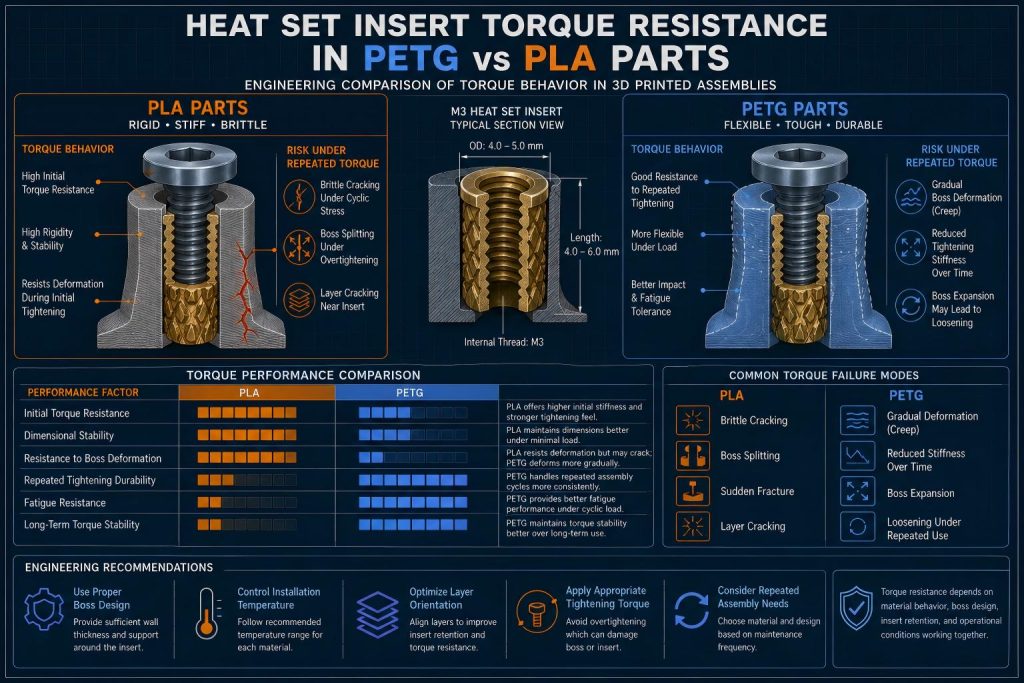
Torque Resistance in PLA Parts
PLA is relatively stiff and dimensionally stable.
This stiffness often provides:
- strong initial fastening feel
- stable insert positioning
- high short-term torque resistance
PLA bosses typically resist deformation during initial tightening cycles.
However, PLA also has limitations under repeated torque loading.
PLA structures may become:
- brittle under cyclic stress
- sensitive to cracking near layer boundaries
- prone to sudden failure under overtightening
In repeated assembly applications, PLA torque resistance may gradually weaken if boss geometry is insufficient.
Localized stress concentration around rigid PLA bosses can increase the risk of structural cracking during repeated tightening cycles. For more detail, see our guide on boss design and heat set insert failure.
Torque Resistance in PETG Parts
PETG behaves differently under fastening loads.
Compared with PLA, PETG is generally:
- more flexible
- more impact resistant
- more tolerant of repeated loading
This flexibility may improve durability under cyclic tightening conditions.
PETG often performs better in assemblies exposed to:
- vibration
- repeated maintenance
- service access cycles
- dynamic loading
However, PETG may also experience:
- gradual boss deformation
- creep behavior
- reduced tightening stiffness over time
Torque stability in PETG depends heavily on proper boss support and balanced load distribution.
Under repeated tightening cycles, gradual PETG deformation can reduce torque consistency and long-term preload stability. In some assemblies, this may contribute to thread loosening, insert rotation, or other repeated assembly failure modes over time.
Heat Set Insert Torque Resistance in PETG vs PLA Parts
Heat set insert torque resistance in PETG vs PLA parts depends on material stiffness, boss geometry, repeated tightening behavior, insert retention, and long-term fastening stability.
Boss Geometry and Torque Stability
Boss structure strongly affects torque resistance in both materials.
Thin unsupported bosses may gradually deform or crack under tightening loads.
Stable fastening structures usually include:
- balanced wall thickness
- proper insert depth
- stable layer orientation
- sufficient support around the insert base
Torque resistance improves when fastening loads are distributed evenly into the surrounding structure.
Related Guide:
M3 Heat Set Insert Boss Design for 3D Printed Parts
Pull-Out Resistance and Torque Loading
Torque behavior and pull-out resistance are closely connected.
Weak retention structures may eventually develop:
- spinning inserts
- loosening during tightening
- reduced fastening consistency
Repeated torque loading gradually increases stress around the insert retention area.
Related Guide:
M3 Heat Set Insert Pull-Out Strength for 3D Printed Parts
Repeated Assembly Performance
Repeated tightening cycles highlight major differences between PLA and PETG.
PLA often provides:
- stronger initial rigidity
- higher dimensional stability
PETG often provides:
- improved fatigue tolerance
- better resistance to cyclic loading
- improved long-term durability
For assemblies requiring frequent maintenance access, PETG is often preferred because it better tolerates repeated torque loading over time.
Related Guide:
Recommended Fastening Structure for Repeated Assembly PETG Parts
Common Torque Failure Differences
PLA
Typical torque-related failures include:
- brittle cracking
- boss splitting
- sudden structural fracture
- layer cracking under overtightening
PETG
Typical torque-related failures include:
- gradual deformation
- reduced tightening stiffness
- boss expansion
- creep-related loosening
Material Behavior Is Critical for Torque Resistance
Torque resistance depends on the interaction between:
- material stiffness
- insert geometry
- boss support
- layer adhesion
- repeated loading behavior
- operational conditions
Reliable fastening systems must be designed around both mechanical loading and long-term material behavior.
Conclusion
Heat set insert torque resistance in PETG vs PLA parts differs significantly because the two materials distribute fastening stress differently.
PLA offers higher rigidity and initial tightening stiffness, while PETG often provides improved repeated assembly durability and long-term fatigue resistance.
Successful fastening systems should always consider material behavior together with boss geometry, insert retention, and operational loading conditions.
Related Engineering Guides
- How to Choose Heat Set Inserts for 3D Printed Parts
- Heat Set Insert Hole Size Guide
- How to Design Bosses for Heat Set Inserts
- PLA vs PETG vs ABS for Threaded Inserts
- Why Heat Set Inserts Fail in 3D Printed Parts
- Pull-Out Strength of Heat Set Inserts in 3D Printed Parts
- Torque Resistance of Heat Set Inserts in 3D Printed Parts
- Layer Adhesion and Heat Set Insert Strength in 3D Printed Parts
- Heat Set Insert Installation Temperature for 3D Printed Parts
- Screw Engagement Length for Heat Set Inserts in 3D Printed Parts
Related Decision Resources
For insert selection, tool choice, and supplier comparison, use these decision-focused references after the engineering requirements are defined.