
Short Engineering Answer
Heat set inserts may loosen in PETG but crack PLA because PETG and PLA respond differently to stress around the insert.
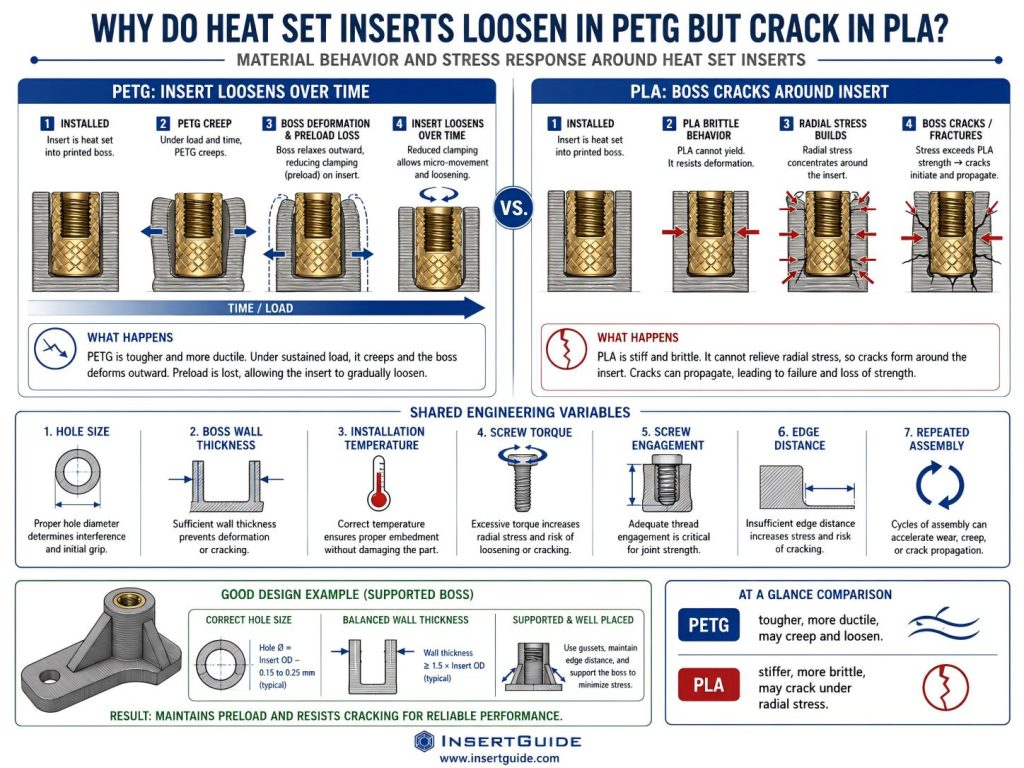
PETG is tougher and more ductile, but it can deform or creep under sustained screw preload. This means a PETG boss may not crack immediately, but the insert joint can lose preload, loosen, or deform over time.
PLA is stiffer and more brittle. It usually holds shape well, but when radial stress from insert installation or screw tightening becomes too high, PLA is more likely to crack instead of slowly deforming.
This difference is not caused by the insert alone. It comes from the relationship between material behavior, hole size, boss wall thickness, installation temperature, screw torque, and long-term load.
Root Causes
PETG Deforms Before It Cracks
PETG can absorb more deformation than PLA.
When a heat set insert is installed into PETG, the material may stretch, soften, or deform around the insert rather than cracking immediately. This can be useful because PETG is less brittle, but it also means the boss may slowly change shape under load.
If the screw applies sustained preload, the PETG around the insert can relax. As the boss deforms, the insert may lose radial support and the joint may become loose.
PETG failure often appears as loosening, preload loss, boss deformation, or insert movement.
PLA Cracks Before It Creeps
PLA is stiff and dimensionally stable, but it is more brittle.
When the insert creates radial stress during installation, PLA may not deform enough to absorb the pressure. Instead, the boss may split, crack, or form small fractures around the insert.
This is especially likely when the pilot hole is too small, the boss wall is thin, the insert is too close to an edge, or screw torque is excessive.
PLA failure often appears as boss cracking, edge splitting, or sudden fracture.
PETG Creep Under Screw Preload
PETG can creep under sustained clamping load.
When a screw is tightened into a heat set insert, the joint creates preload. Over time, PETG may slowly relax under that load, especially if the boss is thin, the screw is over-tightened, or the part is warm.
The screw may still be threaded into the insert, and the insert may still be seated, but the clamping force can drop. This makes the joint feel loose even if nothing visibly broke.
This is why PETG insert joints often need stronger boss support and controlled screw torque.
PLA Brittleness Under Radial Stress
PLA is sensitive to radial stress around the insert.
If the pilot hole is undersized, the insert must force too much plastic outward during installation. PLA may not stretch enough to relieve that pressure. The result can be vertical boss cracks, surface splitting, or cracks that grow toward an edge.
PLA bosses also crack more easily when the insert is overheated, pushed in off-axis, or placed in thin geometry.
For PLA, controlled hole size and enough boss wall thickness are critical.
Installation Temperature Affects Each Material Differently
PETG and PLA need different installation behavior.
If the insert is too hot in PETG, the boss may over-soften, deform, or collapse. If the insert is too cold, PETG may not flow enough around the knurling.
If the insert is too cold in PLA, the insert may wedge the boss apart and cause cracking. If it is too hot, PLA may soften too much locally and lose dimensional control.
The right temperature is not only about melting the plastic. It is about creating controlled flow without damaging the boss.
Boss Geometry Changes the Failure Mode
The same insert can fail differently depending on boss design.
A thin PETG boss may slowly deform and allow the insert to loosen. A thin PLA boss may crack during installation or screw tightening.
A thick PETG boss with good support may hold preload much better. A thick PLA boss with correct hole size and edge distance may avoid cracking.
Material matters, but boss geometry decides how that material behavior becomes a real failure.
Screw Torque Can Trigger Different Outcomes
Excessive screw torque affects PETG and PLA differently.
In PETG, high torque may create too much preload and cause slow deformation or creep. The joint may loosen after time, heat, or vibration.
In PLA, high torque may create stress concentration and crack the boss more suddenly.
This is why “tighten harder” is not a reliable fix for either material.
Repeated Assembly Makes Both Worse
Repeated screw removal and tightening can weaken both PETG and PLA insert joints.
In PETG, repeated assembly can add interface wear, boss deformation, and preload loss.
In PLA, repeated assembly can open small cracks, increase stress around the boss, or cause edge splitting.
Heat set inserts improve thread durability, but the printed boss still carries the load from repeated screw cycles.
Related Engineering Variables
The difference between PETG loosening and PLA cracking depends on several connected variables:
- Material ductility
- Material brittleness
- Material creep
- Boss wall thickness
- Pilot hole size
- Insert outer diameter
- Insert depth
- Installation temperature
- Screw tightening torque
- Screw engagement length
- Edge distance
- Repeated assembly cycles
- Operating temperature
- Vibration
- Layer adhesion
- Print orientation
These variables should be evaluated together. PETG and PLA do not fail in the same way because they do not respond to stress in the same way.
PETG usually needs attention to preload stability and creep. PLA usually needs attention to radial stress and cracking.
Engineering Interpretation
PETG loosening and PLA cracking are two different material-driven failure paths.
PETG often fails by deformation.
PLA often fails by fracture.
In PETG, the boss may slowly lose shape, preload may drop, and the insert may loosen over time.
In PLA, the boss may remain stiff until stress exceeds its fracture tolerance, then it cracks.
These failures can overlap. PETG can still crack if the boss is too thin or installation is poor. PLA can still loosen if the insert interface is weak or the hole is oversized. But the most common tendencies are different.
This is why the same heat set insert design should not be copied blindly between PETG and PLA.
Material behavior must be part of insert design.
How to Reduce the Risk
To reduce PETG loosening:
- Use enough boss wall thickness.
- Avoid excessive screw preload.
- Use proper screw engagement length.
- Avoid high sustained clamping load in weak bosses.
- Consider operating temperature and creep.
- Design for repeated assembly if the part will be serviced.
- Use correct pilot hole size and controlled installation temperature.
To reduce PLA cracking:
- Avoid undersized holes.
- Use enough boss wall thickness.
- Keep enough edge distance.
- Control installation temperature.
- Avoid forcing the insert into the boss.
- Avoid excessive screw torque.
- Add ribs, fillets, or local support around the boss.
- Align print orientation with the load direction.
For both materials, the best solution is not simply changing the insert. The better solution is matching hole size, boss geometry, screw load, and installation conditions to the material.
A reliable heat set insert joint starts with understanding how the printed plastic fails.
Related InsertGuide Pages
- Why Do Heat Set Inserts Fail in PETG Parts?
- Why Do Heat Set Inserts Crack PLA Bosses?
- Why Does PETG Lose Screw Torque Over Time?
- Why Do Bosses Crack Around Heat Set Inserts?
- What Causes Boss Deformation Around Heat Set Inserts?
- PLA vs PETG Fastening Behavior for Heat Set Inserts
- PLA vs PETG vs ABS for Threaded Inserts
- Heat Set Insert Hole Size Guide
- How to Design Bosses for Heat Set Inserts
FAQ
Why does PETG loosen around heat set inserts?
PETG can loosen around heat set inserts because it may creep or deform under sustained screw preload. As the boss relaxes, preload drops and the insert may lose support over time.
Why does PLA crack around heat set inserts?
PLA cracks around heat set inserts because it is stiff and relatively brittle. If the insert creates too much radial stress during installation or screw tightening, the PLA boss may fracture instead of deforming.
Is PETG better than PLA for heat set inserts?
Neither material is universally better. PETG is tougher but may creep under preload. PLA is stiffer but more likely to crack. The better choice depends on boss design, hole size, screw torque, temperature, and assembly frequency.
Related Decision Resources
For insert selection, tool choice, and supplier comparison, use these decision-focused references after the engineering requirements are defined.