
Short Engineering Answer
Heat set inserts fail in motor mounts when the printed fastening structure cannot maintain preload, boss support, torque resistance, or pull-out strength under motor vibration, heat, dynamic load, and repeated maintenance.
Motor mounts are demanding because they combine several failure drivers at once. The screw joint may be exposed to vibration, torque reaction, heat from the motor, side load, belt tension, impact, or repeated screw removal. If the boss is thin, screw engagement is short, the hole is poorly sized, or the printed material creeps under load, the insert joint may loosen, spin, pull out, crack the boss, or lose alignment.
The insert itself is rarely the only weak point. Most failures come from the surrounding printed boss, material behavior, installation quality, layer orientation, and load path.
A reliable motor mount insert joint must be designed for dynamic load and vibration, not only for initial screw installation.
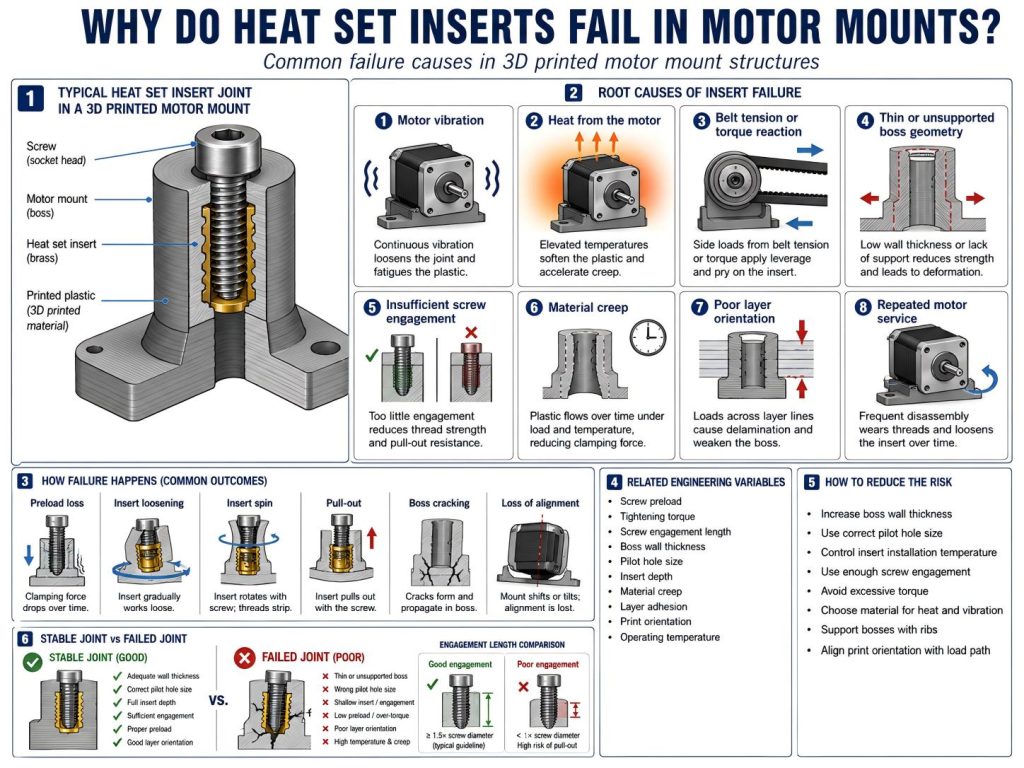
Root Causes
Motor Vibration
Motors create vibration through rotation, imbalance, torque ripple, belt movement, drivetrain load, or gear engagement.
If a heat set insert joint has weak preload, poor boss support, or short screw engagement, vibration can create small movements at the screw and insert interface. Over time, these small movements can reduce preload, wear the plastic-to-insert boundary, and make the insert loosen or spin.
Vibration usually does not destroy the insert first. It exposes weaknesses in the printed fastening structure.
Heat From the Motor
Motor mounts may experience heat from the motor body, nearby electronics, enclosed spaces, or continuous operation.
Heat can reduce the stiffness of printed plastics and increase creep under screw preload. PETG may slowly deform under sustained clamping load. PLA may soften or crack depending on temperature and stress. ABS, ASA, nylon, or reinforced materials may perform better in some motor mount applications, but still depend on boss design and installation quality.
The printed boss does not need to melt for insert reliability to decrease. Moderate heat can still accelerate preload loss and boss deformation.
Torque Reaction and Side Load
A motor mount does not only hold a screw. It often resists motor torque, belt tension, drivetrain force, or side load.
These loads can bend the printed mount and stress the insert boss from different directions. If the boss is not supported by enough surrounding material, the load may concentrate around the insert.
Side load can lead to boss cracking, layer separation, insert loosening, or pull-out failure, especially in thin printed brackets.
Belt Tension or Mechanical Load
Many motor mounts carry belt tension, chain tension, gear mesh force, or mounting pressure.
These loads can apply continuous or cyclic force through the insert joint. If the insert is placed near a thin wall, slot, edge, or unsupported mounting ear, the boss may deform over time.
Belt tension is especially important because it can create sustained load that combines with vibration and heat.
Thin or Unsupported Boss Geometry
Motor mounts are often designed to be compact.
Compact geometry can create thin bosses, shallow insert depth, short edge distance, or unsupported walls. These features reduce the amount of plastic that can support the insert.
A correct pilot hole does not guarantee reliability if the boss cannot resist dynamic load, preload, and vibration.
For motor mounts, the boss should be treated as part of the load path, not as a small cylinder for holding a threaded insert.
Insufficient Screw Engagement
Short screw engagement reduces joint reliability.
If the screw engages too few threads inside the insert, load is concentrated over a smaller thread length. This can increase local stress and make the joint more sensitive to vibration, torque variation, and repeated service.
Enough screw engagement helps distribute load through the insert and into the boss.
Poor Layer Orientation
FDM printed motor mounts are directionally strong.
If motor load, belt tension, or screw preload acts across weak layer lines, the mount may crack or delaminate around the insert. This can happen even if the insert itself is properly installed.
Print orientation should be chosen based on the motor load path, not only surface finish or print convenience.
Repeated Motor Service
Motor mounts may be adjusted, replaced, retensioned, or removed during maintenance.
Each screw removal and reinstallation applies torque to the insert and surrounding boss. Over time, this can weaken the plastic-to-insert interface, reduce preload stability, or cause insert spin during tightening.
A heat set insert improves repeated service compared with printed threads, but the printed boss still needs enough structure to survive service cycles.
Related Engineering Variables
Heat set insert reliability in motor mounts depends on several connected variables:
- Motor vibration
- Motor heat
- Screw preload
- Tightening torque
- Screw engagement length
- Boss wall thickness
- Boss stiffness
- Pilot hole size
- Insert depth
- Belt tension
- Torque reaction
- Side load
- Material creep
- Repeated service cycles
- Layer adhesion
- Print orientation
- Operating temperature
- Mount geometry
These variables should be evaluated together. A motor mount insert joint may work during static assembly but fail after vibration, heat, belt tension, or repeated adjustment.
Motor mount fastening reliability is not only about thread durability. It is about maintaining preload, alignment, and boss support under real operating conditions.
Engineering Interpretation
Heat set insert failure in motor mounts is usually a vibration, heat, and dynamic load problem.
The failure may appear as:
- Insert loosening from preload loss
- Insert spin during tightening or retensioning
- Pull-out from belt or motor load
- Boss deformation from heat and screw preload
- Boss cracking from side load or over-tightening
- Layer separation from poor print orientation
- Loss of motor alignment or belt tension stability
These failure modes often overlap.
For example, motor heat may soften the boss slightly. Vibration then reduces preload. Belt tension adds side load. After repeated adjustment, the insert interface weakens and the insert may begin to spin or loosen.
This is why motor mount insert joints should be designed around the actual load path, not just the insert diameter.
How to Reduce the Risk
To reduce heat set insert failure in motor mounts:
- Use enough boss wall thickness around each insert.
- Avoid thin, unsupported, or edge-adjacent bosses.
- Use the correct pilot hole size for the printed material.
- Control insert installation temperature.
- Avoid overheating the boss during insertion.
- Use enough screw engagement length.
- Avoid excessive screw torque.
- Choose material based on motor heat, creep, vibration, and load.
- Align print orientation with the motor load path.
- Support high-load bosses with ribs or thicker surrounding geometry.
- Consider belt tension, torque reaction, and side load during design.
- Design for repeated adjustment or motor service if expected.
- Reduce vibration where possible.
A reliable motor mount insert joint is a supported fastening system. The screw, insert, boss, material, and load path must work together under heat, vibration, and dynamic mechanical load.
Related InsertGuide Pages
- Why Do Heat Set Inserts Fail Under Vibration?
- Why Does Screw Preload Drop in 3D Printed Insert Joints?
- Why Do Threaded Inserts Loosen After Repeated Screw Removal?
- What Causes Boss Deformation Around Heat Set Inserts?
- Why Do Heat Set Inserts Pull Out of 3D Printed Parts?
- Why Do Bosses Crack Around Heat Set Inserts?
- Screw Engagement Length for Heat Set Inserts in 3D Printed Parts
- Layer Adhesion and Heat Set Insert Strength in 3D Printed Parts
- How to Design Bosses for Heat Set Inserts
FAQ
Are heat set inserts good for 3D printed motor mounts?
Yes. Heat set inserts can work well in motor mounts when the boss, screw engagement, material, and print orientation are designed for vibration, heat, and mechanical load.
Why do inserts loosen in motor mounts?
Inserts loosen in motor mounts when vibration, heat, belt tension, preload loss, weak boss support, material creep, or repeated adjustment weakens the printed plastic around the insert.
Can motor heat weaken heat set insert joints?
Yes. Motor heat can reduce plastic stiffness and increase creep under screw preload. This can lead to preload loss, boss deformation, or insert loosening over time.