
M3 heat set inserts are among the most commonly used threaded inserts for 3D printed assemblies because they provide a balance between fastening strength, compact geometry, and assembly flexibility.
However, successful insert installation depends on more than thread size alone.
In 3D printed parts, fastening reliability is strongly influenced by:
- insert outer diameter
- insert length
- hole diameter
- boss geometry
- installation temperature
- wall thickness
- material behavior
Engineering reference dimensions help create stable fastening structures with improved pull-out strength, torque resistance, and repeated assembly durability.
For how M3 insert dimensions relate to printed hole sizing, see M3 Heat Set Insert Hole Size for 3D Printed Parts.
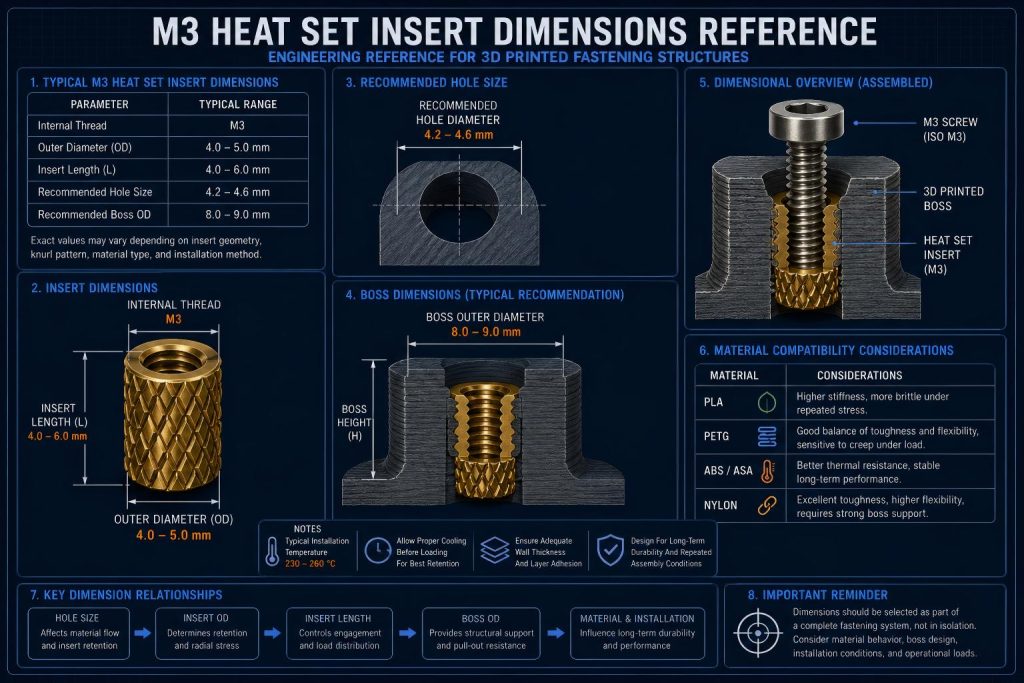
Typical M3 Heat Set Insert Dimensions
Although dimensions vary between manufacturers, most M3 heat set inserts used for 3D printed parts fall within similar engineering ranges.
Typical reference dimensions include:
| Parameter | Typical Range |
|---|---|
| Internal Thread | M3 |
| Outer Diameter | 4.0 – 5.0 mm |
| Insert Length | 4.0 – 6.0 mm |
| Recommended Hole Size | 4.2 – 4.6 mm |
| Recommended Boss OD | 8.0 – 9.0 mm |
Exact values may vary depending on:
- insert geometry
- knurl pattern
- material type
- installation method
- structural loading conditions
Outer Diameter and Insert Retention
Insert outer diameter strongly affects pull-out resistance and installation stability.
Larger diameters may improve retention force but also increase radial stress inside the surrounding boss structure.
In PETG and ABS parts, oversized inserts may eventually cause:
- boss cracking
- layer separation
- deformation under repeated loading
Balanced insert geometry is generally more reliable than maximizing insert size alone.
Related Guide:
M3 Heat Set Insert Pull-Out Strength for 3D Printed Parts
Insert Length and Load Distribution
Longer inserts provide larger engagement areas with the surrounding material.
This may improve:
- pull-out strength
- load transfer
- repeated assembly durability
However, excessive insert depth may weaken thin printed structures or reduce clearance for internal components.
Insert length should match the available boss height and expected operational loading conditions.
Recommended Hole Diameter
Hole size directly affects material flow around the insert during thermal installation.
If the hole is too small:
- installation stress increases
- boss deformation becomes more likely
- material may over-expand during heating
If the hole is too large:
- retention strength decreases
- insert spinning becomes more likely
- fastening stability may weaken over time
Related Guide:
M3 Heat Set Insert Hole Size for 3D Printed Parts
Boss Diameter Recommendations
Boss geometry strongly affects insert performance.
Typical M3 fastening structures often use boss outer diameters around:
8.0 – 9.0 mmdepending on:
- material type
- wall support
- load direction
- repeated assembly requirements
Thin bosses may fail even when insert dimensions appear correct.
Related Guide:
M3 Heat Set Insert Boss Design for 3D Printed Parts
Material Compatibility Considerations
Different materials behave differently around M3 inserts.
PLA
- higher stiffness
- lower flexibility
- more brittle under repeated stress
PETG
- improved flexibility
- better impact resistance
- more sensitive to creep deformation
ABS / ASA
- better thermal resistance
- improved long-term stability
- more installation-sensitive
Nylon
- excellent toughness
- higher flexibility
- requires stable boss support
Material behavior should always be evaluated together with insert geometry and fastening conditions.
Related Guide:
Recommended M3 Heat Set Inserts for PETG
Common Dimension-Related Failure Cases
Oversized Hole Diameter
May reduce insert retention and long-term fastening stability.
Excessive Insert Diameter
May overstress thin printed bosses during installation.
Insufficient Boss Diameter
May reduce pull-out strength and torque resistance.
Poor Length Selection
Very short inserts may reduce retention strength, while excessively long inserts may weaken surrounding structures.
M3 Dimensions Are Part of a Complete Fastening System
Insert dimensions should not be selected independently.
Reliable fastening performance depends on the interaction between:
- insert geometry
- boss structure
- material behavior
- hole sizing
- installation conditions
- operational loading
- repeated assembly requirements
Engineering reference dimensions are most effective when integrated into a complete fastening strategy.
Conclusion
M3 heat set insert dimensions directly affect fastening reliability in 3D printed assemblies.
Stable fastening performance requires balancing insert geometry, boss dimensions, material behavior, and installation conditions rather than focusing on thread size alone.
In engineering applications, dimension references should support the design of complete fastening systems rather than isolated insert installations.
Related Engineering Guides
- How to Choose Heat Set Inserts for 3D Printed Parts
- Heat Set Insert Hole Size Guide
- How to Design Bosses for Heat Set Inserts
- PLA vs PETG vs ABS for Threaded Inserts
- Why Heat Set Inserts Fail in 3D Printed Parts
- Pull-Out Strength of Heat Set Inserts in 3D Printed Parts
- Torque Resistance of Heat Set Inserts in 3D Printed Parts
- Layer Adhesion and Heat Set Insert Strength in 3D Printed Parts
- Heat Set Insert Installation Temperature for 3D Printed Parts
- Screw Engagement Length for Heat Set Inserts in 3D Printed Parts
Related Decision Resources
For insert selection, tool choice, and supplier comparison, use these decision-focused references after the engineering requirements are defined.