
Short Engineering Answer
Bosses crack around heat set inserts when the plastic structure surrounding the insert cannot absorb radial stress from installation, thermal expansion, screw load, or insert pressure.
This usually happens because the boss wall is too thin, the pilot hole is too small, the insert is overheated, the material is brittle, or the insert is placed too close to an edge. In many cases, the crack is not caused by the insert alone. It is caused by the relationship between boss geometry, hole size, material behavior, installation temperature, and load direction.
A heat set insert needs surrounding plastic to flow around its knurled surface. But that same surrounding plastic also needs enough wall thickness and structural support to resist splitting. If the boss is weak, the insert may create outward pressure that the printed part cannot contain.
Boss cracking is a structural design problem, not just an installation problem.
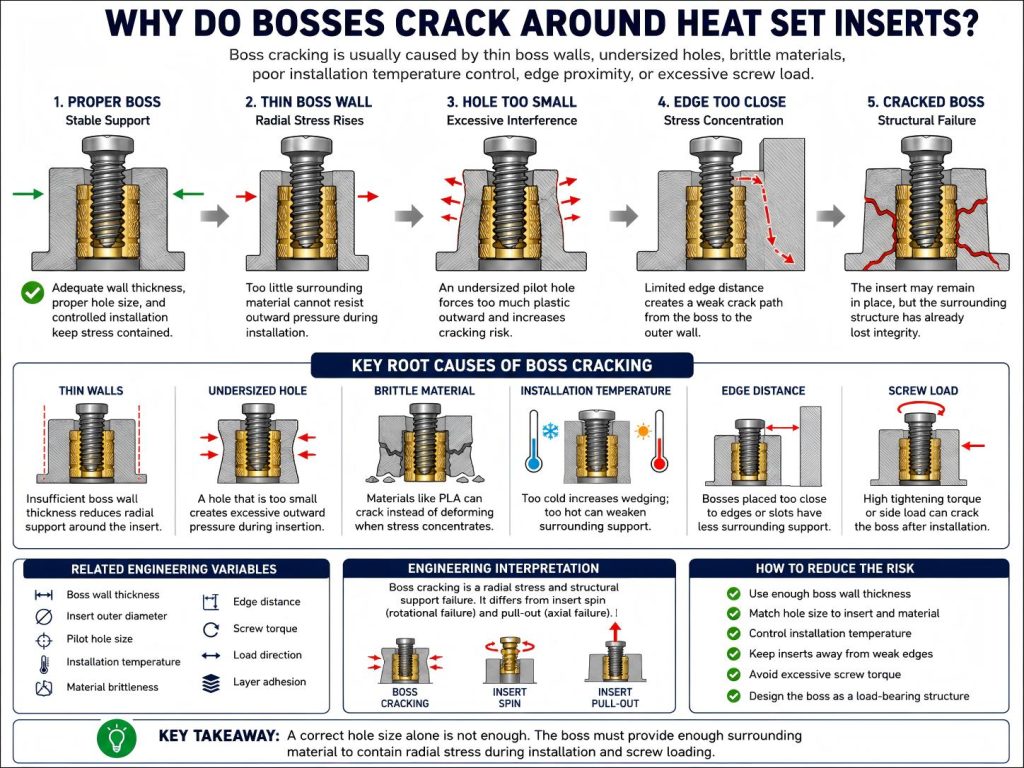
Root Causes
Thin Boss Wall Thickness
A thin boss wall is one of the most common reasons bosses crack around heat set inserts.
During installation, the heated insert softens and displaces plastic outward. If there is not enough material around the insert, the boss wall may expand, split, or form small vertical cracks.
This is especially likely when the insert outer diameter is large compared with the boss diameter. A correct pilot hole does not guarantee reliability if the boss wall is too thin to support the insert.
Pilot Hole Too Small
If the pilot hole is too small, the insert must push too much plastic outward during installation.
This can create high radial pressure inside the boss. Instead of flowing smoothly around the insert knurling, the plastic may be forced outward until the boss wall cracks.
A tight hole may feel strong at first, but excessive interference can damage the printed structure. Hole size should provide enough material engagement without creating uncontrolled outward stress.
Brittle Material Behavior
Material behavior strongly affects cracking risk.
PLA is stiff and prints easily, but it can be more brittle than PETG or ABS. When the insert creates radial stress, PLA bosses may crack instead of deforming. PETG may deform more before cracking, while ABS may tolerate heat and stress better in some designs.
This does not mean PLA cannot use heat set inserts. It means PLA boss design needs more attention to wall thickness, edge distance, hole size, and installation temperature.
Poor Installation Temperature Control
Installation temperature can also cause boss cracking.
If the insert is too cold, it may not allow the plastic to soften and flow properly. The insert then behaves more like a mechanical wedge, forcing material outward and increasing crack risk.
If the insert is too hot, the surrounding plastic may soften too much, collapse, or lose structural support. This can lead to deformation first, and cracking later under screw load.
Good installation temperature should allow controlled plastic flow without burning, collapsing, or overstressing the boss.
Insert Too Close to an Edge
A boss placed too close to an outer wall, corner, slot, or thin feature has less surrounding plastic to resist stress.
When the insert is installed or loaded by a screw, stress may concentrate toward the nearest weak edge. This can produce a crack path from the boss to the edge of the part.
Edge distance matters because the boss is not only a hole. It is a load-bearing structure.
Screw Load After Installation
Some boss cracks do not appear during insert installation. They appear later when the screw is tightened.
If the screw applies high clamping force, bending load, or side load, the boss may crack around the insert even if installation looked clean. This is more likely when the boss wall is thin, the layer orientation is weak, or the screw load is not aligned with the insert axis.
A boss must resist both installation stress and service load.
Related Engineering Variables
Boss cracking is affected by several connected variables:
- Boss outer diameter
- Boss wall thickness
- Insert outer diameter
- Pilot hole size
- Installation temperature
- Material brittleness
- Screw tightening torque
- Edge distance
- Layer adhesion
- Print orientation
- Load direction
- Insert depth
These variables should be evaluated together. A boss can crack even if the insert size is correct. The printed structure must have enough material around the insert to resist radial pressure, screw load, and long-term stress.
For example, a small PLA boss with a tight pilot hole and a high installation temperature may crack more easily than a thicker PETG or ABS boss with controlled hole size and better wall support.
Engineering Interpretation
Boss cracking is a radial stress and structural support failure.
It is different from insert spin and pull-out failure.
Insert spin happens when the plastic-to-insert interface cannot resist rotational torque.
Pull-out happens when the insert loses axial retention and is pulled out of the printed part.
Boss cracking happens when the surrounding printed structure cannot contain the stresses created by insert installation or screw loading.
The insert may still be seated in the part, but the boss structure around it has already lost integrity. Once a crack forms, torque resistance, pull-out strength, and long-term fastening reliability can all decrease.
This is why boss design is not a secondary detail. In many 3D printed fastening structures, the boss is the real load-bearing element.
How to Reduce the Risk
To reduce boss cracking around heat set inserts:
- Use enough boss wall thickness around the insert.
- Match pilot hole size to the insert and printed material.
- Avoid forcing an insert into an undersized hole.
- Control installation temperature.
- Avoid overheating the surrounding boss.
- Keep inserts away from thin edges or unsupported walls.
- Use suitable material for the expected load and temperature.
- Avoid excessive screw tightening torque.
- Align screw load with the insert axis where possible.
- Improve boss geometry before increasing insert size.
A larger insert is not always the solution. If the boss wall is too thin, a larger insert may increase radial stress and make cracking worse.
In most cases, preventing boss cracking requires designing the printed boss as a load-bearing structure, not simply adding a hole for the insert.
Related Root Cause Guides
Boss cracking is usually connected to boss wall thickness, hole size, radial expansion during installation, material stiffness, and edge distance. For the main design variables, see How to Design Bosses for Heat Set Inserts, Heat Set Insert Hole Size Guide, and Installation Temperature for Heat Set Inserts in 3D Printed Parts.
FAQ
Why does a boss crack during heat set insert installation?
A boss can crack during installation when the insert creates too much outward pressure. This may happen if the pilot hole is too small, the boss wall is too thin, the material is brittle, or the insert is pushed in without enough controlled plastic flow.
Are PLA bosses more likely to crack around heat set inserts?
PLA bosses can be more likely to crack because PLA is relatively stiff and brittle. However, cracking depends on boss geometry, hole size, installation temperature, edge distance, and screw load. PLA can work well if the boss is designed with enough support.
Can a correct hole size still lead to boss cracking?
Yes. A correct hole size helps, but it cannot compensate for a weak boss. If the boss wall is too thin, the insert is too close to an edge, or the material cannot absorb radial stress, cracking can still occur.
Related InsertGuide Pages
- How to Design Bosses for Heat Set Inserts
- M3 Heat Set Insert Boss Design for 3D Printed Parts
- Heat Set Insert Hole Size Guide
- M3 Heat Set Insert Hole Size for 3D Printed Parts
- Heat Set Insert Installation Temperature for 3D Printed Parts
- PLA vs PETG vs ABS for Threaded Inserts
- Layer Adhesion and Heat Set Insert Strength in 3D Printed Parts
- Why Heat Set Inserts Fail in 3D Printed Parts