
Short Engineering Answer
Heat set inserts spin in 3D printed parts because the plastic around the insert cannot resist rotational torque from the screw.
This is not always an insert-only problem. Insert spin is usually caused by the relationship between pilot hole size, insert outer diameter, boss geometry, material behavior, installation temperature, and screw tightening load.
When the screw applies torque, the knurled outer surface of the insert must transfer that torque into the surrounding plastic. If the plastic-to-insert interface is weak, softened, oversized, poorly supported, or damaged by repeated assembly, the insert may rotate inside the part.
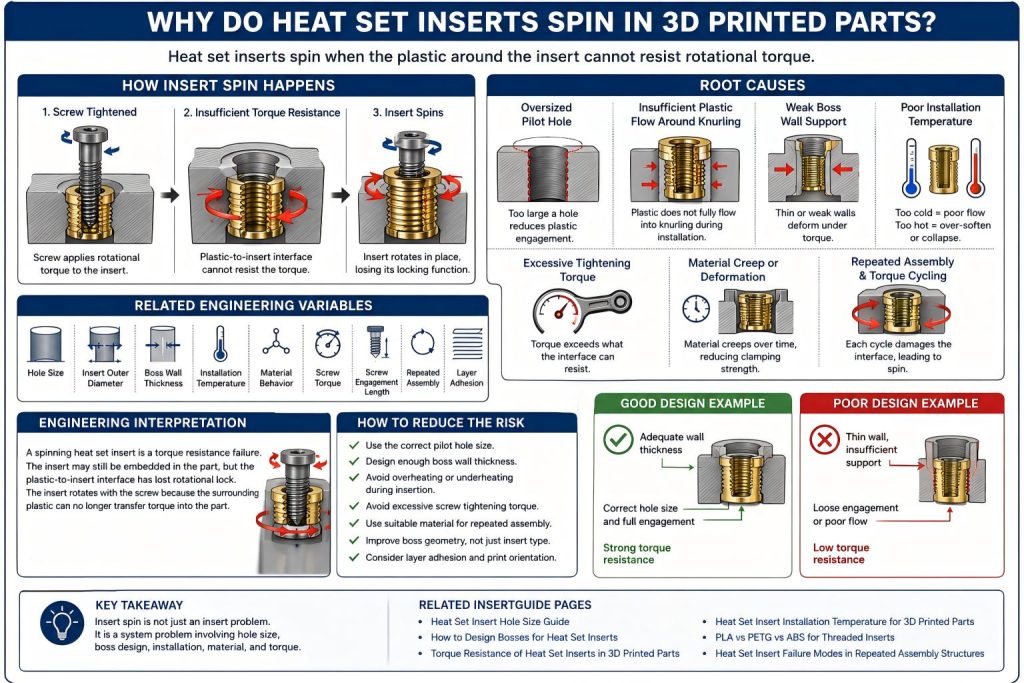
Root Causes
Oversized Pilot Hole
If the pilot hole is too large, the insert does not displace enough plastic during installation. The knurling may not be fully surrounded by material, reducing rotational lock.
Insufficient Plastic Flow Around Knurling
Heat set inserts depend on softened plastic flowing into the knurled or textured outer surface. If the plastic does not flow properly, the insert may sit inside the hole without strong mechanical engagement.
Weak Boss Wall Support
A thin or weak boss wall may not provide enough radial support around the insert. Even if the hole size is correct, the surrounding structure may deform under screw torque.
Poor Installation Temperature Control
If the insert is installed too cold, the plastic may not flow into the knurling. If it is installed too hot, the plastic may over-soften, collapse, or lose local strength.
Both conditions can reduce torque resistance.
Excessive Tightening Torque
If the screw is tightened beyond what the insert-plastic interface can resist, the insert may break free and rotate. This is especially common in small bosses, thin walls, or soft materials.
Material Creep or Deformation
Materials such as PETG can deform or creep under sustained clamping load. Over time, this can reduce the preload and weaken the plastic around the insert.
Repeated Assembly and Torque Cycling
Repeated screw installation and removal can gradually damage the plastic-to-insert interface. Each torque cycle may reduce the rotational grip until the insert starts to spin.
Related Engineering Variables
Insert spin is affected by several connected variables:
- Hole size
- Insert outer diameter
- Boss wall thickness
- Installation temperature
- Material behavior
- Screw torque
- Screw engagement length
- Repeated assembly
- Layer adhesion
These variables should be considered together. A correct hole size alone does not guarantee torque resistance if the boss is weak, the material creeps, or the screw load is too high.
Engineering Interpretation
A spinning heat set insert is a torque resistance failure.
The insert may still appear embedded in the printed part, but the plastic-to-insert interface has lost its rotational lock. In this condition, the insert no longer behaves as a fixed threaded anchor. Instead, it rotates with the screw because the surrounding plastic can no longer transfer torque into the part structure.
This failure is different from pull-out failure. Pull-out failure happens along the insert axis. Insert spin happens around the insert axis.
How to Reduce the Risk
To reduce the risk of heat set inserts spinning in 3D printed parts:
- Use the correct pilot hole size for the insert and material.
- Match the hole size to the insert outer diameter, not only the screw size.
- Design enough boss wall thickness around the insert.
- Avoid overheating or underheating during insertion.
- Avoid excessive screw tightening torque.
- Use materials suitable for repeated assembly when torque cycling is expected.
- Improve boss geometry instead of only changing insert type.
- Consider layer adhesion and print orientation in load-bearing bosses.
In most cases, the solution is not simply choosing a different insert. The surrounding printed structure must be able to support the insert under torque.
Related InsertGuide Pages
- Torque Resistance of Heat Set Inserts in 3D Printed Parts
- Heat Set Insert Hole Size Guide
- How to Design Bosses for Heat Set Inserts
- Heat Set Insert Installation Temperature for 3D Printed Parts
- PLA vs PETG vs ABS for Threaded Inserts
- Heat Set Insert Failure Modes in Repeated Assembly Structures
Related Root Cause Guides
Insert spin is usually connected to hole sizing, plastic flow around the knurl, boss support, and torque resistance. For the main design variables, see Heat Set Insert Hole Size Guide and Torque Resistance of Heat Set Inserts in 3D Printed Parts.
FAQ
Why does a heat set insert spin when tightening a screw?
A heat set insert rotates when the torque from the screw is higher than the rotational grip between the insert knurling and the surrounding plastic.
Is insert spin caused by a wrong hole size?
Hole size is one common cause, but not the only one. Boss wall thickness, installation temperature, material behavior, screw torque, and repeated assembly also affect torque resistance.
Is insert spin the same as pull-out failure?
No. Insert spin is a rotational failure around the insert axis. Pull-out failure is an axial failure where the insert is pulled out of the printed part.