
M3 heat set inserts are commonly used in 3D printed assemblies that require durable threaded fastening. However, the long-term reliability of these inserts depends heavily on pull-out strength.
Pull-out strength refers to the force required to remove the insert from the surrounding printed structure.
In 3D printed parts, pull-out performance is influenced by:
- boss geometry
- hole size
- layer adhesion
- material behavior
- installation temperature
- load direction
- repeated assembly cycles
A correctly installed insert may still fail if the surrounding fastening structure cannot properly distribute mechanical loads.
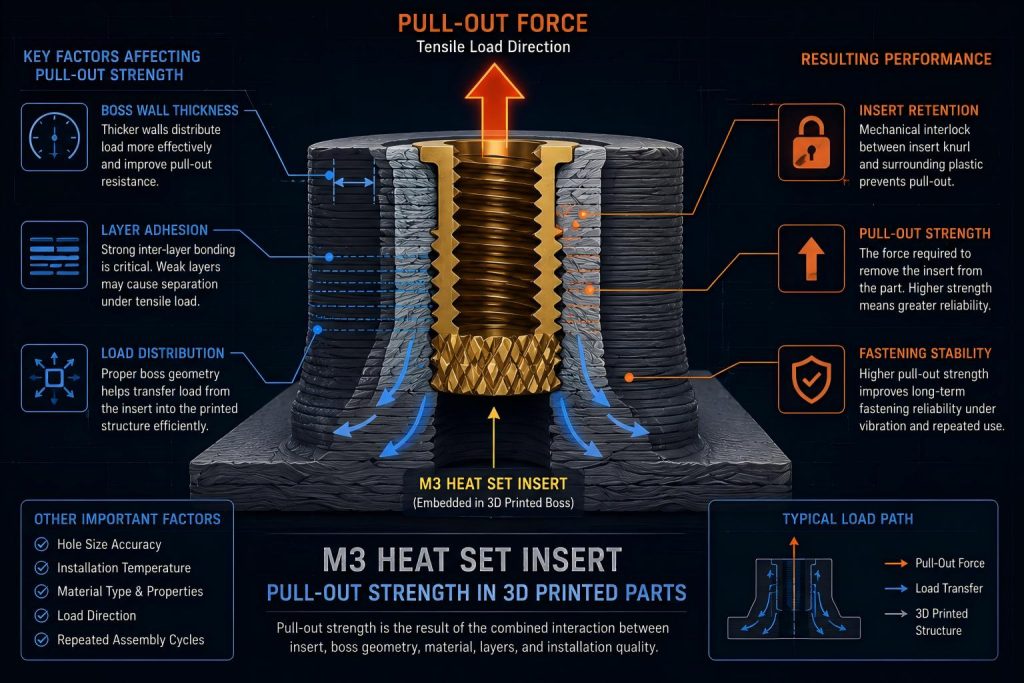
Why Pull-Out Strength Matters
M3 inserts are frequently used in:
- electronics enclosures
- robotics systems
- battery housings
- modular fixtures
- removable service panels
These assemblies often experience repeated loading, vibration, or maintenance cycles.
Insufficient pull-out strength may lead to:
- insert loosening
- structural cracking
- spinning inserts
- layer separation
- fastening instability
In functional engineering assemblies, pull-out resistance is one of the most important indicators of fastening durability.
Factors Affecting M3 Pull-Out Strength
Boss Geometry
The surrounding boss structure distributes load from the insert into the printed part.
Weak bosses often fail before the insert itself.
Important boss considerations include:
- wall thickness
- boss diameter
- support geometry
- load distribution path
Thin bosses may reduce pull-out resistance even when insert installation appears successful.
Related Guide:
M3 Heat Set Insert Boss Design for 3D Printed Parts
Hole Size
Hole diameter directly affects material flow around the insert knurl geometry.
If the hole is too large, the insert may not develop enough mechanical interlock.
If the hole is too small, installation stress may damage the surrounding structure.
Related Guide:
M3 Heat Set Insert Hole Size for 3D Printed Parts
Layer Adhesion
3D printed parts are anisotropic structures.
Weak layer bonding often reduces pull-out strength significantly, especially when loads act perpendicular to layer lines.
Layer orientation, print temperature, and cooling behavior all affect fastening durability.
Related Guide:
Layer Adhesion and Heat Set Insert Strength in 3D Printed Parts
Installation Temperature
Heat set insert installation changes the surrounding material structure through localized heating.
Excessive installation temperature may soften too much material and weaken insert retention.
Insufficient temperature may prevent proper bonding around the knurl geometry.
Stable thermal installation behavior is critical for repeatable pull-out performance.
Related Guide:
Heat Set Insert Installation Temperature for 3D Printed Parts
Material Behavior
Different materials respond differently to pull-out loading.
PLA often provides high stiffness but lower impact tolerance.
PETG offers more flexibility but may deform under sustained load.
ABS and nylon may behave differently under vibration and elevated temperatures.
Material selection strongly affects long-term insert retention.
Related Guide:
PLA vs PETG vs ABS for Threaded Inserts
Common Pull-Out Failure Cases
Weak Boss Structures
Thin or unsupported bosses may crack or deform under tensile loading.
Oversized Holes
For size-specific diagnosis, compare retention problems with M3 insert pull-out failure.
For the adjacent rotational retention behavior, see M3 torque resistance.
Large hole diameters reduce contact pressure between the insert and the surrounding plastic.
Poor Layer Adhesion
Weak interlayer bonding often causes failure along print layer boundaries.
Overheating During Installation
Excessive thermal exposure may weaken the surrounding material and reduce long-term retention strength.
Pull-Out Strength Is Part of a Fastening System
Pull-out resistance should not be treated as an isolated mechanical value.
Successful fastening performance depends on the interaction between:
- boss design
- hole size
- material behavior
- installation stability
- layer adhesion
- load direction
- repeated assembly conditions
The insert and surrounding structure must function together as a complete engineering fastening system.
Related Engineering Guides
- M3 Heat Set Insert Hole Size for 3D Printed Parts
- M3 Heat Set Insert Boss Design for 3D Printed Parts
- Heat Set Insert Hole Size Guide
- Pull-Out Strength of Heat Set Inserts in 3D Printed Parts
- Torque Resistance of Heat Set Inserts in 3D Printed Parts
- Layer Adhesion and Heat Set Insert Strength in 3D Printed Parts
- Heat Set Insert Installation Temperature for 3D Printed Parts
Conclusion
M3 heat set insert pull-out strength depends on more than insert geometry alone.
Long-term fastening durability is determined by the interaction between boss structure, hole size, layer adhesion, installation conditions, and operational loading behavior.
In functional 3D printed assemblies, stable pull-out performance requires treating the insert and surrounding structure as a complete integrated fastening system.
Related Engineering Guides
- How to Choose Heat Set Inserts for 3D Printed Parts
- Heat Set Insert Hole Size Guide
- How to Design Bosses for Heat Set Inserts
- PLA vs PETG vs ABS for Threaded Inserts
- Why Heat Set Inserts Fail in 3D Printed Parts
- Pull-Out Strength of Heat Set Inserts in 3D Printed Parts
- Torque Resistance of Heat Set Inserts in 3D Printed Parts
- Layer Adhesion and Heat Set Insert Strength in 3D Printed Parts
- Heat Set Insert Installation Temperature for 3D Printed Parts
- Screw Engagement Length for Heat Set Inserts in 3D Printed Parts
Related Decision Resources
For insert selection, tool choice, and supplier comparison, use these decision-focused references after the engineering requirements are defined.