
Heat set inserts in battery enclosures are used to create durable threaded points for removable covers, battery retainers, cable strain relief brackets, BMS mounting points, connector plates, and serviceable access panels. In 3D printed battery enclosures, inserts help the enclosure survive repeated opening, maintenance, vibration, and screw assembly without wearing out printed plastic threads.
Battery enclosures are not ordinary boxes. They often need to manage mechanical retention, service access, vibration, cable routing, thermal behavior, and protection of internal components. A screw that holds a battery cover may look simple, but it may be part of a system that keeps the pack secured, accessible, and protected.
The key point is:
Heat set inserts in battery enclosures should support serviceable fastening while protecting the enclosure structure, internal components, and cable routing.
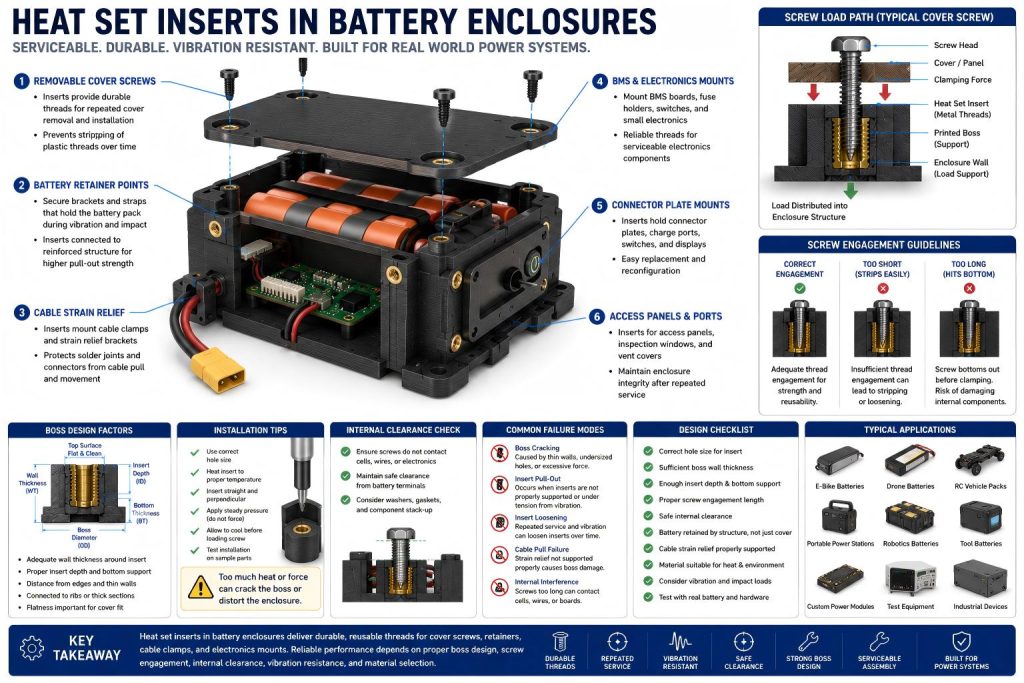
Why Battery Enclosures Use Heat Set Inserts
Battery enclosures are used in robotics, drones, RC vehicles, portable electronics, test equipment, small machines, sensor systems, and custom power modules. Many of these assemblies need removable covers or brackets because batteries may require inspection, replacement, charging access, wiring changes, or service.
Printed plastic threads may work for a first prototype, but battery enclosures are often opened and closed repeatedly. Over time, printed threads can wear out, strip, or lose screw retention.
Heat set inserts improve:
- removable cover durability
- repeated service access
- battery retainer fastening
- connector plate mounting
- cable clamp attachment
- BMS board mounting
- vibration resistance
- enclosure reusability
- screw retention after repeated cycles
In a battery enclosure, insert reliability is not only about holding a screw. It is about keeping the enclosure serviceable without damaging the printed structure.
Common Insert Locations in Battery Enclosures
Heat set inserts are usually placed where screws need to hold removable or serviceable parts.
Removable Cover Screws
Removable covers are one of the most common insert applications in battery enclosures. Covers may provide access to the battery pack, wiring, charge port, fuse, switch, BMS board, or internal connector.
These screws may be removed many times during development or service. Heat set inserts prevent cover screw points from wearing out.
Cover inserts should be placed away from very thin edges. If the cover screws are too close to the enclosure wall, the boss may crack during installation or tightening. For repeated cover access, correct hole size helps the insert seat cleanly without cracking thin cover bosses or loosening after service cycles.
Battery Retainer Brackets
Battery packs often need mechanical retention so they do not move during vibration, impact, or handling. A printed enclosure may include retainer plates, straps, clamps, or crossbars.
Heat set inserts can hold these retainers, but the boss must be stronger than a normal cover screw boss because the battery mass may create shock loads.
Battery retainer inserts should be connected to thicker enclosure sections, ribs, or reinforced zones.
Cable Strain Relief Points
Battery enclosures often include power leads, balance wires, charging cables, sensor wires, or connector harnesses. Cable strain relief reduces stress on solder joints, connectors, and internal wiring.
Heat set inserts can hold small cable clamps or strain relief plates. These insert points should not be isolated on thin walls because cable pull can crack the enclosure over time.
Cable clamp bosses should be tied into the enclosure structure whenever possible.
BMS and Electronics Mounting Points
Battery management systems, protection boards, fuse holders, switches, displays, and small control boards may need internal mounting points.
These inserts often carry light loads, but alignment and electrical clearance matter. The boss should not interfere with wiring, heat sinks, cells, insulation, or connector access.
Connector and Port Plates
Some enclosures use removable connector plates for charge ports, XT-style connectors, USB-C modules, switches, fuses, or panel-mount sockets.
Heat set inserts allow these plates to be replaced or reconfigured without rebuilding the entire enclosure.
Connector plate inserts should preserve flatness so the panel fits cleanly and does not create gaps.
Service Access and Repeated Assembly
Battery enclosures often require more service access than ordinary housings. During prototyping, a pack may be opened frequently for testing, wiring changes, or inspection. When cover screws, retainer screws, or connector plates are tightened repeatedly, torque resistance helps prevent inserts from rotating inside the printed enclosure boss. In field use, covers may be opened for replacement, troubleshooting, or periodic maintenance.
This makes repeated screw assembly important.
Poor insert design can lead to:
- loose cover screws
- stripped printed threads
- cracked cover bosses
- insert pull-out
- uneven cover clamping
- cable clamp failure
- enclosure gaps after repeated service
- internal components shifting during use
A battery enclosure should be designed so the user can open and close it without slowly destroying the screw points.
The first time a cover closes is not the real test. The twentieth service cycle is where the tiny mechanical goblins start taking notes.
Boss Design for Battery Enclosure Inserts
The insert boss is the local structure that holds the threaded connection. In battery enclosures, boss design must consider both fastening strength and space constraints. For battery covers, retainers, and cable clamp points, boss design should match the insert’s service function instead of using the same geometry everywhere in the enclosure.
Important boss design factors include:
- outer boss diameter
- wall thickness around the insert
- insert depth
- bottom material thickness
- distance from enclosure edges
- clearance from battery cells
- clearance from wires and connectors
- access for the installation tool
- cover compression behavior
- connection to ribs or thicker walls
- screw engagement length
A cover screw boss may not need the same strength as a battery retainer boss. A cable clamp boss may need better pull resistance than a display panel boss. A connector plate boss may need better flatness and alignment than a simple access cover boss.
Do not use the same boss geometry everywhere in a battery enclosure. Each insert should match its load and service function.
Insert Depth and Screw Engagement
Battery enclosures often use small screws, but small screws can still cause problems if engagement length is poor.
If screw engagement is too short, the screw may loosen during vibration or repeated cover removal. If the screw is too long, it may bottom out below the insert or contact internal components.
In battery enclosures, screw engagement length should hold the cover or retainer securely without allowing the screw to bottom out or threaten internal cells, wires, or boards.
This is especially important in battery enclosures because internal clearance may be limited.
Screw length should account for:
- cover thickness
- washer thickness
- gasket thickness if used
- insert length
- boss depth
- internal clearance
- nearby cells or wires
- expected service cycles
A screw should clamp the intended part, not press into the plastic below the insert or threaten the internal pack. Battery enclosures do not enjoy surprise screw spears.
Material Choice for Battery Enclosures
Material choice affects strength, heat resistance, impact behavior, and insert installation.
PLA
PLA can work for early prototypes, low-temperature desktop battery holders, or simple mockups. It prints accurately and holds shape well under mild conditions.
However, PLA is not ideal for battery enclosures exposed to heat, impact, vibration, outdoor conditions, or repeated service. It can soften near warm electronics or crack in thin bosses.
PLA should be used cautiously for non-critical battery enclosure prototypes.
PETG
PETG is tougher than PLA and can be useful for moderate-duty battery enclosures. It has better impact resistance and can handle light service use.
However, PETG can flex under load. Insert bosses should be designed with enough wall thickness and support, especially around covers and battery retainers.
ABS and ASA
ABS and ASA offer better heat resistance than PLA and can be useful for functional battery enclosures, outdoor devices, or serviceable housings.
They require controlled printing to maintain cover fit, flatness, and enclosure alignment.
Nylon and Carbon Fiber Nylon
Nylon and carbon fiber nylon can be useful for stronger battery enclosures in robotics, drones, RC vehicles, and industrial devices.
Carbon fiber nylon provides stiffness and dimensional stability, which can help cover fit and retainer strength. Insert installation must still be controlled carefully, and electrical isolation should be considered depending on the material, design, and battery system.
Thermal and Electrical Considerations
Battery enclosures are mechanical structures, but they exist near electrical and thermal systems. Insert design should not ignore this.
Heat set inserts are metal. They can conduct electricity and heat. In many designs, inserts are isolated from battery terminals and conductive paths, but designers should still check clearances carefully.
Consider:
- distance from cells and terminals
- clearance from exposed conductors
- insulation around wiring
- heat sources near the enclosure
- thermal softening of the printed material
- whether insert installation heat affects nearby thin walls
- whether metal inserts could contact internal hardware
- whether service screws could reach internal components
This article does not define electrical safety rules or battery protection requirements. It focuses on mechanical insert design. Battery systems should be designed with proper electrical, thermal, and safety practices for the specific application.
From the fastening point of view, the important idea is simple: threaded inserts should improve serviceability without creating new internal risks.
Vibration, Impact, and Battery Retention
Battery enclosures are often used in moving systems. Drones, RC vehicles, robots, portable devices, and mobile equipment may expose the enclosure to vibration and impact.
Battery mass can create significant loads during motion. A battery retainer screw may experience more stress than a normal cover screw because it helps keep the battery from shifting. For battery retainer brackets and moving enclosures, pull-out strength should be evaluated because battery mass can amplify loads during vibration, impact, or sudden movement.
Design considerations include:
- reinforced retainer insert bosses
- ribs around battery hold-down areas
- screw engagement for retainer brackets
- enclosure wall thickness near impact zones
- cable strain relief near exits
- avoiding isolated bosses on thin walls
- preventing battery motion from loading cover screws
- separating service cover screws from structural retainer screws when possible
If the battery is heavy, do not rely only on thin cover screws to hold it in place. Use proper internal support and retention features.
The cover should close the enclosure. The retainer should hold the battery. Those jobs should not be confused.
Common Failure Modes in Battery Enclosure Inserts
Heat set inserts in battery enclosures usually fail through service wear, vibration, poor boss design, or internal clearance mistakes.
Cover Insert Loosening
Repeated opening and closing can loosen inserts if the boss is too thin, the hole is oversized, or the screw is overtightened.
This can lead to cover gaps, rattling, or loss of serviceability.
Boss Cracking
Boss cracking can happen during insert installation or screw tightening.
Common causes include:
- undersized holes
- brittle material
- thin boss walls
- insert too close to an edge
- excessive insertion force
- overtightened cover screws
- installation temperature too low or too high
For thin enclosure walls and compact cover bosses, installation temperature should be controlled so the insert seats without cracking the boss or deforming the cover fit.
Insert Pull-Out
Insert pull-out can occur when the insert carries tension from a retainer, cable clamp, or cover under vibration.
Battery retainer points are especially important because battery mass can amplify loads during motion.
Cable Clamp Failure
Cable strain relief inserts can fail if cable pull is transferred into a thin unsupported wall. The clamp may remain attached at first, but repeated cable movement can loosen the boss.
Cover Misalignment
If insert installation distorts the cover bosses or panel edges, the cover may no longer sit flat. This can create gaps, uneven screw loading, or poor fit.
Internal Interference
A screw may be too long and contact internal cells, wires, boards, or connectors. This is a design and assembly problem that should be checked before use.
Design Checklist for Battery Enclosures
Before using heat set inserts in a battery enclosure, check the following:
- Is the insert used for a cover, retainer, cable clamp, BMS board, or connector plate?
- Does the boss have enough wall thickness?
- Is there enough material below the insert?
- Is the insert far enough from thin edges?
- Is the screw engagement length sufficient?
- Will the screw bottom out below the insert?
- Is there safe internal clearance behind the screw?
- Are battery cells and wires protected from screw contact?
- Is the battery retained by structural features, not only the cover?
- Are cable strain relief points supported by ribs or thick walls?
- Will the enclosure be opened repeatedly?
- Does the material suit the heat and vibration environment?
- Will insert installation heat distort the cover fit?
- Are metal inserts isolated from sensitive electrical paths?
- Has the enclosure been tested with the real battery, wires, and cover installed?
Battery enclosure inserts should be checked as part of the full assembly, not as separate screw holes floating in CAD space.
Engineering Takeaway
Heat set inserts can make 3D printed battery enclosures more durable, serviceable, and reliable. They are especially useful for removable covers, battery retainers, cable clamps, connector plates, BMS mounts, and access panels.
But battery enclosures require more care than simple housings.
Reliable insert design depends on:
- correct hole size
- controlled installation
- sufficient boss wall thickness
- proper screw engagement
- safe internal screw clearance
- reinforced retainer points
- cable strain relief support
- suitable material choice
- vibration and impact awareness
- protection of internal electrical components
A good battery enclosure does not only close around a battery.
It holds the battery, protects the wiring, allows service access, and keeps threaded points reliable after repeated use.
Heat set inserts provide durable threads, but the enclosure must provide the structure and clearance that make those threads safe and useful.
Related Failure Question
Battery enclosures depend on stable screw preload, safe cover retention, and reliable boss support around the insert. For failure diagnosis, see why heat set inserts fail in battery enclosures.
FAQ
Are heat set inserts useful in battery enclosures?
Yes. Heat set inserts are useful in battery enclosures because they provide durable metal threads for removable covers, battery retainers, cable clamps, BMS mounts, connector plates, and serviceable access panels.
Where should heat set inserts be used in a battery enclosure?
They are most useful in cover screw points, battery hold-down brackets, cable strain relief mounts, connector plates, internal electronics mounts, and access panels that need repeated service.
What causes inserts to fail in battery enclosures?
Common causes include thin boss walls, undersized or oversized holes, poor installation temperature, short screw engagement, vibration, cable pull, overtightening, insert placement near thin edges, and insufficient support around battery retainers.
Can screws in battery enclosures contact internal components?
Yes, if screw length and internal clearance are not checked. Screws should not bottom out below inserts or contact cells, wires, boards, terminals, or connectors.
What material is best for 3D printed battery enclosures with inserts?
PLA can work for early prototypes, PETG for moderate-duty housings, ABS or ASA for better heat resistance, and nylon or carbon fiber nylon for stronger functional enclosures. Material choice should consider heat, vibration, impact, service access, and electrical clearance.
Related Engineering Guides
- How to Choose Heat Set Inserts for 3D Printed Parts
- Heat Set Insert Hole Size Guide
- How to Design Bosses for Heat Set Inserts
- PLA vs PETG vs ABS for Threaded Inserts
- Why Heat Set Inserts Fail in 3D Printed Parts
- Pull-Out Strength of Heat Set Inserts in 3D Printed Parts
- Torque Resistance of Heat Set Inserts in 3D Printed Parts
- Layer Adhesion and Heat Set Insert Strength in 3D Printed Parts
- Heat Set Insert Installation Temperature for 3D Printed Parts
- Screw Engagement Length for Heat Set Inserts in 3D Printed Parts