
Heat set inserts in small batch manufacturing parts are used when 3D printed components need durable metal threads for repeated assembly, adjustment, service, and production use.
In small batch production, printed parts may be used as assembly aids, positioning blocks, fixture components, product housings, test adapters, labeling guides, sensor mounts, temporary brackets, and replaceable tooling elements. Many of these parts need screws, removable hardware, modular attachments, or repeatable fastening points.
Heat set inserts are useful because they allow 3D printed parts to accept durable metal threads. They make printed components easier to assemble, adjust, service, and reuse across repeated production cycles.
But in small batch manufacturing, the insert is not just a threaded detail.
It becomes part of the production workflow.
The key point is:
In small batch manufacturing, heat set inserts help 3D printed parts move from one-time prototypes into repeatable, serviceable production tools and components.
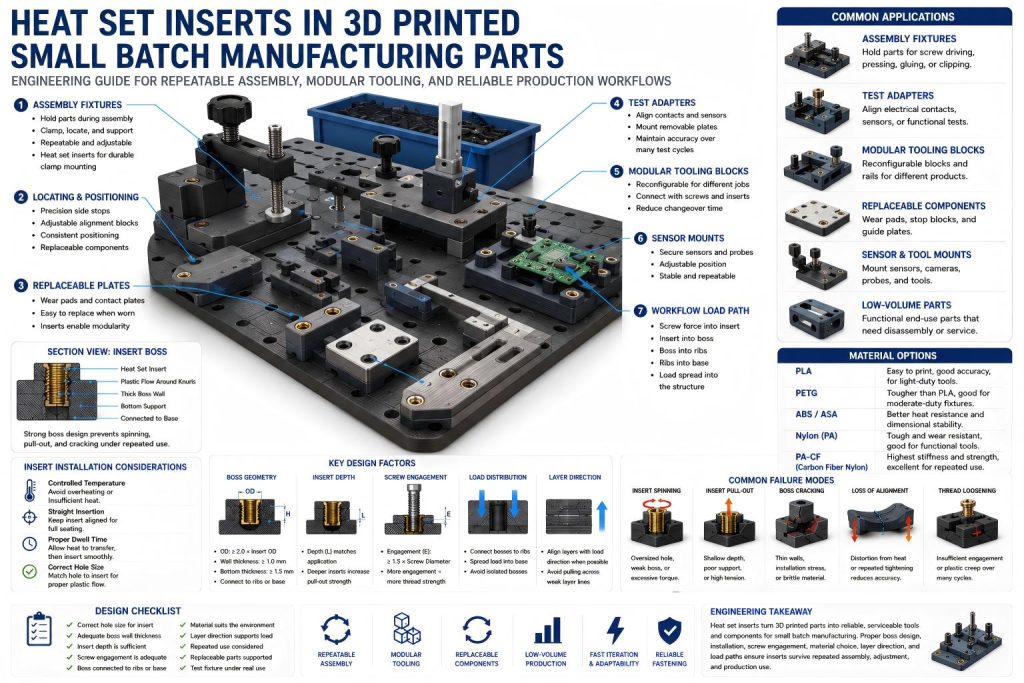
Why Small Batch Manufacturing Uses 3D Printed Parts
Small batch manufacturing often needs flexible tooling. A company may need to build 10, 50, 200, or 1,000 units before deciding whether a product deserves full tooling investment.
In this stage, speed and adaptability matter.
3D printed parts are commonly used for:
- assembly fixtures
- product test adapters
- positioning blocks
- temporary brackets
- small equipment mounts
- drill guides
- labeling and marking guides
- inspection tools
- packaging aids
- sensor holders
- modular workholding parts
- low-volume end-use components
The advantage is not only that 3D printing is fast. The real advantage is that parts can be revised quickly when the production process changes.
If a hole moves, a sensor changes, a clamp needs adjustment, or a workpiece geometry is updated, the printed tool can be modified without waiting for machined tooling.
Heat set inserts make this flexibility more practical because they allow printed parts to survive repeated assembly and adjustment.
Why Heat Set Inserts Matter in Small Batch Production
Small batch manufacturing often involves repeated use. A printed part may be installed, removed, adjusted, tightened, and reused many times during a production run.
Printed plastic threads may be acceptable for a quick prototype, but they are usually weak for repeated use. They can wear, strip, deform, or lose clamping consistency.
Heat set inserts improve these weak points by providing:
- reusable metal threads
- better screw retention
- improved serviceability
- stronger fastening points
- more consistent assembly
- easier replacement of worn components
- better modularity
- reduced risk of damaging printed holes
This matters when a printed part becomes part of a production process instead of a one-time test object.
A prototype only needs to prove an idea.
A small batch manufacturing part must keep working after the idea becomes a workflow.
Common Insert Applications in Small Batch Manufacturing
Heat set inserts can be used in many different printed production aids and low-volume parts.
Assembly Fixtures
Assembly fixtures hold parts in position while workers install screws, adhesives, labels, clips, electronics, or covers.
In these fixtures, inserts are often used to mount clamps, stops, guide blocks, or replaceable contact pads. The insert must survive repeated tightening without loosening inside the printed body.
If the fixture is used daily, insert retention becomes more important than it appears in CAD.
Test Adapters
Small batch production often needs testing before shipment. Printed test adapters may hold a product, align electrical contacts, position sensors, or support a measuring device.
Heat set inserts are useful when the adapter needs removable plates, adjustable contact points, or replaceable alignment features.
For test adapters, insert placement should avoid distortion because even small shifts can affect repeatability.
Modular Production Blocks
A small batch workflow may use modular printed blocks that can be rearranged for different product versions.
Inserts allow these blocks to connect with screws, rails, plates, or alignment features. They make printed tooling easier to rebuild without destroying the base structure.
This is especially useful when the same workbench must handle several product variants.
Replaceable Wear Parts
Some printed production tools have contact surfaces that wear over time. Instead of replacing the entire fixture, designers can use insert-mounted replaceable pads, guides, or plates.
Heat set inserts make this approach more practical because the base tool can remain in service while worn components are changed.
Low-Volume End-Use Components
In some cases, the printed part itself is part of the product being sold or delivered. Examples include small housings, brackets, mounts, covers, adapters, and custom assemblies.
Heat set inserts allow these parts to accept screws more reliably, especially when the product needs maintenance, disassembly, or field service.
Repeatability Is More Important Than One-Time Strength
In small batch manufacturing, a printed part does not only need to be strong once. It needs to behave consistently across repeated use.
This is where insert design becomes important.
A screw connection may feel solid during the first assembly, but repeated tightening can slowly damage the printed structure if the insert is poorly supported.
Common repeatability problems include:
- insert loosening after many cycles
- screw torque becoming inconsistent
- fixture alignment changing over time
- plastic threads wearing out
- bosses cracking from repeated tightening
- replaceable parts no longer sitting flat
- clamps losing their original position
When screws are tightened and removed across many production cycles, torque resistance helps prevent the insert from rotating inside the printed boss.
A small batch tool should be judged by how it performs on the fiftieth or hundredth use, not only on the first.
The first assembly is a handshake. The hundredth is the truth serum.
Boss Design for Small Batch Manufacturing Parts
The boss around the insert carries much of the mechanical responsibility.
For repeated-use production parts, boss design should match how often the screw is tightened, removed, adjusted, or loaded during the workflow.
A heat set insert should not be placed in a thin unsupported wall if the part will be used repeatedly. The surrounding geometry must resist cracking, spinning, pull-out, and deformation.
Important boss design factors include:
- wall thickness around the insert
- outer boss diameter
- insert depth
- bottom material thickness
- distance from edges
- support ribs
- connection to the main part body
- expected tightening force
- frequency of screw removal
- direction of applied load
For small batch manufacturing, the boss should be designed according to how often the screw will be used.
A cover screw used once during assembly may need less support than a clamp screw adjusted several times per shift. A replaceable plate may need more durable threaded points than a fixed decorative cover.
The insert location should match the production behavior, not just the part geometry.
Load Paths in Printed Production Tools
Every screw connection creates a load path.
When a screw is tightened, force moves through the screw head, into the attached hardware, through the insert, into the boss, and then into the printed body.
If the insert boss is isolated, the load stays concentrated in one small area. This can cause cracking, flexing, or insert movement.
For clamp bases, replaceable plates, and modular connectors, pull-out strength should be evaluated as part of the full load path through the printed production tool.
If the boss is tied into ribs, thick walls, or a reinforced base, the load spreads into the larger structure.
For small batch manufacturing parts, this is especially important in:
- clamp bases
- adjustable stops
- product locating blocks
- tool mounting points
- guide plates
- replaceable wear surfaces
- modular fixture connectors
The insert should not be treated as a metal island inside plastic. It should be part of a reinforced mechanical route.
Good load paths turn screw force into useful holding force. Poor load paths turn it into slow plastic damage.
Material Choice for Small Batch Manufacturing Inserts
Material choice depends on whether the printed part is a light-duty aid, a repeated-use fixture, or a functional end-use component.
PLA
PLA can work for light-duty positioning aids, templates, and low-stress assembly tools. It prints accurately and holds shape well in normal conditions.
However, PLA can be brittle and heat sensitive. It is not ideal for high clamping force, repeated impact, warm environments, or heavily serviced insert locations.
PLA parts with inserts should use generous boss geometry and avoid thin edge-mounted insert points.
PETG
PETG is tougher than PLA and often works well for moderate-duty production aids. It can absorb impact better, but it may flex under sustained load.
For PETG small batch tooling, insert bosses should be designed to reduce creep or deformation, especially around clamp points or adjustment screws.
ABS and ASA
ABS and ASA offer better heat resistance and can be useful for production environments where parts may see warmth, repeated handling, or more demanding use.
They require careful printing to maintain dimensional accuracy and layer adhesion.
Nylon and Carbon Fiber Nylon
Nylon and carbon fiber nylon are strong options for repeated-use tools, brackets, and functional production parts.
Carbon fiber nylon offers stiffness and dimensional stability, which can help fixtures and production aids maintain alignment. However, insert installation must be controlled, and bosses still need proper wall thickness and load support.
A better material improves the foundation, but it does not rescue a weak insert design.
Insert Installation and Production Reliability
Heat set insert installation should be consistent when parts will be used in production.
In a one-off prototype, a slightly tilted insert or minor surface distortion may be tolerable. In a small batch manufacturing part, that same issue may affect assembly quality or repeatability.
Important installation considerations include:
- correct hole size
- controlled insertion temperature
- straight insert alignment
- proper insert depth
- stable press-in motion
- sufficient cooling time
- no overheating around the hole
- no raised material interfering with mating parts
- no insert sitting above the surface
If multiple copies of the same printed tool are produced, installation consistency becomes part of the production process. Each insert should seat at the same depth and orientation so that every tool behaves similarly.
The insert installation method should be tested before producing a batch of parts.
Modularity and Replaceable Components
Small batch manufacturing changes often. A product may move through several revisions before reaching stable production.
Heat set inserts support modular tooling because they allow printed components to be removed and replaced without destroying the base fixture.
Useful modular structures include:
- replaceable stop blocks
- removable clamp arms
- interchangeable guide plates
- adjustable locating pins
- sensor mounting plates
- fixture extension blocks
- product-specific adapters
- replaceable wear pads
This modularity can reduce the cost of process changes. Instead of printing a completely new tool, the designer can replace only the block, plate, or adapter that changed.
This is one of the strongest reasons to use heat set inserts in small batch manufacturing.
They do not only improve strength. They make the production system easier to modify.
Common Failure Modes in Small Batch Manufacturing Parts
Heat set inserts in small batch manufacturing parts tend to fail in predictable ways.
Insert Spinning
The insert rotates when the screw is tightened or removed.
Common causes include:
- oversized hole
- weak boss wall
- poor heat insertion
- excessive screw torque
- unsupported insert location
- repeated tightening cycles
This often happens when a printed part is used more frequently than originally expected.
Insert Pull-Out
The insert pulls out of the printed part under clamp force, tension, or repeated service.
Causes may include:
- insufficient insert depth
- shallow boss
- thin bottom material
- poor layer orientation
- weak material
- load applied directly upward
- boss not connected to the main structure
Pull-out is especially important for clamps, lifting points, replaceable plates, and modular connectors.
Boss Cracking
The boss cracks during installation or after repeated tightening.
Typical causes include:
- hole too small
- insert installed with too much pressure
- insert temperature too low
- insert temperature too high
- brittle material
- thin boss wall
- insert too close to an edge
Boss cracking can turn a reliable-looking tool into a short-life production part.
Loss of Alignment
In manufacturing, alignment matters. If insert installation or repeated tightening distorts the tool, the fixture may no longer hold parts consistently.
Loss of alignment can affect:
- inspection accuracy
- drilling positions
- label placement
- assembly repeatability
- sensor contact
- product fit
This failure may be subtle because the insert may still feel secure while the tool becomes inaccurate.
Thread Loosening Over Repeated Cycles
Screws may loosen after repeated use if engagement is too short, clamping force is inconsistent, or the surrounding plastic slowly deforms.
This is common in parts used for adjustment or modular reconfiguration.
Design Checklist for Small Batch Manufacturing Parts
Before using heat set inserts in small batch manufacturing parts, check the following:
- Will this screw be removed or tightened repeatedly?
- Is the insert located in a load-bearing or serviceable area?
- Does the boss have enough wall thickness?
- Is there enough material below the insert?
- Is the insert far enough from edges and thin walls?
- Is the boss connected to ribs or the main body?
- Is the screw engagement length sufficient?
- Does the material resist the expected load and environment?
- Will the part see clamping force or only positioning force?
- Could insert installation distort an accuracy-critical surface?
- Does the print orientation support pull-out and torque loads?
- Are replaceable components supported by durable threaded points?
- Can the same installation method be repeated across multiple printed parts?
- Has the part been tested after repeated assembly cycles?
Small batch production does not forgive every shortcut. It simply reveals them more slowly.
Engineering Takeaway
Heat set inserts help 3D printed parts become more useful in small batch manufacturing because they provide durable, reusable, serviceable threaded connections.
They are especially valuable for:
- assembly fixtures
- modular tooling
- replaceable plates
- positioning blocks
- test adapters
- inspection tools
- low-volume functional parts
- repeated-use production aids
But the insert must be designed as part of the manufacturing workflow.
A reliable small batch manufacturing part depends on:
- proper hole size
- controlled insert installation
- strong boss geometry
- sufficient screw engagement
- good material selection
- supported load paths
- suitable print orientation
- repeatable assembly behavior
The goal is not only to make the printed part accept a screw.
The goal is to make the printed part keep accepting that screw after real production use begins.
FAQ
Are heat set inserts useful in small batch manufacturing parts?
Yes. Heat set inserts are useful in small batch manufacturing parts because they provide durable metal threads for assembly fixtures, test adapters, positioning blocks, modular tooling, replaceable plates, and low-volume functional components.
Why not use printed plastic threads for small batch production?
Printed plastic threads may work for prototypes, but they can wear, strip, deform, or lose consistency after repeated assembly. Heat set inserts provide more durable threads for repeated screw use.
Where should heat set inserts be used in small batch manufacturing tools?
They are most useful in clamp mounts, adjustable stops, replaceable wear plates, test adapters, modular fixture blocks, sensor mounts, and low-volume parts that require disassembly or service.
What causes inserts to fail in small batch production parts?
Common causes include thin boss walls, insufficient insert depth, poor installation temperature, weak layer orientation, short screw engagement, excessive tightening, and unsupported load paths.
What material works best for small batch printed parts with inserts?
The best material depends on the load and environment. PLA can work for light-duty tools, PETG for moderate use, ABS or ASA for warmer environments, and nylon or carbon fiber nylon for stronger repeated-use production parts.
Related Engineering Guides
- How to Choose Heat Set Inserts for 3D Printed Parts
- Heat Set Insert Hole Size Guide
- How to Design Bosses for Heat Set Inserts
- PLA vs PETG vs ABS for Threaded Inserts
- Why Heat Set Inserts Fail in 3D Printed Parts
- Pull-Out Strength of Heat Set Inserts in 3D Printed Parts
- Torque Resistance of Heat Set Inserts in 3D Printed Parts
- Layer Adhesion and Heat Set Insert Strength in 3D Printed Parts
- Heat Set Insert Installation Temperature for 3D Printed Parts
- Screw Engagement Length for Heat Set Inserts in 3D Printed Parts