
Heat set inserts for modular prototype assemblies are used when a 3D printed prototype needs repeated disassembly, module replacement, design iteration, service access, or interchangeable brackets without damaging printed plastic threads.
This application is different from a one-time printed assembly. In a modular prototype, parts may be opened, changed, tested, removed, replaced, and reassembled many times before the design is finalized. The insert joint must survive repeated screw removal, preload changes, insert torque demand, boss stress, and long-term material behavior.
For a related modular robotics application, see Heat Set Inserts in Modular Robotics Systems.
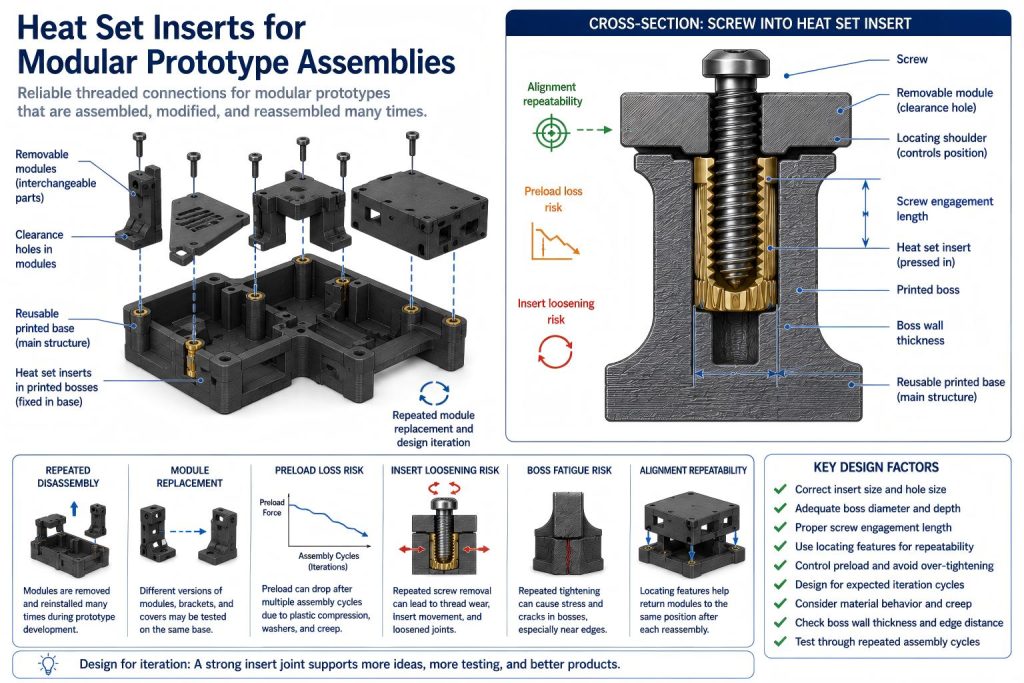
Why Modular Prototype Assemblies Need a Specific Insert Design Approach
Prototype assemblies often change during development. A cover may be removed to access electronics. A bracket may be swapped for a revised geometry. A sensor module may be repositioned. A motor plate may be tested in several versions. A fixture may be adjusted after early trial runs.
In these cases, the fastening structure is not only holding the part together. It is supporting the design iteration process.
A modular prototype insert joint may need to handle:
- repeated module removal and reinstallation
- changing screw preload after each assembly cycle
- slight alignment changes between prototype versions
- boss stress from repeated tightening
- thread wear from frequent screw use
- material creep under sustained clamp force
- insert spin during service
- pull-out load from interchangeable parts
For this reason, modular prototype assemblies should be designed as serviceable fastening systems, not just as temporary printed parts with screws.
Typical Modular Prototype Use Cases
Heat set inserts may be useful in prototypes where the same base structure supports multiple removable or replaceable modules.
Common examples include:
- interchangeable sensor modules
- removable electronics covers
- replaceable motor brackets
- prototype robot modules
- swappable camera mounts
- test fixture modules
- removable battery compartments
- modular enclosure panels
- adjustable mounting plates
- prototype assemblies used across several design revisions
In these applications, the insert becomes a reusable service point rather than a one-time thread.
Main Failure Modes in Modular Prototype Assemblies
Thread Loosening After Repeated Screw Removal
Prototype parts are often assembled and disassembled many times. If screw removal happens frequently, the insert joint may lose stability because of thread wear, plastic relaxation, weak boss support, or repeated preload changes.
See also: Why Do Threaded Inserts Loosen After Repeated Screw Removal?
Repeated Assembly Weakening the Insert Joint
Each assembly cycle can slightly change how the screw, insert, and printed plastic interact. A joint that feels strong during the first test may become less stable after several prototype revisions.
See also: Why Does Repeated Assembly Weaken Heat Set Inserts?
Screw Preload Drop
When a module is removed and reinstalled, the screw preload may not return to the same level. Plastic compression, material creep, screw seating, and small alignment changes can reduce clamp force over time.
See also: Why Does Screw Preload Drop in 3D Printed Insert Joints?
Insert Spin During Module Replacement
If the insert has poor torque resistance, it may rotate during screw tightening or removal. This can make the prototype difficult to service and may damage the surrounding boss.
See also: Why Do Heat Set Inserts Spin in 3D Printed Parts?
Boss Cracking After Multiple Revisions
Prototype bosses may be redesigned, drilled, modified, or reused across several iterations. If the boss is too thin, the hole is too tight, or the insert is close to an edge, cracking may appear after repeated assembly cycles.
See also: Why Do Bosses Crack Around Heat Set Inserts?
Design Variables for Modular Prototype Assemblies
A reliable modular prototype should be designed around the full assembly process, not only around the first successful installation.
| Design Variable | Why It Matters in Modular Prototype Assemblies |
|---|---|
| Insert size | Affects thread engagement, torque resistance, and service durability. |
| Hole size | Controls plastic flow, insert retention, installation stress, and long-term reliability. |
| Boss diameter | Determines how much printed material supports repeated tightening and loosening. |
| Boss depth | Helps prevent shallow support, proud inserts, and screw bottoming. |
| Screw engagement length | Controls clamp stability without bottoming out inside the insert or boss. |
| Module alignment | Affects whether repeated reassembly returns parts to the correct position. |
| Material behavior | PLA, PETG, ABS, nylon, and carbon fiber nylon respond differently to repeated tightening, heat, and creep. |
| Service frequency | Determines whether the insert joint must survive a few cycles or many design iterations. |
For general hole design, see the Heat Set Insert Hole Size Guide. For boss geometry, see How to Design Bosses for Heat Set Inserts.
Recommended Fastening Structure
For modular prototype assemblies, the heat set insert is usually best installed in the fixed base structure, main housing, frame, or reusable printed body. The removable module should normally use clearance holes, slots, or locating features depending on the design.
A typical modular prototype fastening structure includes:
- heat set inserts installed in the reusable base structure
- clearance holes in removable modules
- enough boss diameter around each insert
- enough boss depth for full insert seating
- controlled screw engagement length
- locating features if repeatable position matters
- enough stiffness so the screw does not pull the module into shape
The insert should support repeated assembly. It should not compensate for poor module fit, warped geometry, or weak alignment features.
Module Alignment and Locating Features
In modular prototypes, screws are often used to hold parts together, but screws alone should not be responsible for accurate positioning if alignment matters.
For better repeatability, consider adding:
- printed locating shoulders
- pockets for removable modules
- edge stops
- alignment ribs
- clearance-controlled screw holes
- dowel features where appropriate
The insert provides durable fastening. The locating geometry provides repeatable position. These two functions should be designed separately when the prototype needs consistent reassembly.
Screw Engagement and Prototype Iteration
Screw engagement length should be long enough to provide stable clamping during repeated design changes, but not so long that the screw bottoms out inside the insert or below the boss.
Prototype assemblies often use different module thicknesses across revisions. A screw that works for one version may be too short or too long for another version.
When checking screw engagement, consider:
- module thickness
- washer thickness, if used
- insert thread depth
- boss depth
- clearance below the insert
- expected number of design iterations
- whether several module versions will use the same base insert
For deeper reference, see Screw Engagement Length for Heat Set Inserts in 3D Printed Parts.
Material Behavior During Repeated Prototyping
Material choice affects how well the insert joint survives repeated assembly and design iteration.
PLA can provide stiffness and good dimensional control, but it may crack around tight inserts or thin bosses. PETG is tougher, but it may creep under sustained screw preload. ABS can tolerate heat better than PLA, but still depends on hole fit and boss geometry. Nylon and carbon fiber nylon may provide better toughness, but printed tolerance, moisture behavior, and local stress concentration still matter.
For material comparison, see PLA vs PETG vs ABS for Threaded Inserts.
Repeated Assembly and Service Life
A modular prototype may be opened and modified more often than the final product. The insert joint should be designed for this development reality.
Repeated assembly can contribute to:
- insert movement inside the boss
- screw thread wear
- plastic compression under the screw head
- preload relaxation
- module alignment changes
- boss cracking after multiple cycles
For a broader explanation, see Heat Set Inserts for Repeated Assembly in 3D Printed Parts.
Design Checks Before Using Heat Set Inserts in Modular Prototypes
Before relying on heat set inserts in a modular prototype assembly, check the following:
- Confirm the insert dimensions and recommended printed hole size.
- Print a test coupon using the same material and print settings.
- Check that the removable module seats flat before screw tightening.
- Verify screw engagement without bottoming out.
- Check boss diameter and boss depth around each insert.
- Add locating features if repeatable position matters.
- Test several module removal and reassembly cycles.
- Inspect the boss for cracks after repeated tightening.
- Check whether preload drops after several prototype revisions.
- Confirm that future module versions can still use the same insert layout.
When Heat Set Inserts Are a Good Fit
Heat set inserts are a good fit for modular prototype assemblies when the design needs:
- repeated design iteration
- removable modules
- stronger threads than printed plastic threads
- serviceable brackets, covers, or plates
- durable fastening across several prototype versions
- controlled screw engagement
- modular testing without reprinting the main body
They are especially useful when the base structure is reused while modules, panels, brackets, or covers are changed during development.
When the Design Needs More Caution
Heat set inserts need more caution when:
- the same insert will be used through many revisions
- the module thickness may change between versions
- the boss is close to an edge or thin wall
- the screw may be tightened by different users
- the material is PETG under sustained preload
- the assembly must hold precise alignment after reinstallation
- the insert is placed directly in a high-stress load path
If the assembly is specifically a modular robotics system, see Heat Set Inserts in Modular Robotics Systems.
Practical Summary
Heat set inserts for modular prototype assemblies should be designed as repeated-service fastening points. The insert, screw, boss, removable module, printed material, locating geometry, and design iteration cycle all affect reliability.
A good modular prototype should allow parts to be removed and replaced without insert spin, boss cracking, preload loss, screw bottoming, or alignment drift after repeated assembly.
For modular prototypes, the key question is not only whether the insert holds during the first assembly. The more important question is whether the fastening structure remains reliable after several design changes, test cycles, and module replacements.
FAQ
Are heat set inserts useful for modular prototype assemblies?
Yes. Heat set inserts are useful when a 3D printed prototype needs removable modules, repeated assembly, stronger threads, and durable service points during design iteration.
Where should inserts be placed in a modular prototype?
In most designs, inserts should be installed in the reusable base structure, main housing, or fixed frame. Removable modules usually use clearance holes or slots.
Why do inserts loosen during prototype iteration?
Inserts may loosen because of repeated screw removal, preload changes, weak boss geometry, material creep, thread wear, or screw engagement changes between prototype versions.
Do modular prototypes need locating features?
If repeatable alignment matters, yes. Screws provide clamp force, but locating features help modules return to the same position after removal and reinstallation.
Can PETG be used for modular prototype assemblies?
PETG can be used, but it may creep under sustained screw preload. If the prototype will be assembled many times, preload stability and insert retention should be tested.
Should modular prototype joints be tested through repeated assembly cycles?
Yes. Repeated module removal and reassembly can reveal insert spin, boss cracking, screw bottoming, preload loss, thread wear, and alignment drift before the design is finalized.
Related Guides
- Heat Set Inserts in Modular Robotics Systems
- Heat Set Inserts for Repeated Assembly in 3D Printed Parts
- Why Does Repeated Assembly Weaken Heat Set Inserts?
- Why Do Threaded Inserts Loosen After Repeated Screw Removal?
- Why Does Screw Preload Drop in 3D Printed Insert Joints?
- Heat Set Insert Hole Size Guide
- How to Design Bosses for Heat Set Inserts
- Screw Engagement Length for Heat Set Inserts in 3D Printed Parts