
Short Engineering Answer
Threaded inserts loosen after repeated screw removal when the plastic around the insert gradually loses preload, radial support, or mechanical locking.
The metal threads inside the insert usually survive repeated use better than printed plastic threads. However, every screw removal and reinstallation applies torque, compression, and small interface movement to the surrounding printed boss. Over time, this can weaken the plastic-to-insert interface even when the insert itself is not visibly damaged.
In 3D printed parts, loosening after repeated screw removal is usually a plastic interface stability problem, not a metal thread problem.
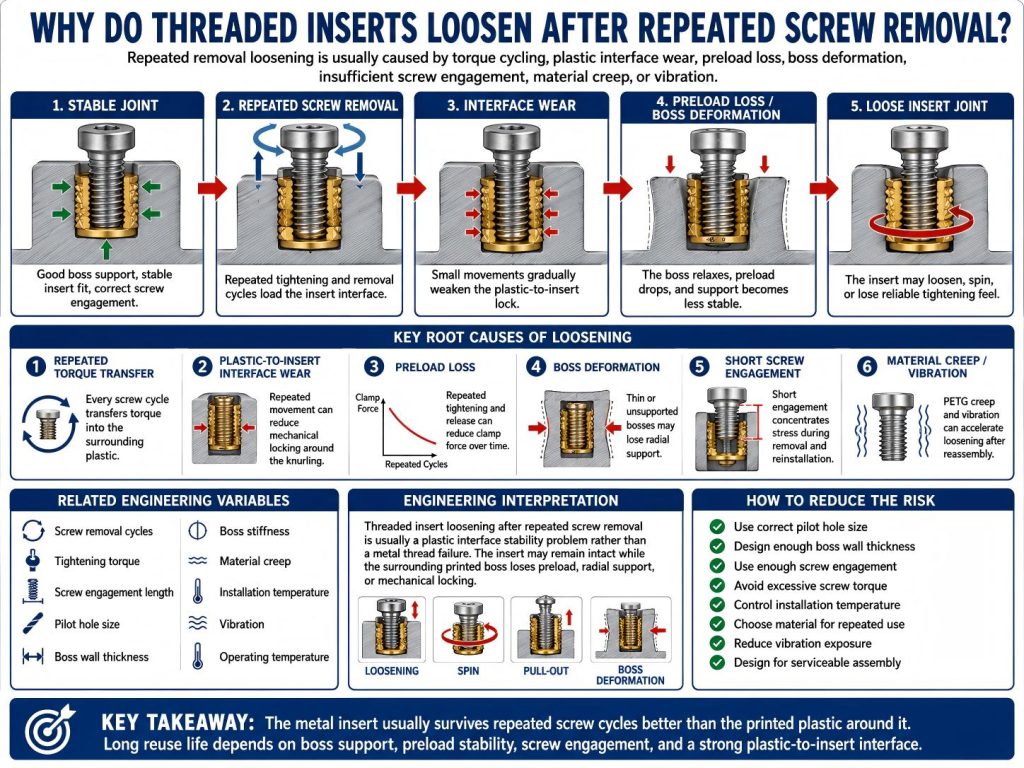
Root Causes
Repeated Torque Transfer
Every time a screw is removed or tightened, torque passes through the insert into the printed plastic around it.
If the boss is thick and well supported, the interface may handle many cycles. If the boss is thin, the hole is oversized, or the material deforms easily, each cycle can slightly reduce the grip around the insert.
This can eventually make the insert feel loose or allow it to rotate under screw torque.
Plastic-to-Insert Interface Wear
Heat set inserts rely on softened plastic flowing around their knurled or textured outer surface.
Repeated screw removal does not usually wear the metal insert first. Instead, it can create small movements at the plastic-to-insert boundary. These movements can reduce the mechanical lock between the insert and the printed boss.
Once this interface becomes less stable, the insert may loosen, spin, or lose torque resistance.
Preload Loss
A screw joint stays tight because of preload.
Repeated screw removal and reinstallation repeatedly applies and releases clamping force. If the printed plastic creeps, compresses, or relaxes, the joint may not return to the same preload after each cycle.
This is common in PETG parts, thin bosses, high-torque joints, and serviceable assemblies exposed to heat or vibration.
The screw may still thread into the insert, but the joint no longer feels as tight or consistent.
Boss Deformation
The boss around the insert must hold its shape through repeated use.
If the boss wall is thin, unsupported, or close to an edge, repeated screw cycles can deform the boss. This reduces radial support around the insert and weakens the surrounding plastic structure.
Boss deformation can appear as looseness, inconsistent screw feel, insert spin, or reduced pull-out strength.
A correct hole size helps, but it cannot compensate for a weak boss.
Insufficient Screw Engagement
Short screw engagement can make repeated screw removal more damaging.
If the screw engages too few threads, load is concentrated over a shorter insert length. This increases local stress during tightening and removal.
Enough screw engagement distributes load more evenly through the insert and reduces stress on the boss and plastic interface.
For reusable assemblies, screw engagement length should be treated as a design variable, not an afterthought.
Material Creep and Relaxation
Different printed materials respond differently to repeated screw removal.
PETG can creep or relax under sustained preload, which may reduce long-term clamping force. PLA is stiffer, but it may crack more easily if stress concentrates around the boss. ABS may tolerate heat and deformation better in some cases, but still depends on boss geometry and installation quality.
The insert may not be damaged, but the surrounding plastic may change shape or lose support after repeated use.
Vibration After Reassembly
Many parts that are opened repeatedly are also exposed to vibration.
Robotics assemblies, RC cars, drones, printer parts, fixtures, and enclosures may be disassembled, reassembled, and then used under motion or vibration. If the insert interface has already weakened, vibration can accelerate loosening.
In these cases, repeated screw removal and vibration work together rather than acting as separate problems.
Related Engineering Variables
Threaded insert loosening after repeated screw removal depends on several connected variables:
- Number of screw removal cycles
- Screw tightening torque
- Screw engagement length
- Insert outer diameter
- Insert length
- Insert depth
- Pilot hole size
- Boss wall thickness
- Boss stiffness
- Material creep
- Installation temperature
- Plastic flow around knurling
- Vibration
- Operating temperature
- Layer adhesion
- Print orientation
These variables should be evaluated as a system. A threaded insert can survive repeated screw use, but the printed boss and plastic interface must also remain stable.
The limiting factor is often not the internal thread. It is the surrounding printed structure.
Engineering Interpretation
Threaded insert loosening after repeated screw removal is a repeated assembly failure.
It is related to several other failure modes:
- Insert spin from reduced torque resistance
- Insert loosening from preload loss
- Pull-out from reduced axial retention
- Boss deformation from repeated clamping load
- Boss cracking from stress concentration
- Layer separation from poor load direction
A threaded insert improves thread durability, but it does not remove the need for proper boss design.
If the insert loosens after repeated screw removal, the first question should not be “Is the insert strong enough?”
The better question is: “Can the printed boss maintain support after repeated screw cycles?”
The answer depends on hole size, material behavior, screw engagement, installation quality, and load conditions.
How to Reduce the Risk
To reduce loosening after repeated screw removal:
- Use heat set inserts instead of printed plastic threads for reusable joints.
- Use the correct pilot hole size.
- Design enough boss wall thickness around the insert.
- Use enough boss height and surrounding support.
- Use enough screw engagement length.
- Avoid excessive tightening torque.
- Control installation temperature.
- Avoid overheating or collapsing the boss.
- Choose material based on repeated use, preload, heat, and vibration.
- Avoid thin or unsupported bosses.
- Reduce vibration where possible.
- Design serviceable parts for repeated assembly from the beginning.
A reusable threaded insert joint should be designed as a supported fastening system. The insert provides the metal thread, but the printed boss provides the structural foundation.
If the boss weakens, the insert joint weakens.
Related InsertGuide Pages
- Why Does Repeated Assembly Weaken Heat Set Inserts?
- How Many Times Can a Heat Set Insert Be Reused in a 3D Printed Part?
- Heat Set Inserts for Repeated Assembly in 3D Printed Parts
- Heat Set Insert Failure Modes in Repeated Assembly Structures
- Why Do Heat Set Inserts Become Loose Over Time?
- Screw Engagement Length for Heat Set Inserts in 3D Printed Parts
- Heat Set Insert Torque Resistance in PETG vs PLA Parts
- How to Design Bosses for Heat Set Inserts
FAQ
Why does an insert feel loose after removing a screw many times?
An insert can feel loose after many screw removal cycles because torque and preload repeatedly stress the plastic-to-insert interface. Over time, the printed boss may deform, relax, or lose grip around the insert.
Does repeated screw removal damage the metal insert?
Usually the metal insert is not damaged first. In many 3D printed parts, the surrounding plastic interface weakens before the metal threads wear out.
Can screw engagement length affect insert loosening?
Yes. Short screw engagement concentrates load and can make the joint more sensitive to repeated tightening and removal. Enough screw engagement helps distribute load through the insert and boss.