
Introduction
RC car assemblies place heavy demands on fastening reliability.
Unlike static printed models, RC vehicles experience:
- vibration
- repeated impacts
- suspension movement
- crash loading
- outdoor temperature variation
- repeated maintenance and upgrades
Directly threaded plastic holes often wear quickly under these conditions.
Heat set inserts provide durable reusable metal threads that improve fastening reliability and long-term serviceability in RC car parts.
Reliable fastening becomes especially important because RC vehicles continuously transfer force through moving suspension systems, chassis structures, wheel assemblies, and drivetrain components.
A fastening point that works in a display model may fail rapidly in a moving RC platform.
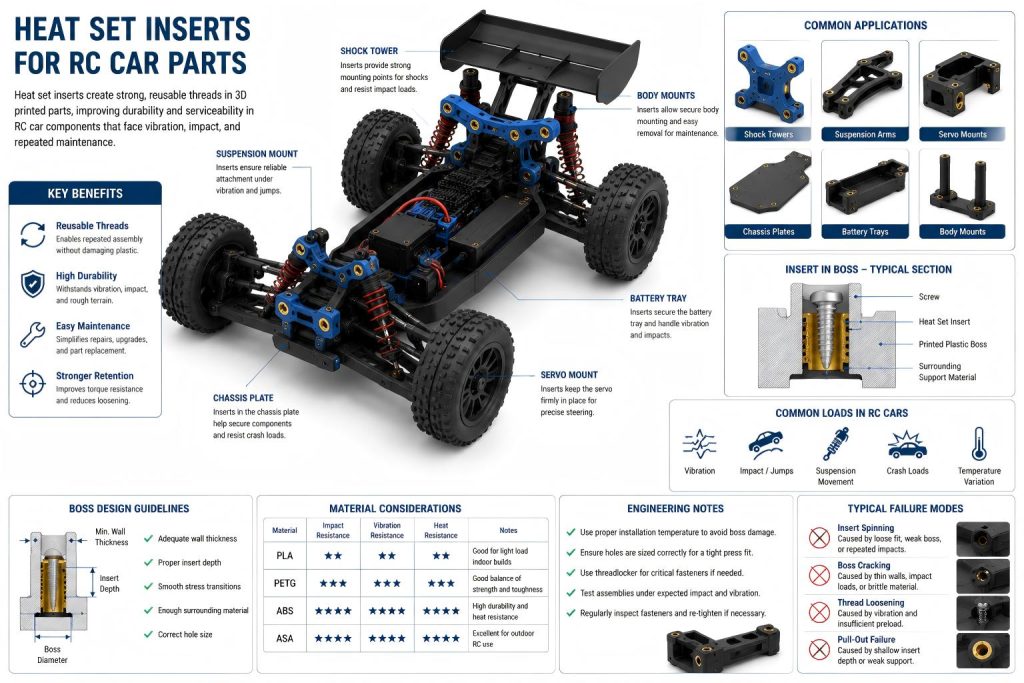
Why RC Car Parts Use Heat Set Inserts
RC vehicles experience repeated mechanical stress during operation.
Fastening systems may be exposed to:
- vibration
- shock loading
- jump impacts
- chassis flex
- repeated wheel forces
- maintenance disassembly
Heat set inserts improve fastening reliability by creating durable threaded connections inside printed thermoplastic structures.
Common advantages include:
- reusable threaded connections
- improved impact resistance
- better maintenance capability
- reduced thread wear
- improved clamp stability
- stronger fastening retention
- easier part replacement
Reliable fastening becomes especially important in high-speed or off-road RC systems.
Common RC Parts That Use Inserts
Heat set inserts are commonly used in:
- suspension mounts
- shock towers
- battery trays
- chassis plates
- body mounts
- servo mounts
- wheel protection structures
- drivetrain covers
- electronics housings
- modular frame components
Many RC builders use inserts to improve durability and simplify maintenance.
Why Fastening Reliability Matters in RC Cars
RC vehicles continuously transfer force through moving mechanical systems.
Poor fastening reliability may cause:
- suspension instability
- loose steering components
- cracked chassis sections
- vibration-related failures
- drivetrain misalignment
- maintenance problems
Fastening systems must survive repeated impact and vibration cycles.
Reliable insert performance improves:
- structural stability
- maintenance repeatability
- impact durability
- vibration resistance
- assembly consistency
Impact Loading in RC Assemblies
RC vehicles experience sudden shock loads during crashes, jumps, and rough terrain operation.
These loads generate high stress concentration around fastening points.
Common Impact Conditions
- landing shocks
- wheel impacts
- rollover crashes
- suspension compression
- abrupt directional changes
- drivetrain torque spikes
Weak fastening structures may gradually loosen or fail under repeated impact cycles.
Under repeated crash and landing loads, pull-out strength becomes a key factor in whether the insert stays anchored in the printed structure.
Boss Design for RC Components
Boss geometry strongly affects fastening survival under impact loading.
Weak bosses may crack or deform during repeated shocks.
Reliable boss structures generally require:
- sufficient wall thickness
- balanced stress distribution
- proper insert depth
- strong surrounding material support
- smooth structural transitions
RC applications often require stronger boss support than decorative or static printed parts.
For more detailed geometry rules, see boss design for heat set inserts.
Material Selection for RC Inserts
Material behavior strongly affects durability.
PLA
PLA may work for low-speed or indoor RC projects but often struggles under repeated impact and outdoor heat exposure.
Common problems include:
- brittle cracking
- creep
- heat softening
- thread loosening
PETG
PETG provides:
- improved impact resistance
- better flexibility
- reduced brittle fracture
It is commonly used for medium-load RC components.
ABS and ASA
ABS and ASA generally provide:
- improved durability
- better heat resistance
- stronger long-term structural stability
- improved vibration tolerance
These materials are often preferred for demanding RC applications.
Common Failure Problems in RC Parts
Several fastening failures appear repeatedly in RC systems.
Insert Spinning
Often caused by:
- oversized holes
- weak boss support
- repeated impact stress
- insufficient surrounding material
For RC parts exposed to drivetrain vibration and repeated tightening, torque resistance helps prevent inserts from rotating inside the printed boss.
Boss Cracking
Usually related to:
- thin wall sections
- brittle materials
- excessive insertion stress
- repeated crash loading
Thread Loosening
Common causes include:
- vibration
- suspension movement
- repeated shock cycles
- insufficient preload
Pull-Out Failure
Often caused by:
- shallow insert depth
- weak surrounding structure
- repeated impact loading
- material deformation
Print Orientation and Impact Resistance
Print orientation strongly affects crash durability.
Poor orientation may increase:
- layer separation
- cracking
- pull-out failure
- impact weakness
RC assemblies often require careful orientation planning to improve structural survival during impacts.
Serviceability in RC Platforms
RC vehicles frequently require:
- repairs
- upgrades
- suspension tuning
- electronics replacement
- drivetrain maintenance
Heat set inserts improve serviceability by allowing repeated assembly without damaging printed threads.
This becomes especially valuable in modular RC builds.
Engineering Factors That Affect Reliability
Important related engineering factors include:
- boss wall thickness
- insert depth
- print orientation
- impact loading
- vibration exposure
- material stiffness
- layer adhesion
- screw engagement length(In serviceable RC assemblies, screw engagement length should be selected carefully so repeated maintenance does not overload the insert or surrounding plastic.)
- surrounding material volume
- installation quality
Reliable fastening depends on the entire surrounding structure rather than the insert alone.
Related Failure Question
RC car parts often expose insert joints to impact, vibration, repeated screw removal, and local boss cracking. For failure diagnosis, see why heat set inserts fail in RC car parts.
FAQ
Why are heat set inserts useful in RC car parts?
RC vehicles experience vibration, impacts, and repeated maintenance cycles. Inserts improve durability and fastening reliability.
Can RC crashes damage inserts?
Yes. Repeated impacts may crack surrounding bosses or weaken layer adhesion if the structure is poorly designed.
Is PLA suitable for RC inserts?
PLA may work for low-load projects but is generally less durable under repeated impacts and outdoor heat exposure.
Why do RC inserts loosen over time?
Vibration, suspension movement, and repeated impacts may gradually reduce clamp force and weaken surrounding plastic.
Does print orientation affect RC durability?
Yes. Poor print orientation may weaken impact resistance and increase cracking or pull-out risk.
Conclusion
Heat set inserts play an important role in improving fastening reliability in RC car assemblies.
Reliable RC fastening depends on proper boss design, material selection, print orientation, impact resistance, and vibration durability.
Well-designed insert structures improve serviceability, crash resistance, and long-term structural stability in dynamic RC systems.
Related Engineering Guides
- How to Choose Heat Set Inserts for 3D Printed Parts
- Heat Set Insert Hole Size Guide
- How to Design Bosses for Heat Set Inserts
- PLA vs PETG vs ABS for Threaded Inserts
- Why Heat Set Inserts Fail in 3D Printed Parts
- Pull-Out Strength of Heat Set Inserts in 3D Printed Parts
- Torque Resistance of Heat Set Inserts in 3D Printed Parts
- Layer Adhesion and Heat Set Insert Strength in 3D Printed Parts
- Heat Set Insert Installation Temperature for 3D Printed Parts
- Screw Engagement Length for Heat Set Inserts in 3D Printed Parts