
Short Engineering Answer
Heat set inserts fail in electronics enclosures when the printed enclosure structure cannot maintain screw preload, boss support, thread stability, or cover clamping force under repeated opening, heat, vibration, thin walls, or material creep.
Electronics enclosures often look like simple screw-and-cover assemblies, but the insert joints may carry several loads at once: lid clamping, PCB mounting, cable strain, gasket compression, service access, and vibration from fans, motors, or nearby equipment.
The heat set insert is rarely the only weak point. Most failures come from the surrounding printed boss, pilot hole size, screw engagement length, material behavior, installation temperature, and repeated service cycles.
A reliable enclosure insert joint must be designed for long-term clamping and serviceability, not only for clean insert installation.
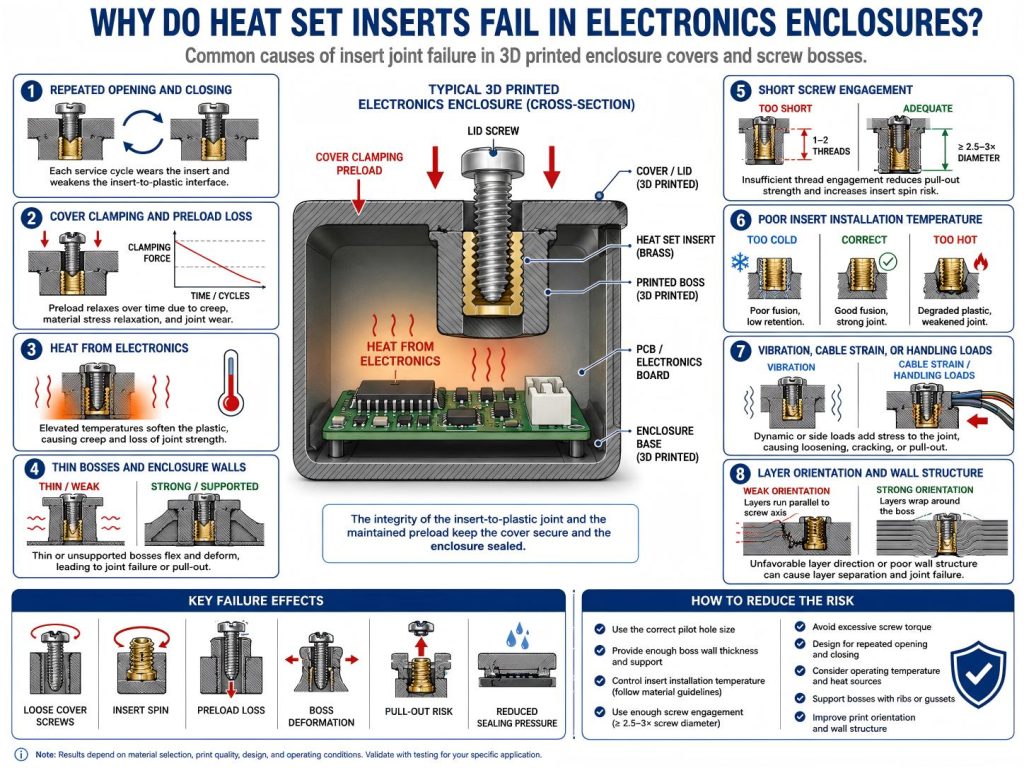
Root Causes
Repeated Opening and Closing
Electronics enclosures are often opened for assembly, inspection, wiring changes, debugging, repair, or upgrades.
Each screw removal and reinstallation transfers torque into the insert and printed boss. Over time, this can weaken the plastic-to-insert interface, especially if the boss wall is thin, the screw is over-tightened, or the pilot hole is not well matched to the insert.
A heat set insert improves thread durability, but it does not prevent the printed boss from wearing, deforming, or losing support after repeated use.
Cover Clamping and Preload Loss
Enclosure screws often clamp a lid, cover, gasket, or panel.
The clamping force depends on the screw preload staying stable. If the printed boss or enclosure wall creeps, compresses, or deforms, preload drops over time.
The cover may still appear installed, but the joint may feel loose, rattle, lose alignment, or fail to maintain sealing pressure.
This is especially important for enclosures with gaskets, snap-fit features, cable exits, or thin cover flanges.
Heat From Electronics
Electronics enclosures may contain heat-generating components such as power modules, voltage regulators, batteries, LEDs, drivers, motors, or enclosed PCBs.
Heat can reduce plastic stiffness and increase creep under preload. PETG and similar materials may relax around the insert over time, while PLA may soften or crack depending on temperature and stress concentration.
The enclosure does not need to become visibly deformed for screw preload to drop. Small dimensional changes around the boss can reduce joint reliability.
Thin Bosses and Enclosure Walls
Electronics enclosures are often designed with thin walls to save material, space, or print time.
Thin bosses may not provide enough radial support around the insert. Thin lid flanges or enclosure walls may also compress under screw load.
If the boss is too narrow, too tall, unsupported, or too close to an edge, the insert may loosen, spin, pull out, or crack the surrounding structure.
A correct hole size cannot fully compensate for a weak enclosure boss.
Short Screw Engagement
Short screws are common in compact electronics enclosures.
If screw engagement length is too short, the load is concentrated over a small thread area. This can reduce preload stability and increase local stress in the insert and boss.
Enough screw engagement helps distribute load and makes the enclosure joint less sensitive to repeated opening, vibration, and small dimensional changes.
Poor Insert Installation Temperature
Heat set insert installation requires controlled plastic flow around the insert knurling.
If the insert is installed too cold, the plastic may not flow enough to create a strong mechanical lock. If it is installed too hot, the boss may over-soften, collapse, or lose dimensional stability.
Both conditions can reduce long-term enclosure reliability, especially when the enclosure is opened repeatedly or exposed to heat during operation.
Vibration, Cable Strain, or Handling Loads
Some electronics enclosures are exposed to vibration, cable pulling, handling, transport, or mounting loads.
These loads can create small movements at the screw joint. If preload has already dropped or boss support is weak, the insert may gradually loosen or spin.
Cable strain is especially important when connectors, glands, or strain-relief features are attached near insert bosses.
Layer Orientation and Wall Structure
FDM printed enclosures are directionally strong.
If screw load or cover clamping force acts across weak layer lines, the boss may split, delaminate, or lose pull-out strength. Thin walls and low wall count can make this worse.
Heat set inserts improve thread durability, but they do not remove the directional strength limits of printed plastic.
Related Engineering Variables
Heat set insert reliability in electronics enclosures depends on several connected variables:
- Cover clamping force
- Screw preload
- Screw engagement length
- Boss wall thickness
- Boss height
- Enclosure wall thickness
- Pilot hole size
- Insert depth
- Material creep
- Installation temperature
- Operating temperature
- Repeated opening cycles
- Gasket compression
- Cable strain
- Vibration
- Layer adhesion
- Print orientation
- Wall count and local support
These variables should be evaluated together. An insert joint that works in a static enclosure may fail after repeated servicing, heat exposure, or cable loading.
Electronics enclosure fastening is not only about thread durability. It is about keeping the cover, boss, screw, and printed structure stable over time.
Engineering Interpretation
Heat set insert failure in electronics enclosures is usually a preload and serviceability problem.
The failure may appear as:
- Cover screws becoming loose
- Insert spin during screw removal
- Boss deformation under cover preload
- Pull-out from repeated service or cable load
- Boss cracking near thin walls
- Layer separation around screw bosses
- Loss of gasket or cover compression
These failure modes often overlap.
For example, an enclosure may be assembled correctly at first. After heat exposure and repeated opening, the boss may creep, preload may drop, and the insert may begin to loosen or spin.
This is why enclosure insert joints should be designed for repeated access and real operating conditions from the beginning.
How to Reduce the Risk
To reduce heat set insert failure in electronics enclosures:
- Use enough boss wall thickness around each insert.
- Avoid very thin, unsupported enclosure bosses.
- Use the correct pilot hole size for the insert and material.
- Control installation temperature carefully.
- Avoid overheating the boss during insertion.
- Use enough screw engagement length.
- Avoid excessive screw torque.
- Consider heat from electronics and batteries.
- Design for repeated opening if service access is expected.
- Support screw bosses with ribs or surrounding structure.
- Improve print orientation around loaded bosses.
- Use enough wall count and local material support.
- Reduce cable strain near insert joints where possible.
- Avoid relying on high preload in thin printed walls.
A reliable electronics enclosure insert joint must maintain clamping force, boss shape, and thread stability through real use.
The insert gives the enclosure durable threads, but the printed boss still decides whether the joint remains reliable.
Related InsertGuide Pages
- Why Does Screw Preload Drop in 3D Printed Insert Joints?
- Why Do Heat Set Inserts Become Loose Over Time?
- Why Do Threaded Inserts Loosen After Repeated Screw Removal?
- Why Does Repeated Assembly Weaken Heat Set Inserts?
- Why Do Heat Set Inserts Fail in Battery Enclosures?
- Screw Engagement Length for Heat Set Inserts in 3D Printed Parts
- Heat Set Insert Installation Temperature for 3D Printed Parts
- How to Design Bosses for Heat Set Inserts
- Layer Adhesion and Heat Set Insert Strength in 3D Printed Parts
FAQ
Are heat set inserts good for 3D printed electronics enclosures?
Yes. Heat set inserts are useful for electronics enclosures because they provide stronger and more durable threads than printed plastic. However, the boss, screw engagement, material, and cover clamping load must be designed correctly.
Why do enclosure screws become loose over time?
Enclosure screws can become loose when the printed boss creeps, compresses, or deforms under preload. Repeated opening, heat from electronics, vibration, or short screw engagement can make preload loss happen faster.
Can heat from electronics weaken insert joints?
Yes. Heat can reduce plastic stiffness and increase creep around the insert boss. This can reduce screw preload and make the insert joint more likely to loosen, deform, or lose support over time.