
Short Engineering Answer
Heat set inserts fail in RC car parts when the printed fastening structure cannot maintain preload, torque resistance, boss support, or pull-out strength under vibration, impact, repeated maintenance, and dynamic load.
RC car parts often experience shock loads, chassis vibration, motor vibration, wheel impacts, repeated screw removal, and compact lightweight geometry. These conditions can make insert joints loosen, spin, pull out, crack the boss, or separate printed layers over time.
The insert itself is usually not the first weak point. Most failures come from the surrounding printed boss, screw engagement length, material behavior, layer orientation, hole size, and repeated service cycles.
A heat set insert can work well in RC car parts, but the joint must be designed for impact, vibration, and repeated repair, not only for clean installation.
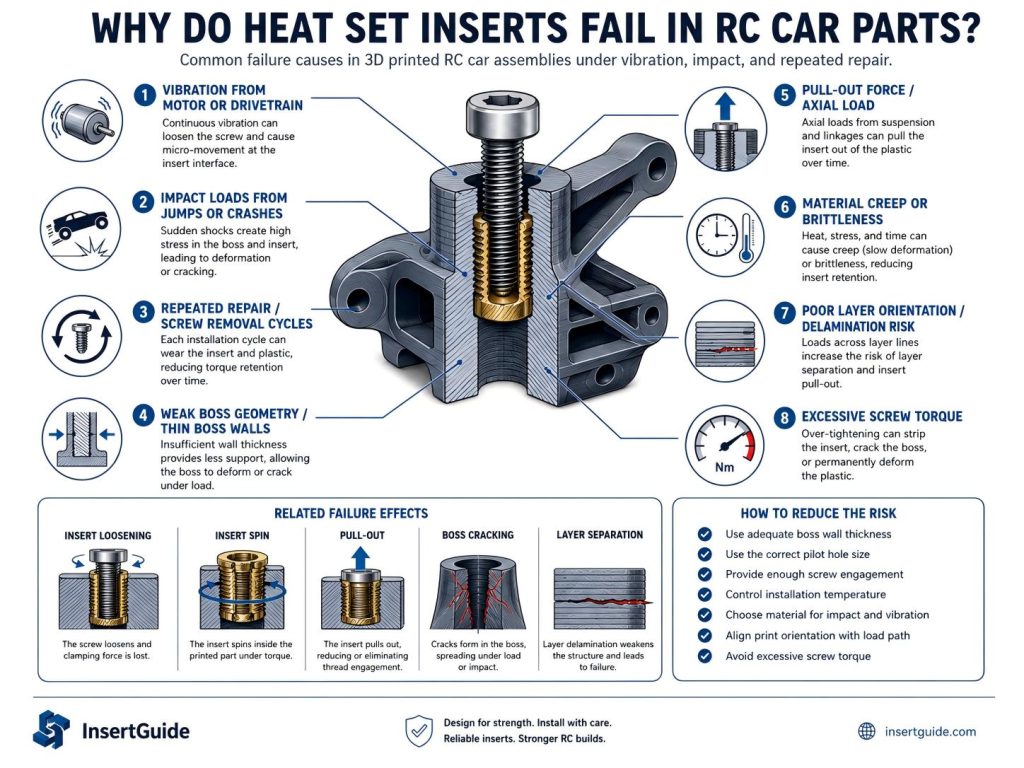
Root Causes
Vibration From Motors and Drivetrain
RC cars often create vibration through motors, gears, wheels, belts, and drivetrain components.
If the insert joint has weak preload, poor boss support, or short screw engagement, vibration can gradually reduce stability. The screw may begin to loosen, the insert may move in the plastic, or the boss may start to fatigue.
Vibration usually exposes weaknesses that already exist in the fastening structure.
Impact and Shock Loads
RC parts are often exposed to impacts from jumps, crashes, landings, and rough surfaces.
Shock loads can stress insert joints much more severely than normal static screw loads. A boss may survive installation but crack or deform after repeated impacts.
This is especially important for suspension mounts, bumper parts, motor mounts, chassis brackets, battery trays, and body mounting structures.
Repeated Repair and Screw Removal
RC cars are frequently repaired, adjusted, tuned, or upgraded.
Each screw removal and reinstallation transfers torque into the insert and surrounding printed boss. Over time, this can weaken the plastic-to-insert interface, reduce preload stability, or increase the risk of insert spin.
Heat set inserts improve thread durability, but they do not make the surrounding printed plastic immune to repeated service cycles.
Thin Lightweight Bosses
RC parts often need to be lightweight and compact.
This can lead to thin bosses, narrow mounting ears, shallow insert depth, or bosses placed close to edges. These shapes may not provide enough support around the insert.
A thin boss can deform, crack, or lose radial support under screw preload, vibration, or impact.
A correct pilot hole does not guarantee reliability if the surrounding boss is too weak.
Pull-Out Load From Mounting Forces
Many RC parts experience axial load through the screw.
A screw may pull on an insert during impact, suspension movement, body flex, or drivetrain loading. If the insert depth is shallow, the hole is oversized, or plastic flow around the knurling is poor, the insert may pull out.
Pull-out strength depends on the full printed fastening structure, not only the insert diameter.
Material Creep or Brittleness
Material behavior matters strongly in RC applications.
PETG may creep or deform under sustained preload, especially near motors or warm electronics. PLA may be stiff but can crack more easily under impact or stress concentration. ABS, ASA, nylon, or reinforced materials may perform better in some RC applications, but still require proper boss design and installation control.
The best material depends on impact, heat, vibration, and required stiffness.
Layer Orientation and Delamination
FDM printed RC parts are directionally strong.
If screw load, impact load, or pull-out force acts across weak layer lines, the part may delaminate around the insert. This can reduce pull-out strength and make the insert joint fail even when the insert itself remains intact.
Print orientation should be selected around the expected load path, especially for suspension brackets, arms, mounts, and chassis parts.
Excessive Screw Torque
Over-tightening screws can damage printed RC parts.
High torque may feel secure during assembly, but it can deform the boss, crack thin features, reduce preload stability, or weaken the insert interface.
For RC parts, controlled torque and sufficient boss support are more reliable than simply tightening harder.
Related Engineering Variables
Heat set insert reliability in RC car parts depends on several connected variables:
- Motor and drivetrain vibration
- Impact load
- Screw preload
- Tightening torque
- Screw engagement length
- Insert depth
- Pilot hole size
- Boss wall thickness
- Boss stiffness
- Material creep
- Material impact resistance
- Repeated repair cycles
- Pull-out load
- Layer adhesion
- Print orientation
- Operating temperature
- Chassis flex and mounting load
These variables should be evaluated together. An insert joint that works in a static printed enclosure may fail quickly in an RC car part because the load environment is more dynamic and impact-heavy.
RC fastening reliability is not only about thread durability. It is about whether the printed structure can survive repeated motion, impact, and repair.
Engineering Interpretation
Heat set insert failure in RC car parts is usually a dynamic load and impact problem.
The failure may appear as:
- Insert loosening from preload loss
- Insert spin during repeated repair
- Pull-out from impact or mounting force
- Boss cracking from thin geometry or over-tightening
- Layer separation from poor print orientation
- Torque loss from vibration or material creep
These failure modes often overlap.
For example, a thin PETG boss may hold the insert during installation. After repeated runs, motor heat and vibration reduce preload. A crash then adds impact load, and the insert pulls out or cracks the boss.
This is why RC car insert joints should be designed for service life, not only first assembly.
How to Reduce the Risk
To reduce heat set insert failure in RC car parts:
- Use enough boss wall thickness around each insert.
- Avoid thin, unsupported mounting ears or bosses.
- Use the correct pilot hole size for the printed material.
- Use enough insert depth for expected pull-out loads.
- Use enough screw engagement length.
- Control installation temperature carefully.
- Avoid overheating the boss during insertion.
- Avoid excessive screw torque.
- Choose material based on impact, heat, and vibration.
- Improve print orientation around loaded insert joints.
- Avoid loading inserts across weak layer lines.
- Design repeated repair points for service cycles.
- Add ribs or local reinforcement around high-load bosses.
- Reduce vibration where possible.
A reliable RC car insert joint is a supported fastening structure. The screw, insert, boss, material, and load path must work together under vibration, impact, and repeated service.
Related InsertGuide Pages
- Why Do Heat Set Inserts Fail Under Vibration?
- Why Does Repeated Assembly Weaken Heat Set Inserts?
- Why Do Threaded Inserts Loosen After Repeated Screw Removal?
- Why Do Heat Set Inserts Pull Out of 3D Printed Parts?
- Why Do Bosses Crack Around Heat Set Inserts?
- Screw Engagement Length for Heat Set Inserts in 3D Printed Parts
- Layer Adhesion and Heat Set Insert Strength in 3D Printed Parts
- How to Design Bosses for Heat Set Inserts
- Heat Set Insert Torque Resistance in PETG vs PLA Parts
FAQ
Are heat set inserts good for 3D printed RC car parts?
Yes. Heat set inserts can be useful in RC car parts that need repeated repair, stronger threads, or removable components. However, the boss, material, print orientation, and screw engagement must be designed for vibration and impact.
Why do inserts loosen in RC car parts?
Inserts loosen in RC car parts when vibration, repeated repair, impact loads, preload loss, weak boss geometry, material creep, or short screw engagement weakens the plastic around the insert.
Can heat set inserts survive RC car impacts?
They can, but only if the surrounding printed structure is strong enough. Impact reliability depends on boss wall thickness, insert depth, material toughness, layer adhesion, and the direction of the load.