
Short Engineering Answer
Heat set inserts fail in sensor brackets when the printed bracket cannot maintain preload, boss support, or insert retention under vibration, side load, repeated adjustment, thin geometry, or poor print orientation.
Sensor brackets are often small, lightweight, and cantilevered. They may hold proximity sensors, limit switches, cameras, encoders, optical sensors, or small PCBs. These parts usually do not look heavily loaded, but they often experience vibration, cable strain, repeated adjustment, and bending load.
The insert itself is rarely the only weak point. Most failures come from the surrounding printed boss, thin bracket arms, short screw engagement, layer orientation, installation quality, and the load path between the sensor and the printed structure.
A heat set insert can improve thread durability in sensor brackets, but the bracket must still be designed as a supported fastening structure.
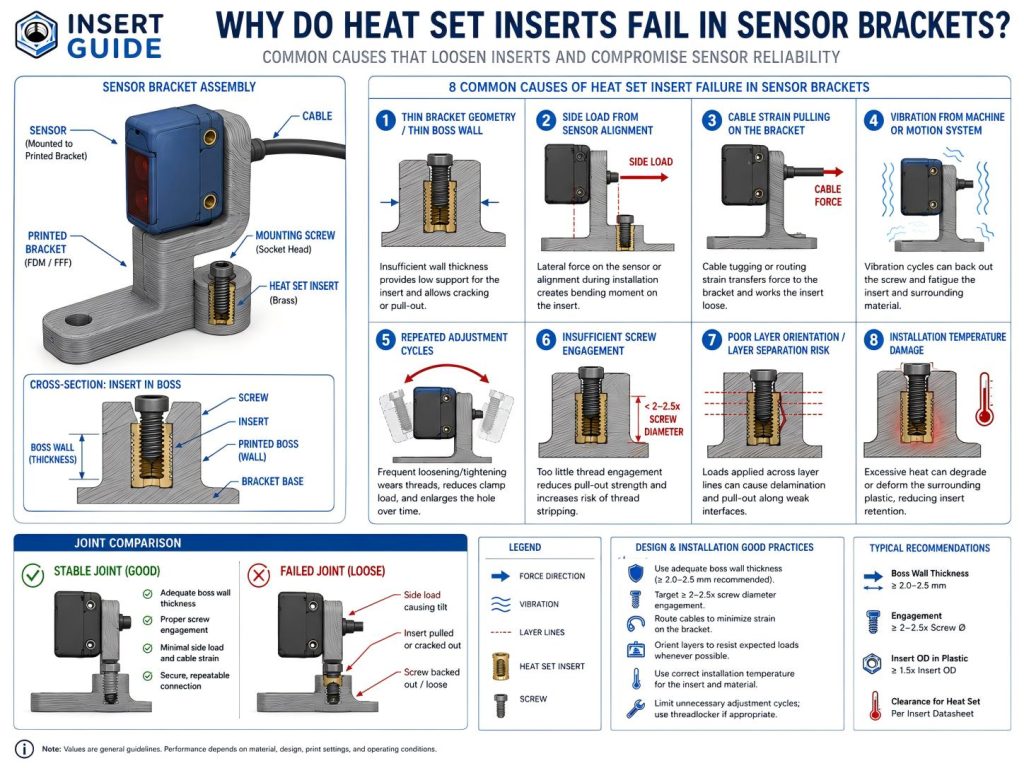
Root Causes
Thin Bracket Geometry
Sensor brackets are often designed with thin arms, small mounting ears, or compact bosses.
This reduces weight and saves space, but it also reduces the amount of printed material around the insert. If the boss wall is too thin or the insert is placed near a narrow edge, the bracket may deform, crack, or allow the insert to loosen.
A correct pilot hole does not guarantee reliability if the surrounding bracket is too weak to support the insert.
Side Load From Sensor Alignment
Sensor brackets often need precise positioning.
When a sensor is adjusted, tightened, bumped, or pulled by a cable, the load may act sideways rather than directly along the screw axis. Side load can bend the bracket and create stress around the insert boss.
Heat set inserts are strongest when the load path is well supported. If the insert is used in a thin cantilevered bracket, side load can cause boss cracking, layer separation, or insert loosening.
Cable Strain
Sensors often have wires or cables attached.
Cable pulling, routing tension, vibration, or accidental handling can transfer load into the bracket. If the cable load is near the insert, the boss may experience bending or twisting that was not considered during design.
Cable strain can slowly weaken the bracket, especially when the printed structure is thin or the sensor is mounted away from the main support body.
Vibration From Machines or Motion Systems
Sensor brackets are often used on machines, printers, robots, drones, RC vehicles, or moving mechanisms.
Vibration can reduce preload and create small movements at the screw and insert interface. If the insert joint has weak boss support, short screw engagement, or poor layer orientation, vibration can gradually cause loosening or cracking.
Vibration usually amplifies existing weaknesses rather than acting as the only cause.
Repeated Adjustment and Repositioning
Sensor brackets may be adjusted many times during setup.
Each screw removal, tightening, or repositioning cycle transfers torque into the insert and surrounding printed boss. Over time, this can weaken the plastic-to-insert interface, especially in small bosses or thin bracket features.
A heat set insert improves repeated adjustment compared with printed plastic threads, but the printed bracket still needs enough structure to survive those cycles.
Short Screw Engagement
Small brackets often use short screws.
If screw engagement length is too short, the load is concentrated in a small section of the insert. This can reduce preload stability and increase local stress around the boss.
Enough screw engagement helps distribute load through the insert and bracket, especially when the sensor is adjusted repeatedly.
Poor Layer Orientation
FDM printed sensor brackets are directionally strong.
If the sensor load, screw preload, or cable force acts across weak layer lines, the bracket may crack or delaminate around the insert. Thin arms and cantilevered features are especially sensitive to print orientation.
A heat set insert improves thread durability, but it does not remove the anisotropic strength limits of 3D printed plastic.
Installation Temperature Damage
Heat set insert installation can damage small bracket bosses if the temperature is poorly controlled.
If the insert is installed too cold, it may force the plastic outward and create stress in the boss. If it is installed too hot, the small boss may over-soften, deform, or lose shape.
Because sensor bracket bosses are often small, they have less thermal mass and less surrounding material to absorb installation error.
Related Engineering Variables
Heat set insert reliability in sensor brackets depends on several connected variables:
- Bracket thickness
- Boss wall thickness
- Boss height
- Pilot hole size
- Insert depth
- Screw engagement length
- Sensor weight
- Cable strain
- Side load
- Vibration
- Repeated adjustment cycles
- Installation temperature
- Material creep
- Layer adhesion
- Print orientation
- Distance from insert to bracket edge
These variables should be evaluated together. A sensor bracket may fail even under light load if the insert is placed in a thin, unsupported boss or if the bracket is printed with weak layer orientation.
Sensor bracket reliability is not only about holding a screw. It is about maintaining alignment and support through adjustment, vibration, and handling.
Engineering Interpretation
Heat set insert failure in sensor brackets is usually a thin-structure and side-load problem.
The failure may appear as:
- Insert loosening after repeated adjustment
- Insert spin during screw tightening
- Boss cracking near the sensor mount
- Pull-out from cable strain or bracket bending
- Layer separation along thin bracket arms
- Loss of sensor alignment
- Reduced preload after vibration
These failure modes often overlap.
For example, a sensor bracket may use a small boss near the end of a thin arm. The insert installs correctly at first. After cable movement, vibration, and repeated alignment adjustments, the boss begins to deform or crack. The sensor then shifts position, and the insert may loosen or spin.
This is why sensor bracket insert joints should be designed for alignment stability, not only screw retention.
How to Reduce the Risk
To reduce heat set insert failure in sensor brackets:
- Use enough boss wall thickness around the insert.
- Avoid placing inserts in very thin bracket arms without support.
- Add ribs or local reinforcement around sensor mounting bosses.
- Use enough screw engagement length.
- Use the correct pilot hole size for the printed material.
- Control installation temperature carefully.
- Avoid overheating small bosses during insertion.
- Route cables so they do not pull directly on the insert joint.
- Align print orientation with the expected bracket load.
- Avoid loading inserts across weak layer lines.
- Design for repeated adjustment if the sensor position will be tuned often.
- Reduce vibration transfer where possible.
- Avoid excessive screw torque in small sensor bosses.
A reliable sensor bracket insert joint must hold both the screw and the sensor position. The insert provides durable threads, but the printed bracket must provide structural support and alignment stability.
Related InsertGuide Pages
- Why Do Heat Set Inserts Fail Under Vibration?
- Why Do Threaded Inserts Loosen After Repeated Screw Removal?
- Why Does Repeated Assembly Weaken Heat Set Inserts?
- Why Do Bosses Crack Around Heat Set Inserts?
- Why Do 3D Printed Layers Separate Around Heat Set Inserts?
- Why Do Heat Set Inserts Pull Out of 3D Printed Parts?
- Screw Engagement Length for Heat Set Inserts in 3D Printed Parts
- How to Design Bosses for Heat Set Inserts
- Layer Adhesion and Heat Set Insert Strength in 3D Printed Parts
FAQ
Are heat set inserts useful in 3D printed sensor brackets?
Yes. Heat set inserts are useful when sensor brackets need repeated adjustment, removable sensors, or stronger threads. However, the bracket must have enough boss support, screw engagement, and proper print orientation.
Why do inserts loosen in sensor brackets?
Inserts loosen in sensor brackets when vibration, repeated adjustment, cable strain, side load, weak boss geometry, or poor layer orientation weakens the printed plastic around the insert.
Can cable strain cause insert failure in a sensor bracket?
Yes. Cable strain can create bending or side load on the bracket. If the insert boss is thin or poorly supported, that load can cause loosening, boss cracking, pull-out, or layer separation.