
Short Engineering Answer
Heat set inserts crack PLA bosses when the printed boss cannot absorb the radial stress created during insert installation or screw loading.
PLA is stiff and dimensionally stable, but it is also more brittle than materials such as PETG or ABS. When a heat set insert pushes softened plastic outward, the surrounding boss must contain that pressure. If the boss wall is too thin, the pilot hole is too small, the insert is overheated, or the boss is close to an edge, PLA may crack instead of deforming.
PLA boss cracking is usually a combination of material brittleness, boss geometry, hole size, installation temperature, and screw load. It is not only an insert problem.
A heat set insert can work in PLA, but the boss must be designed with enough surrounding support and controlled installation conditions.
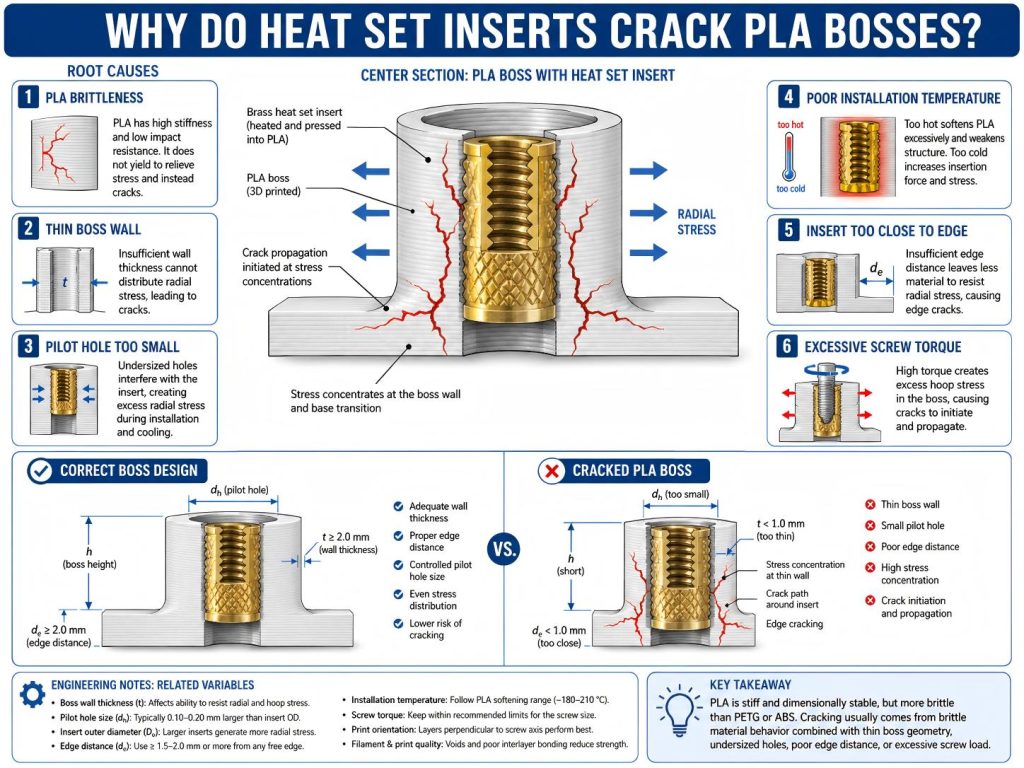
Root Causes
PLA Brittleness
PLA is relatively stiff and brittle compared with PETG or ABS.
This stiffness helps PLA hold shape, but it also means the material may not absorb radial stress well. When an insert expands or pushes material outward during installation, PLA bosses may crack rather than flex.
This is why PLA insert failures often appear as visible boss cracks, edge splitting, or sudden fracture instead of slow deformation.
Thin Boss Wall Thickness
Thin boss walls increase cracking risk.
During heat set insert installation, the insert displaces plastic outward. If the surrounding PLA wall is too thin, there is not enough material to contain that pressure.
The boss may split vertically, crack near the outer wall, or form small fractures that grow later during screw tightening.
A correct hole size helps, but it cannot fully compensate for a weak boss wall.
Pilot Hole Too Small
An undersized pilot hole is one of the most common reasons PLA bosses crack.
If the hole is too small, the insert must force too much plastic outward. PLA may not deform enough to absorb that stress, especially if the boss is small or the insert outer diameter is large.
A tight hole may feel like it creates a stronger fit, but excessive interference can damage the boss before the joint is even used.
The best PLA insert fit allows controlled plastic flow without forcing the boss apart.
Poor Installation Temperature Control
Installation temperature strongly affects PLA boss cracking.
If the insert is too cold, PLA may not soften enough to flow around the knurling. The insert behaves like a wedge and creates high radial stress.
If the insert is too hot, the local plastic can over-soften, lose shape, or become damaged near the boss. The boss may deform during installation and crack later when the screw is tightened.
Controlled temperature is especially important in PLA because the usable processing window is narrower than many users expect.
Insert Too Close to an Edge
A PLA boss near an edge, corner, slot, or thin wall has less surrounding support.
When the insert is installed or loaded by a screw, stress can travel toward the nearest free edge. This can create a crack path from the insert to the outside of the part.
Edge distance matters because PLA does not tolerate stress concentration well.
A boss that works in the center of a part may crack if the same insert is placed near an unsupported edge.
Excessive Screw Torque
PLA bosses can crack after installation if the screw is over-tightened.
High screw torque creates clamping force, radial stress, and sometimes bending load through the boss. If the boss is already stressed from installation, tightening the screw can open existing micro-cracks or create new fractures.
More screw torque does not always create a stronger PLA joint. It can overload the printed structure around the insert.
Poor Layer Orientation
FDM PLA parts are directionally strong.
If the insert load or screw load acts across weak layer lines, cracks may spread along layer boundaries. This can look like boss cracking, layer separation, or edge splitting near the insert.
A heat set insert improves thread durability, but it does not remove PLA’s printed layer structure.
Print orientation should be chosen so the boss can resist the expected screw, torque, and pull-out loads.
Large Insert in a Small Boss
A larger insert may increase thread strength, but it also increases installation stress.
If the insert outer diameter is too large relative to the PLA boss, the remaining wall thickness becomes too small. This makes cracking more likely during installation or screw loading.
In PLA parts, insert size must be matched to available boss geometry. Bigger is not automatically safer.
Related Engineering Variables
PLA boss cracking depends on several connected variables:
- PLA brittleness
- Boss wall thickness
- Boss outer diameter
- Pilot hole size
- Insert outer diameter
- Insert depth
- Edge distance
- Installation temperature
- Installation force
- Screw tightening torque
- Screw engagement length
- Layer adhesion
- Print orientation
- Boss height
- Load direction
- Repeated assembly cycles
These variables should be evaluated together. PLA can hold heat set inserts well when the boss is thick, the hole size is controlled, and screw load is moderate.
Most PLA boss cracks happen when brittle material behavior is combined with thin geometry, excessive interference, poor installation control, or concentrated screw load.
Engineering Interpretation
PLA boss cracking is a radial stress and brittle fracture problem.
It is different from PETG creep, insert spin, and pull-out failure.
PETG may slowly deform or lose preload under sustained load. PLA may crack more suddenly because it is stiffer and less ductile.
Insert spin happens when the insert rotates inside the plastic.
Pull-out happens when the insert loses axial retention.
PLA boss cracking happens when the printed structure around the insert cannot contain radial or screw-induced stress.
Once the boss cracks, other failures become more likely. The insert may loosen, spin, or pull out because the surrounding plastic no longer provides full support.
This is why PLA boss design must focus on wall thickness, edge distance, hole size, and controlled installation.
How to Reduce the Risk
To reduce PLA boss cracking around heat set inserts:
- Use enough boss wall thickness around the insert.
- Avoid placing inserts in thin or unsupported PLA features.
- Use the correct pilot hole size.
- Do not assume a tighter hole is stronger.
- Control installation temperature carefully.
- Avoid forcing inserts into undersized holes.
- Avoid overheating the boss.
- Keep enough edge distance around the boss.
- Avoid excessive screw tightening torque.
- Use enough screw engagement length.
- Align print orientation with the expected load direction.
- Add ribs, fillets, or local thickened pads where needed.
- Consider a smaller insert if the boss is too small.
- Test insert fit in the actual PLA material and printer settings.
PLA can work with heat set inserts, but the printed boss must be designed to reduce stress concentration.
The goal is controlled plastic flow and sufficient boss support, not maximum interference.
Related InsertGuide Pages
- Why Do Bosses Crack Around Heat Set Inserts?
- Why Do Heat Set Inserts Fail When the Hole Is Too Small?
- Why Do Heat Set Inserts Fail Near Edges or Corners?
- Why Do Heat Set Inserts Fail in Thin Wall 3D Printed Parts?
- What Causes Boss Deformation Around Heat Set Inserts?
- Heat Set Insert Hole Size Guide
- How to Design Bosses for Heat Set Inserts
- PLA vs PETG vs ABS for Threaded Inserts
- Layer Adhesion and Heat Set Insert Strength in 3D Printed Parts
FAQ
Can heat set inserts be used in PLA?
Yes. Heat set inserts can be used in PLA, but the boss must have enough wall thickness, correct hole size, controlled installation temperature, and enough edge distance to reduce cracking risk.
Why does PLA crack around heat set inserts?
PLA cracks around heat set inserts because it is relatively stiff and brittle. If the insert creates too much radial stress during installation or screw tightening, the PLA boss may fracture instead of deforming.
Is PETG better than PLA for avoiding boss cracks?
PETG may crack less easily because it is more ductile, but it can creep or deform under preload. PLA may hold shape better but crack more easily. The better material depends on load, temperature, boss design, and assembly frequency.
Related Decision Resources
For insert selection, tool choice, and supplier comparison, use these decision-focused references after the engineering requirements are defined.