
Short Engineering Answer
Heat set inserts fail in 3D printed fixtures when the printed fastening structure cannot maintain preload, boss support, torque resistance, or pull-out strength under repeated clamping, adjustment, vibration, and service loading.
Fixtures often use screws to hold parts, clamp components, locate assemblies, or apply repeatable pressure. These loads can be much higher and more repetitive than simple enclosure screws. If the boss is thin, the insert depth is shallow, the screw engagement is short, the material creeps, or the load direction is poorly supported, the insert joint may loosen, spin, pull out, crack the boss, or lose clamping force.
The insert itself is rarely the only weak point. In fixture applications, failure usually comes from the relationship between insert retention, boss geometry, material behavior, screw preload, clamping load, and repeated use.
A heat set insert can improve thread durability, but the fixture must still be designed as a load-bearing structure.
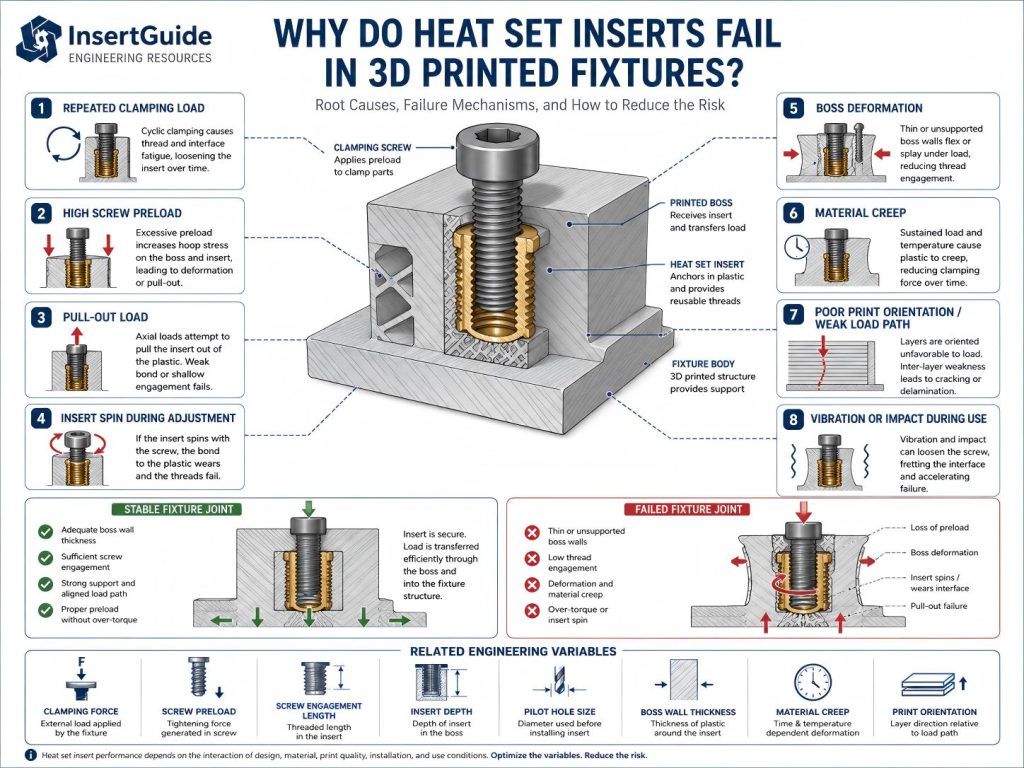
Root Causes
Repeated Clamping Load
Fixtures often rely on screws to clamp parts repeatedly.
Each clamping cycle applies preload through the screw and insert into the printed boss. If the printed plastic compresses, creeps, or deforms, the joint may lose clamping force over time.
This can make the fixture feel less accurate, less repeatable, or less secure after multiple uses.
Repeated clamping is more demanding than one-time screw assembly because the joint must maintain function through many load cycles.
High Screw Preload
A fixture screw may be tightened harder than a normal cover screw.
High preload can improve holding force at first, but it can also overstress the printed boss. In materials such as PETG, sustained preload can lead to creep. In stiffer materials such as PLA, stress concentration may lead to cracking.
If the boss cannot support the preload, the insert joint may deform or loosen even when the insert itself remains intact.
A stronger fixture joint requires controlled preload, not simply more tightening torque.
Pull-Out Load From Clamping or Holding Force
Fixtures often create axial load through the screw.
If the screw pulls upward on the insert or clamps against a workpiece, the insert must resist pull-out force. A shallow insert, oversized hole, weak boss, or poor plastic flow around the knurling can reduce axial retention.
Pull-out failure may happen suddenly when the clamping load exceeds the strength of the printed boss and insert interface.
This is especially important in jigs, workholding blocks, alignment fixtures, test fixtures, and adjustable stops.
Insert Spin During Adjustment
Fixture screws are often adjusted many times.
Every adjustment transfers torque through the insert into the surrounding plastic. If the pilot hole is oversized, the boss support is weak, or the insert interface has worn from repeated use, the insert may begin to rotate with the screw.
Insert spin makes the fixture unreliable because the screw can no longer apply predictable adjustment or clamping force.
Torque resistance is therefore critical in reusable fixtures.
Boss Deformation
The boss around the insert must remain dimensionally stable.
Fixtures often place screws near slots, clamping edges, thin walls, or adjustable features. If the boss is narrow, unsupported, or close to a loaded edge, it may deform under repeated screw force.
Boss deformation can reduce preload, change alignment, weaken insert support, or cause poor fixture repeatability.
For fixtures, boss geometry affects both strength and dimensional accuracy.
Material Creep
Material creep is a common fixture problem.
PETG and similar materials can slowly deform under sustained clamping force. If a fixture remains tightened for long periods, the boss may relax and the screw preload may drop.
This can reduce holding force, loosen the joint, or shift the fixture position over time.
Material choice should be based on clamping duration, operating temperature, load level, and required repeatability.
Layer Orientation and Load Path
Fixtures often carry load in specific directions.
If screw load, pull-out force, or clamping force crosses weak layer lines, the boss or surrounding wall may delaminate or crack. A fixture that looks strong in one orientation may fail if the printed layer direction is poorly aligned with the load path.
Heat set inserts improve thread strength, but they do not remove the anisotropic behavior of FDM printed parts.
For functional fixtures, print orientation should be chosen around the expected load direction.
Vibration or Impact During Use
Some fixtures are used near machines, tools, motors, test rigs, or moving assemblies.
Vibration and impact can accelerate preload loss if the insert joint is already weakened by repeated clamping, material creep, or boss deformation. Small movements at the insert interface can grow into insert loosening, spin, or pull-out failure.
Fixture insert joints should be designed for both static clamping force and real service conditions.
Related Engineering Variables
Heat set insert reliability in 3D printed fixtures depends on several connected variables:
- Clamping force
- Screw preload
- Tightening torque
- Screw engagement length
- Insert length
- Insert depth
- Pilot hole size
- Boss wall thickness
- Boss stiffness
- Material creep
- Fixture load direction
- Repeated adjustment cycles
- Pull-out load
- Torque load
- Layer adhesion
- Print orientation
- Vibration or impact
- Operating temperature
These variables should be evaluated together. A fixture insert joint may work for light positioning but fail under repeated clamping if the boss, material, and screw engagement are not designed for load.
Fixture reliability is not only about having metal threads. It is about keeping the printed fastening structure stable through repeated mechanical use.
Engineering Interpretation
Heat set insert failure in 3D printed fixtures is usually a repeated load and clamping stability problem.
The failure may appear as:
- Insert loosening from preload loss
- Insert spin during repeated adjustment
- Pull-out under clamping load
- Boss deformation from high screw force
- Boss cracking from stress concentration
- Layer separation from poor load direction
- Loss of fixture accuracy or repeatability
These failure modes often interact.
For example, repeated clamping may cause PETG creep. Preload drops. The screw is tightened harder. The boss deforms. Eventually, the insert spins or pulls out.
This is why fixture insert joints should be designed around the actual load path, not only around insert installation.
A heat set insert gives the fixture durable threads, but the printed boss must carry the clamping load.
How to Reduce the Risk
To reduce heat set insert failure in 3D printed fixtures:
- Use enough boss wall thickness around each insert.
- Use enough insert depth for the expected pull-out load.
- Use enough screw engagement length.
- Use the correct pilot hole size for the insert and material.
- Control installation temperature carefully.
- Avoid overheating or collapsing the boss.
- Avoid excessive screw torque.
- Design bosses with ribs or surrounding support.
- Avoid placing inserts too close to loaded edges or thin walls.
- Choose material based on clamping load, creep, and temperature.
- Align print orientation with the expected fixture load path.
- Reduce vibration or impact where possible.
- Design repeated adjustment points for service life, not one-time assembly.
- Use washers or load-spreading features when clamping surfaces need support.
The goal is not only to keep the insert from falling out. The goal is to maintain fixture preload, alignment, and repeatability through repeated use.
A reliable 3D printed fixture needs a supported fastening system, not just a metal insert in plastic.
Related InsertGuide Pages
- Why Does Screw Preload Drop in 3D Printed Insert Joints?
- Why Does Repeated Assembly Weaken Heat Set Inserts?
- Why Do Threaded Inserts Loosen After Repeated Screw Removal?
- Why Do Heat Set Inserts Pull Out of 3D Printed Parts?
- What Causes Boss Deformation Around Heat Set Inserts?
- Torque Resistance of Heat Set Inserts in 3D Printed Parts
- Pull-Out Strength of Heat Set Inserts in 3D Printed Parts
- Screw Engagement Length for Heat Set Inserts in 3D Printed Parts
- How to Design Bosses for Heat Set Inserts
FAQ
Are heat set inserts good for 3D printed fixtures?
Yes. Heat set inserts are useful for 3D printed fixtures because they provide durable threads for repeated adjustment and clamping. However, the boss, material, screw engagement, and load path must be designed for repeated mechanical load.
Why do inserts loosen in printed fixtures?
Inserts loosen in printed fixtures when repeated clamping, screw adjustment, preload loss, material creep, boss deformation, or vibration weakens the plastic-to-insert interface.
Can heat set inserts handle clamping force in fixtures?
They can, but only when the surrounding printed boss is strong enough. Pull-out strength, boss wall thickness, insert depth, screw engagement, and print orientation all affect how much clamping force the fixture can support.