
Short Engineering Answer
Heat set inserts fail when the hole is too small because the insert must force too much printed plastic outward during installation.
A heat set insert needs controlled interference, not excessive force. During installation, softened plastic should flow around the insert knurling and form a mechanical lock. If the hole is too small, the insert behaves more like a wedge. It pushes too much material outward, creating high radial stress in the boss or wall.
This can cause boss cracking, surface bulging, deformation, poor insert alignment, layer separation, or long-term joint weakness.
An undersized hole failure is usually a radial stress problem, not a stronger-fit advantage.
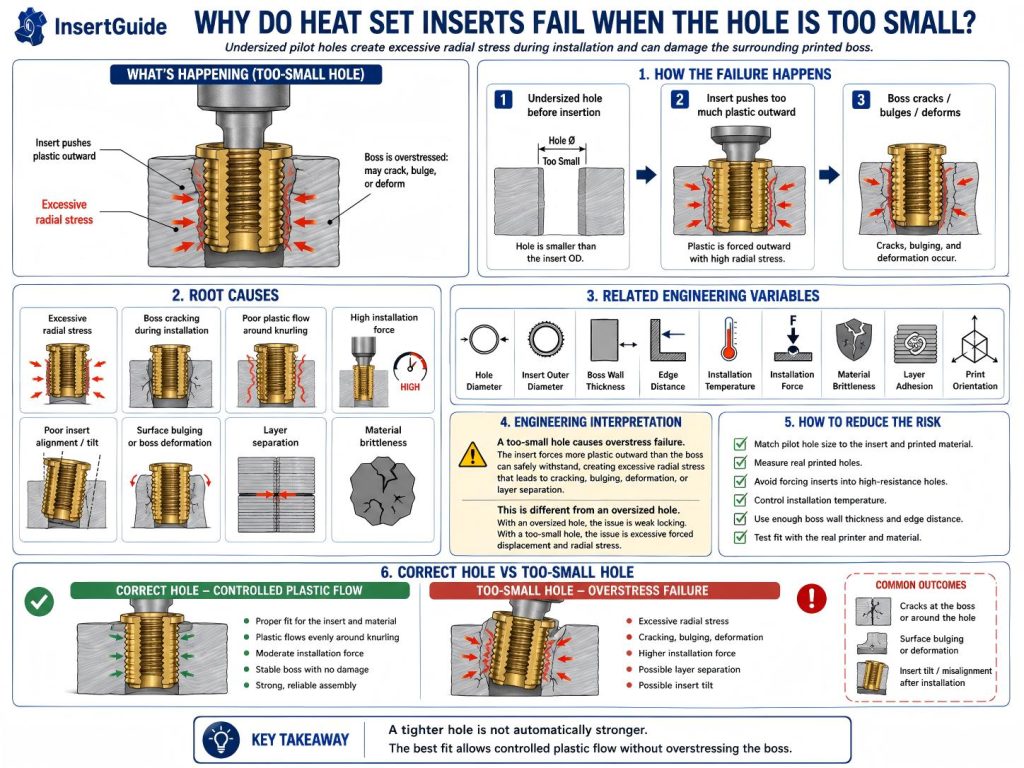
Root Causes
Excessive Radial Stress
A hole that is too small creates excessive radial stress during insert installation.
As the insert enters the printed hole, it displaces plastic outward. In a properly sized hole, this displacement is controlled. In an undersized hole, the plastic has to move too much.
The boss may not have enough wall thickness or ductility to contain that pressure. The result can be cracking, bulging, ovalization, or hidden internal damage around the insert.
A tighter fit is not always stronger.
Boss Cracking During Installation
Boss cracking is one of the most common outcomes of an undersized insert hole.
If the hole is too small, the insert can split the boss as it is pushed in. This is especially likely in PLA, thin bosses, small M3 structures, or parts with poor edge distance.
The crack may appear immediately, or it may remain small and grow later when the screw is tightened.
Once the boss cracks, torque resistance, pull-out strength, and preload stability are all reduced.
Plastic Cannot Flow Smoothly
Heat set insert installation depends on controlled plastic flow.
If the hole is too small, the insert may not allow plastic to flow smoothly around the knurling. Instead, material can be pushed outward, trapped, smeared, or forced into weak areas of the boss.
This may create a poor internal interface even if the insert looks seated from the outside.
Good installation is not just about pressing the insert into the part. It is about forming a stable plastic-to-insert lock without damaging the surrounding structure.
Installation Force Becomes Too High
An undersized hole usually requires more force during installation.
Higher force can bend small features, distort the boss, push the insert off-axis, or cause the insert to sink unevenly. If the operator compensates by increasing heat or pressure, the boss may soften too much or collapse.
This can result in poor alignment, damaged knurl engagement, weak radial support, or inconsistent screw fit.
Poor Insert Alignment
A hole that is too tight can make the insert harder to align.
As the insert enters the hole, uneven resistance may cause it to tilt. A tilted insert creates uneven wall thickness around the boss and concentrates stress on one side.
This can lead to screw misalignment, local cracking, poor preload, or uneven pull-out strength.
In small parts, a slight tilt can become a serious fastening problem.
Surface Bulging or Boss Deformation
If plastic cannot move inward or flow around the insert, it may bulge outward.
Surface bulging is a sign that the boss or wall has been overstressed during installation. Even if no visible crack appears, the printed structure may have lost dimensional stability.
Boss deformation can reduce screw preload, weaken torque resistance, and make the insert joint less reliable under repeated assembly.
Layer Separation
FDM printed parts are weaker between layers than along continuous printed paths.
When an undersized hole creates high radial stress, that stress may split the part along layer lines. This is more likely when the boss is printed in an unfavorable orientation or when layer adhesion is weak.
Layer separation around the insert reduces both pull-out strength and long-term joint stability.
Material Brittleness
Material behavior affects how an undersized hole fails.
PLA may crack because it is relatively stiff and brittle. PETG may deform or bulge more before cracking. ABS or ASA may tolerate some deformation better, but they still need enough boss support and controlled installation.
No material makes an undersized hole automatically safe. The correct fit still matters.
Related Engineering Variables
Undersized hole failure depends on several connected variables:
- Printed hole diameter
- Insert outer diameter
- Insert knurl geometry
- Boss wall thickness
- Boss outer diameter
- Edge distance
- Installation temperature
- Installation force
- Material brittleness
- Material ductility
- Layer adhesion
- Print orientation
- Insert depth
- Screw tightening torque
- Boss height
- Repeated assembly cycles
These variables should be evaluated together. A hole that is slightly tight in a thick ABS boss may behave differently from the same hole in a thin PLA boss near an edge.
The correct hole size is not simply the smallest hole that accepts the insert. It is the size that allows controlled plastic flow without overstressing the printed structure.
Engineering Interpretation
A hole that is too small causes an overstress failure.
This is different from an oversized hole.
An oversized hole usually causes weak locking because the insert does not engage enough plastic.
An undersized hole usually causes structural damage because the insert forces too much plastic outward.
Both can lead to insert failure, but the failure paths are different.
A too-large hole often causes insert spin, loosening, or pull-out because the plastic-to-insert lock is weak.
A too-small hole often causes boss cracking, boss deformation, surface bulging, poor alignment, or layer separation because the printed structure is overstressed.
The best heat set insert joint uses controlled interference, not maximum tightness.
How to Reduce the Risk
To reduce heat set insert failure from undersized holes:
- Do not assume a tighter hole is stronger.
- Match pilot hole size to the insert and printed material.
- Measure actual printed holes, not only CAD dimensions.
- Test insert fit using the real printer, material, and slicer settings.
- Avoid forcing the insert into a hole with high resistance.
- Control installation temperature carefully.
- Avoid increasing heat to compensate for a poor hole size.
- Use enough boss wall thickness around the insert.
- Increase edge distance where possible.
- Avoid placing tight insert holes in thin walls or small corner bosses.
- Align print orientation with the expected load direction.
- Use a smaller insert or larger boss if the structure cannot support the required hole size.
The goal is to let the plastic flow around the insert, not to crush the boss around it.
A reliable heat set insert joint starts with a hole that supports controlled installation and long-term load resistance.
Related InsertGuide Pages
- Heat Set Insert Hole Size Guide
- M3 Heat Set Insert Hole Size for 3D Printed Parts
- Why Do Heat Set Inserts Fail When the Hole Is Too Large?
- Why Do Bosses Crack Around Heat Set Inserts?
- What Causes Boss Deformation Around Heat Set Inserts?
- Why Do Heat Set Inserts Fail Near Edges or Corners?
- Why Do Heat Set Inserts Fail in Thin Wall 3D Printed Parts?
- Heat Set Insert Installation Temperature for 3D Printed Parts
- How to Design Bosses for Heat Set Inserts
FAQ
Is a smaller hole stronger for heat set inserts?
Not always. A smaller hole may increase interference, but too much interference can crack, deform, or overstress the boss. The best hole size creates controlled plastic flow without damaging the printed structure.
What happens if the insert hole is too small?
If the insert hole is too small, the insert may force too much plastic outward during installation. This can cause boss cracking, surface bulging, layer separation, poor alignment, or long-term joint weakness.
Can higher installation temperature fix a hole that is too small?
Not reliably. Higher temperature may make the insert easier to push in, but it can also over-soften or collapse the boss. The better fix is correct hole sizing and enough boss support.