
Short Engineering Answer
Screw preload drops in 3D printed insert joints when the printed plastic around the insert, boss, or clamped surface relaxes, creeps, deforms, or loses support after tightening.
A screw may feel tight during assembly because tightening torque creates clamping force. But in 3D printed parts, that clamping force depends on the surrounding plastic structure staying stable. If the material creeps, the boss deforms, the screw engagement is too short, the insert fit is weak, or the joint is exposed to vibration or heat, preload can gradually decrease.
Preload drop is not always caused by screw back-out. In many cases, the screw remains in place, but the printed structure has relaxed enough that the clamping force is lower than before.
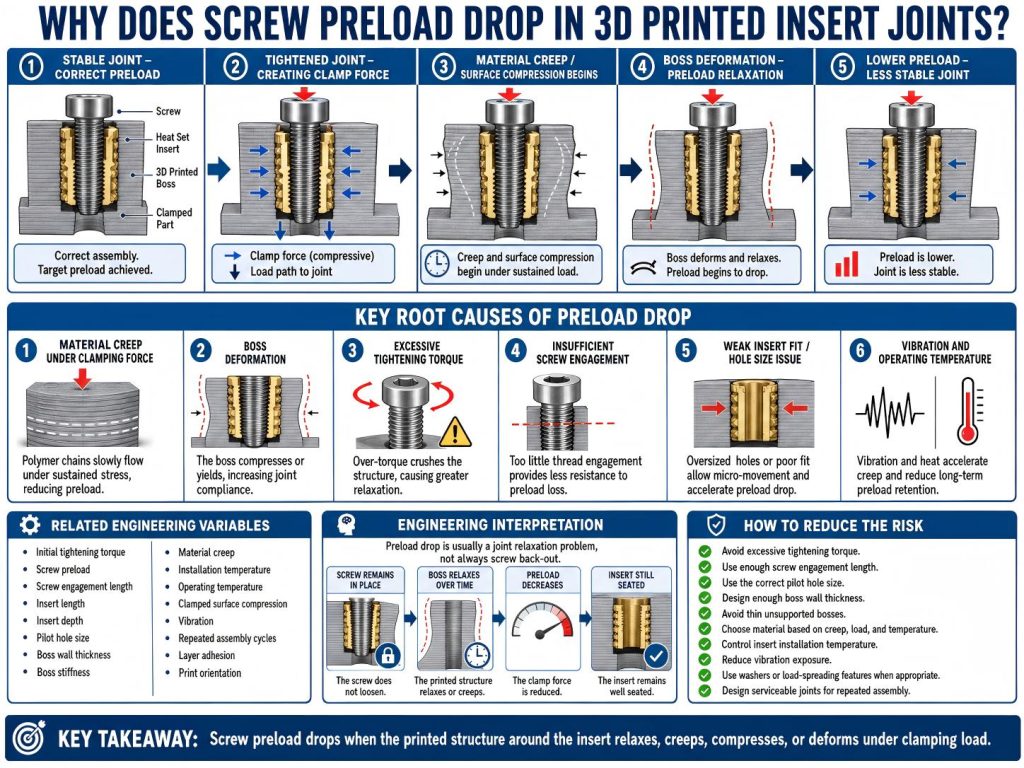
Root Causes
Material Creep Under Clamping Force
Many 3D printed plastics can deform slowly under sustained load.
When a screw is tightened into a heat set insert, the joint compresses the printed material. If the material creeps over time, the distance between clamped surfaces may change slightly. This reduces screw preload.
PETG is a common example because it can relax under sustained clamping load, especially when boss geometry is weak or the part is exposed to heat. PLA may creep less in some cases, but it can crack under stress concentration. ABS may tolerate heat and deformation better in some applications, but still depends on design quality.
Boss Deformation Around the Insert
The boss must support both the insert and the screw load.
If the boss wall is thin, tall, unsupported, or close to an edge, tightening the screw can deform the boss. This may happen immediately during assembly or gradually under load.
As the boss deforms, radial support around the insert decreases. The screw may still be engaged, but the joint loses clamping force because the printed structure no longer holds its original shape.
Boss deformation is one of the most common reasons preload drops in functional printed assemblies.
Excessive Tightening Torque
More screw torque does not always create a more reliable joint.
If the tightening torque exceeds what the printed boss and material can support, the plastic may compress, yield, creep, or crack. The joint may feel tight at first, but the high preload can accelerate plastic relaxation.
This is especially important in PETG, thin bosses, small M3 joints, and serviceable parts that are repeatedly tightened.
A reliable joint needs controlled preload, not maximum torque.
Insufficient Screw Engagement Length
Screw engagement length affects how load is distributed through the insert.
If the screw engages only a short portion of the insert, the load is concentrated near a smaller thread region. This can make preload less stable and increase local stress around the insert.
Short engagement also makes the joint more sensitive to vibration, repeated assembly, and small dimensional changes in the printed plastic.
Enough screw engagement helps distribute load more consistently through the insert and boss.
Weak Insert Fit
A heat set insert depends on the surrounding plastic for support.
If the pilot hole is too large, the insert may not have enough mechanical lock. If the hole is too small, the boss may be overstressed or deformed during installation. Both conditions can reduce preload stability.
A weak insert fit may not fail immediately. Instead, the joint may slowly lose stiffness, torque resistance, and clamping force after assembly.
Surface Compression in Printed Parts
3D printed surfaces can compress under screw load.
Layer lines, wall patterns, infill transitions, and local surface roughness can all affect how a clamped joint settles after tightening. If the clamped plastic surface compresses or embeds slightly under the screw head, washer, or mating part, preload can drop.
This is why preload loss can happen even when the insert itself is stable.
Vibration and Dynamic Load
Vibration can accelerate preload loss.
When a printed insert joint is exposed to repeated motion, motor vibration, cyclic load, or impact, small movements can occur at the screw, insert, boss, or clamped surface. If preload has already dropped due to creep or deformation, vibration can make loosening happen faster.
Vibration usually exposes an existing weakness in preload stability rather than being the only cause.
Operating Temperature
Temperature affects the stiffness and creep behavior of printed plastics.
A joint that holds preload at room temperature may lose preload faster near motors, batteries, electronics, heated chambers, or warm outdoor conditions. The material does not need to melt. A moderate increase in temperature can reduce stiffness and increase relaxation under clamping load.
For preload-sensitive joints, operating temperature should be treated as a design variable.
Related Engineering Variables
Screw preload stability depends on several connected variables:
- Initial tightening torque
- Screw preload
- Screw engagement length
- Insert length
- Insert depth
- Pilot hole size
- Boss wall thickness
- Boss stiffness
- Material creep
- Installation temperature
- Operating temperature
- Clamped surface compression
- Vibration
- Repeated assembly cycles
- Layer adhesion
- Print orientation
These variables should be evaluated together. A joint may lose preload even if the insert does not spin, pull out, or visibly loosen.
Preload drop is often a hidden failure mode because the joint can still look assembled while clamping force has decreased.
Engineering Interpretation
Screw preload drop is a joint relaxation problem.
It is related to insert loosening, PETG torque loss, repeated assembly failure, and vibration failure, but it is not exactly the same as any one of them.
Insert spin is a rotational failure.
Pull-out is an axial retention failure.
Boss cracking is a structural fracture.
Preload drop happens when the clamping force in the screw joint decreases because the printed structure relaxes, compresses, creeps, or deforms.
A heat set insert provides durable metal threads, but it does not guarantee stable preload. The preload is maintained by the screw, insert, boss, material, and clamped structure working together.
If the printed part cannot maintain dimensional stability under load, the joint will lose preload over time.
How to Reduce the Risk
To reduce screw preload drop in 3D printed insert joints:
- Avoid excessive tightening torque.
- Use enough screw engagement length.
- Use the correct pilot hole size.
- Design enough boss wall thickness around the insert.
- Avoid thin, unsupported, or edge-adjacent bosses.
- Choose material based on creep, load, and operating temperature.
- Control insert installation temperature.
- Avoid overheating the boss during insertion.
- Reduce vibration exposure where possible.
- Use washers or load-spreading features when appropriate.
- Design serviceable joints for repeated assembly.
- Avoid relying on high preload in weak printed bosses.
The goal is to maintain clamping force over time, not simply to make the screw feel tight during assembly.
For 3D printed insert joints, preload stability depends on the entire fastening structure.
Related InsertGuide Pages
- Why Does PETG Lose Screw Torque Over Time?
- Why Do Heat Set Inserts Become Loose Over Time?
- Why Does Repeated Assembly Weaken Heat Set Inserts?
- What Causes Boss Deformation Around Heat Set Inserts?
- Why Do Heat Set Inserts Fail Under Vibration?
- Screw Engagement Length for Heat Set Inserts in 3D Printed Parts
- Heat Set Insert Torque Resistance in PETG vs PLA Parts
- How to Design Bosses for Heat Set Inserts
- PLA vs PETG Fastening Behavior for Heat Set Inserts
FAQ
Can screw preload drop even if the screw does not back out?
Yes. Screw preload can drop when the printed plastic creeps, compresses, or deforms under clamping load. The screw may remain in place, but the joint loses clamping force.
Is preload loss common in PETG insert joints?
PETG can lose preload under sustained load because it may creep or relax over time. The risk depends on boss design, screw torque, operating temperature, screw engagement, and load conditions.
Does tightening the screw harder prevent preload loss?
Not usually. Over-tightening can increase stress and accelerate plastic deformation. Better preload stability usually comes from stronger boss design, proper screw engagement, controlled torque, and suitable material choice.