
Short Engineering Answer
The most common reason heat set inserts fail in 3D printed parts is not the insert itself. It is usually a mismatch between hole size, boss design, material behavior, installation temperature, and the load applied by the screw.
A heat set insert works only when the surrounding printed plastic can support it. If the pilot hole is too large, the insert may not lock into the plastic. If the hole is too small, the boss may crack or deform. If the boss wall is thin, the insert may lose support. If the material creeps, the joint may loosen over time. If the screw applies too much torque or pull-out load, the insert may spin, loosen, pull out, or damage the boss.
Most failures happen because the fastening structure is treated as a hole with a metal insert, instead of a complete load-bearing system.
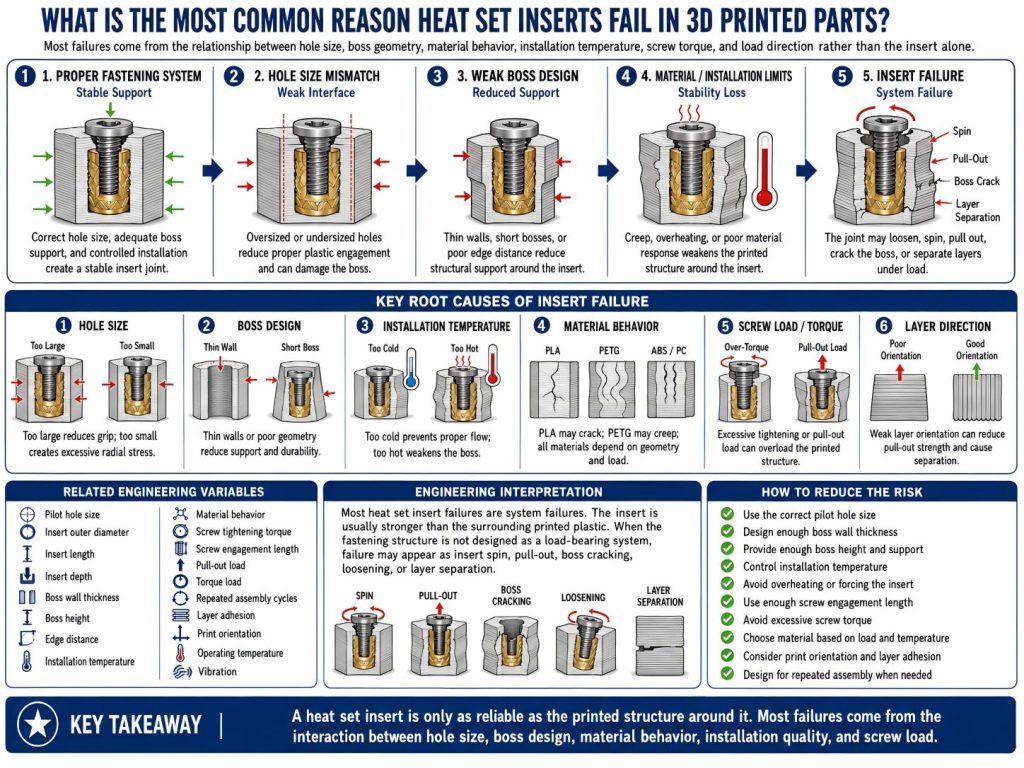
Root Causes
Poor Relationship Between Hole Size and Insert Geometry
Hole size is one of the first variables that affects insert reliability.
If the hole is too large, the insert does not displace enough plastic during installation. The knurled surface may not be fully surrounded by softened material, reducing torque resistance and pull-out strength.
If the hole is too small, the insert forces too much plastic outward. This can create radial stress, boss deformation, cracking, or surface bulging.
A reliable heat set insert joint needs controlled interference. The hole must be small enough for plastic engagement but not so small that it damages the boss.
Weak Boss Design
The boss is the main load-bearing structure around the insert.
Even with the correct hole size, a weak boss can cause failure. Thin walls, short boss height, poor edge distance, unsupported geometry, or sharp transitions can reduce structural support around the insert.
A weak boss may crack during installation, deform under screw preload, lose radial support, or allow the insert to spin or pull out.
This is why boss geometry often matters as much as the insert size.
Incorrect Installation Temperature
Installation temperature controls how plastic flows around the insert.
If the insert is installed too cold, the plastic may not soften enough. The insert may wedge into the hole and create stress instead of forming a clean mechanical lock.
If the insert is installed too hot, the boss may over-soften, collapse, deform, or lose strength around the insert.
A good installation should create controlled plastic flow around the knurling without burning, voiding, or weakening the boss.
Material Behavior
Different 3D printing materials fail in different ways.
PLA is stiff and can hold shape well, but it may crack under radial stress or stress concentration.
PETG is tougher and less brittle, but it can creep or deform under sustained preload, heat, or repeated assembly.
ABS can tolerate heat and deformation better in some conditions, but still depends on hole size, boss design, and installation quality.
There is no universal best material for every heat set insert application. Material behavior must be matched to the load, temperature, assembly frequency, and boss geometry.
Excessive Screw Torque
A heat set insert joint can fail when the screw applies more load than the printed structure can support.
Excessive tightening torque can deform the boss, reduce preload stability, damage the plastic-to-insert interface, or cause insert spin. In some materials, the boss may crack immediately. In others, the structure may creep or loosen over time.
More torque does not automatically create a stronger joint. If the boss and material cannot support the preload, higher torque can make failure happen sooner.
Insufficient Screw Engagement
Screw engagement length affects how load is transferred through the insert.
If the screw engages too few threads, the load is concentrated in a short section of the insert. This can increase local stress and reduce joint stability.
Insufficient engagement can contribute to loosening, poor preload retention, insert movement, and repeated assembly failure.
A strong insert joint needs enough thread engagement to distribute load properly.
Poor Load Direction or Layer Orientation
FDM printed parts are anisotropic, meaning strength changes with print orientation.
If the screw load, pull-out load, or bending load acts across weak layer lines, the printed structure may fail even if the insert is properly installed.
Layer separation, boss cracking, and reduced pull-out strength often come from load paths that cross weak layer bonds.
Heat set inserts improve thread durability, but they do not remove the directional strength limits of 3D printed parts.
Related Engineering Variables
For a broader diagnosis path, use the heat set insert troubleshooting page before changing insert size or material.
Heat set insert failure depends on several connected variables:
- Pilot hole size
- Insert outer diameter
- Insert length
- Insert depth
- Boss wall thickness
- Boss height
- Edge distance
- Installation temperature
- Material behavior
- Screw tightening torque
- Screw engagement length
- Pull-out load
- Torque load
- Repeated assembly cycles
- Layer adhesion
- Print orientation
- Operating temperature
- Vibration
These variables should not be evaluated separately. A failure may appear as insert spin, pull-out, boss cracking, loosening, or layer separation, but the root cause is often a combination of geometry, material, and load.
The most reliable designs treat the insert, boss, screw, and printed material as one fastening system.
Engineering Interpretation
Most heat set insert failures are system failures.
The metal insert is usually stronger than the surrounding printed plastic. The limiting factor is often the printed structure that supports the insert.
If the insert spins, the plastic-to-insert interface cannot resist rotational torque.
If the insert pulls out, the structure cannot resist axial load.
If the boss cracks, the surrounding plastic cannot contain radial stress.
If the joint becomes loose, the structure has lost preload or interface stability.
If layers separate, the load path has exceeded layer adhesion.
These failures look different, but they often share the same underlying issue: the printed part was not designed as a load-bearing fastening structure.
How to Reduce the Risk
To reduce the risk of heat set insert failure in 3D printed parts:
- Use the correct pilot hole size for the insert and printed material.
- Design enough boss wall thickness around the insert.
- Provide enough boss height and structural support.
- Control installation temperature carefully.
- Avoid overheating or forcing the insert.
- Use enough screw engagement length.
- Avoid excessive screw torque.
- Choose material based on load, temperature, and assembly frequency.
- Consider print orientation and layer adhesion.
- Avoid placing bosses too close to edges or thin walls.
- Design for repeated assembly if the part will be opened often.
- Treat vibration and operating temperature as design variables.
The most important rule is simple: do not design only for insert installation. Design for the load the insert must carry after installation.
A heat set insert is only as reliable as the printed structure around it.
Related InsertGuide Pages
- Why Heat Set Inserts Fail in 3D Printed Parts
- Heat Set Insert Hole Size Guide
- How to Design Bosses for Heat Set Inserts
- Pull-Out Strength of Heat Set Inserts in 3D Printed Parts
- Torque Resistance of Heat Set Inserts in 3D Printed Parts
- Layer Adhesion and Heat Set Insert Strength in 3D Printed Parts
- Heat Set Insert Installation Temperature for 3D Printed Parts
- Screw Engagement Length for Heat Set Inserts in 3D Printed Parts
- What Causes Boss Deformation Around Heat Set Inserts?
- Why Do Heat Set Inserts Become Loose Over Time?
FAQ
Are heat set insert failures usually caused by the insert?
Usually not. In many 3D printed parts, the insert remains intact while the surrounding plastic fails. The cause is often poor hole size, weak boss design, material creep, installation error, or excessive screw load.
Is hole size the most important factor?
Hole size is important, but it is not the only factor. A correct hole size cannot fix a thin boss, weak layer orientation, poor material choice, overheating, or excessive screw torque.
Can a stronger insert prevent failure?
Not always. A stronger or larger insert may help only if the printed boss can support it. If the boss is thin, poorly supported, or made from material that creeps under load, changing the insert alone may not solve the problem.