
Short Engineering Answer
Boss deformation around heat set inserts happens when the printed boss cannot maintain its shape under installation heat, radial insert pressure, screw preload, material creep, or repeated assembly load.
The insert may be installed correctly at first, but the surrounding boss can soften, expand, compress, creep, or distort over time. This reduces support around the insert and can lead to loosening, insert spin, pull-out failure, boss cracking, or poor screw preload retention.
Boss deformation is usually not caused by one factor alone. It comes from the relationship between boss wall thickness, hole size, material behavior, installation temperature, screw torque, insert depth, and long-term load.
A heat set insert does not work as an isolated metal part. It depends on the printed boss to remain dimensionally stable.
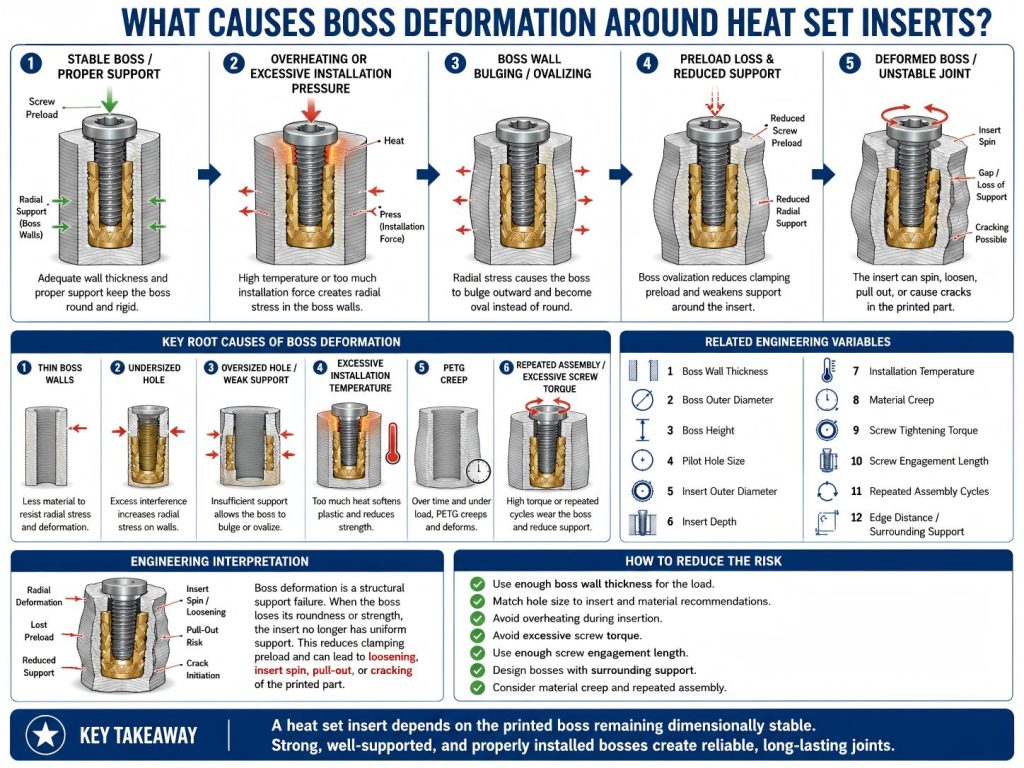
Root Causes
Thin Boss Wall Thickness
A thin boss wall has limited material to resist radial pressure and screw load.
During heat set insert installation, the softened plastic must flow around the insert knurling. If the boss wall is too thin, the outward pressure can cause the boss to bulge, stretch, or crack.
Even if the boss does not crack immediately, it may lose dimensional stability. This can reduce the mechanical lock around the insert and make the joint weaker over time.
A correct hole size cannot fully compensate for insufficient boss wall thickness.
Excessive Installation Temperature
Installation temperature directly affects boss deformation.
If the insert is too hot, the surrounding plastic may over-soften. Instead of flowing only around the insert knurling, the boss may collapse, widen, sink, or lose shape.
Overheating can also damage the local structure around the insert. The boss may look acceptable from the outside, but the plastic-to-insert interface may be weaker than expected.
Good installation should create controlled plastic flow, not uncontrolled melting.
Undersized Pilot Hole
A pilot hole that is too small can force too much plastic outward during installation.
The insert acts like a wedge if the hole does not provide enough space for controlled material displacement. This can stretch or deform the boss wall, especially in small M3 structures or brittle materials.
An undersized hole may feel tight during installation, but the extra interference can damage the printed boss and reduce long-term reliability.
Oversized Pilot Hole
An oversized pilot hole can also contribute to deformation, but in a different way.
If the hole is too large, the insert may not be surrounded by enough plastic. Under screw load, the boss may flex or deform because the insert does not have stable radial support.
This can lead to loose inserts, reduced torque resistance, or uneven load transfer through the boss.
Both undersized and oversized holes can create problems. The goal is controlled fit, not simply a tighter or looser hole.
Material Creep
Some 3D printing materials deform slowly under sustained load.
PETG is a common example. PETG can work well with heat set inserts, but under continuous screw preload, heat, or vibration, it may creep around the boss and insert.
As the boss deforms, screw preload can drop and the insert may lose support. This is one reason PETG insert joints can feel stable at first but become loose after long-term use.
PLA may deform less under sustained load, but it can crack more easily under stress concentration. ABS may tolerate heat and deformation better in some cases, but still depends on boss geometry and installation quality.
Excessive Screw Torque
Screw torque creates clamping force through the insert and boss.
If the screw is over-tightened, the boss may compress, bulge, or deform around the insert. This is especially likely when the boss wall is thin, the material is soft, or the screw engagement length is short.
More torque does not always create a stronger joint. If the printed structure cannot support the preload, higher torque can accelerate deformation and reduce reliability.
Repeated Assembly
Repeated screw installation and removal can gradually deform the boss.
Each assembly cycle applies torque, compression, and local stress to the insert-to-plastic interface. Over time, this can enlarge the hole region, reduce radial support, or create small movements around the insert.
In serviceable parts, boss deformation may appear as loose screws, inconsistent tightening feel, insert spin, or reduced pull-out strength.
Poor Boss Support or Edge Distance
A boss that is isolated, tall, thin, or close to an edge is more likely to deform.
Bosses need support from the surrounding printed structure. If the boss is attached to a thin wall, placed near a slot, or located close to an outer edge, load may concentrate in a small area.
This can cause bending, ovalization, cracking, or local collapse around the insert.
The boss should be designed as part of the load path, not only as a vertical cylinder for holding an insert.
Related Engineering Variables
Boss deformation depends on several connected variables:
- Boss wall thickness
- Boss outer diameter
- Boss height
- Pilot hole size
- Insert outer diameter
- Insert depth
- Installation temperature
- Material creep
- Screw tightening torque
- Screw engagement length
- Repeated assembly cycles
- Operating temperature
- Vibration
- Edge distance
- Layer adhesion
- Print orientation
These variables should be evaluated together. A boss may remain stable under light static load but deform under repeated tightening, high preload, heat, or vibration.
Boss deformation is not only a dimensional issue. It is a fastening reliability issue because the insert depends on the boss for support.
Engineering Interpretation
Boss deformation is a structural support failure.
It is related to insert loosening, insert spin, boss cracking, pull-out failure, and torque loss.
If the boss deforms, the insert may lose radial support. Once that support is reduced, several failure modes can follow:
- The insert may spin because torque resistance drops.
- The joint may loosen because preload is no longer stable.
- The insert may pull out because axial retention is reduced.
- The boss may crack because deformation concentrates stress.
- The screw may feel inconsistent during repeated assembly.
This is why boss design is central to heat set insert performance.
The insert provides metal threads, but the boss provides the structural foundation. If the boss cannot hold its shape, the fastening joint cannot remain reliable.
How to Reduce the Risk
To reduce boss deformation around heat set inserts:
- Use enough boss wall thickness around the insert.
- Match pilot hole size to the insert and printed material.
- Avoid forcing inserts into undersized holes.
- Avoid oversized holes that reduce radial support.
- Control installation temperature carefully.
- Avoid overheating the boss during insertion.
- Use moderate screw torque.
- Use enough screw engagement length.
- Design bosses with surrounding structural support.
- Avoid placing bosses too close to edges, slots, or thin walls.
- Choose material based on creep, temperature, and load conditions.
- Design serviceable parts for repeated assembly.
- Consider vibration and operating temperature during design.
The goal is to keep the boss dimensionally stable during installation and use.
A stronger heat set insert joint usually comes from better boss geometry, controlled installation, and realistic load design, not only from changing the insert type.
Related InsertGuide Pages
- How to Design Bosses for Heat Set Inserts
- M3 Heat Set Insert Boss Design for 3D Printed Parts
- Why Do Bosses Crack Around Heat Set Inserts?
- Why Do Heat Set Inserts Become Loose Over Time?
- Why Does PETG Lose Screw Torque Over Time?
- Heat Set Insert Hole Size Guide
- Heat Set Insert Installation Temperature for 3D Printed Parts
- Heat Set Insert Torque Resistance in PETG vs PLA Parts
- Why Heat Set Inserts Fail in 3D Printed Parts
FAQ
Why does the boss deform after installing a heat set insert?
A boss can deform after installation if the insert overheats the plastic, the pilot hole is too small, the boss wall is thin, or the surrounding structure cannot resist radial pressure from the insert.
Can PETG bosses deform around heat set inserts?
Yes. PETG can deform or creep under sustained screw preload, heat, or vibration. PETG can work well with heat set inserts, but boss wall thickness, torque control, and long-term load conditions must be considered.
Is boss deformation the same as boss cracking?
No. Boss deformation means the boss changes shape, compresses, bulges, or loses support. Boss cracking means the structure has fractured. Deformation can happen before cracking and may lead to loosening, insert spin, or pull-out failure.