
Short Engineering Answer
Heat set inserts fail under vibration when the surrounding printed structure cannot maintain stable preload, torque resistance, or mechanical engagement during repeated dynamic loading.
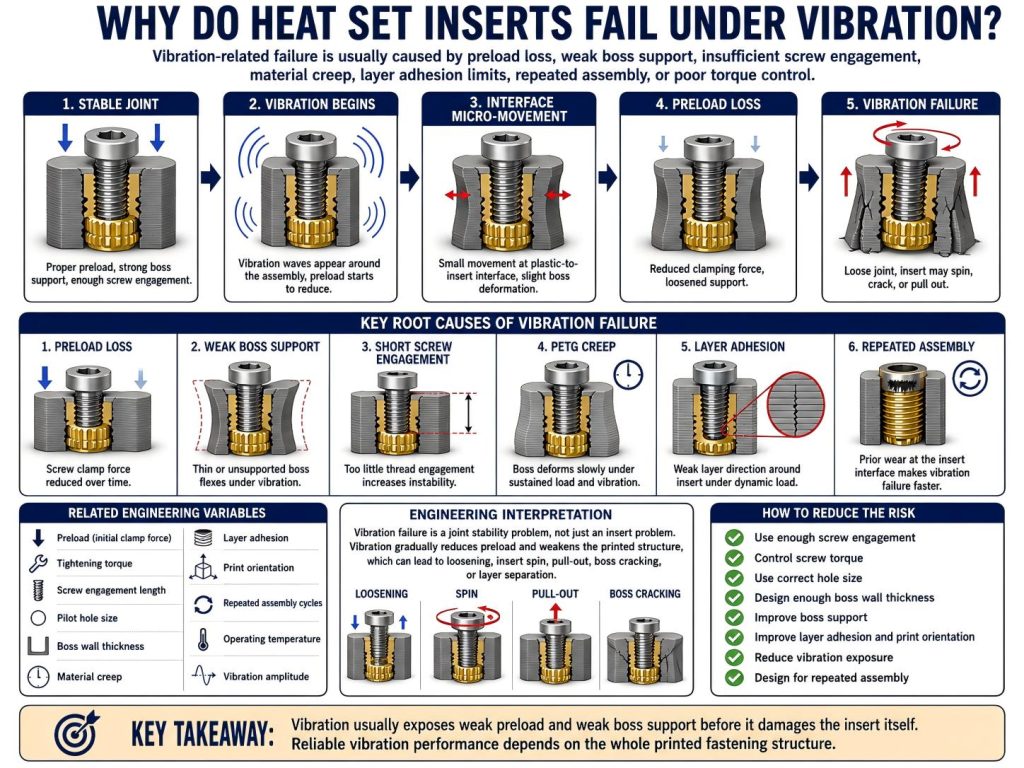
Vibration does not usually destroy the metal insert first. Instead, it exposes weaknesses in the printed plastic around the insert. If the boss is thin, the screw engagement is short, the material creeps, the pilot hole is oversized, or the joint has already lost preload, vibration can make the insert loosen, spin, crack the boss, or pull out over time.
A heat set insert improves thread durability, but vibration reliability depends on the whole fastening structure: insert fit, boss geometry, screw preload, material behavior, layer adhesion, and load direction.
Root Causes
Preload Loss Under Dynamic Load
A screw joint depends on preload to stay stable.
When vibration is present, the joint experiences small repeated movements and changing load direction. If the clamping force is already low, the screw may lose stability and the insert joint may begin to loosen.
This does not always mean the screw backs out immediately. In many 3D printed parts, the printed plastic relaxes, compresses, or deforms first. Once preload drops, vibration can accelerate movement at the screw, insert, and boss interface.
Plastic Creep Around the Insert
Materials such as PETG can creep under sustained clamping load.
When vibration is added, the joint is no longer only holding a static screw load. It must also resist repeated small load changes. If the PETG boss is thin or the screw is over-tightened, creep can reduce preload and make the joint more sensitive to vibration.
This is why PETG parts may feel stable after assembly but become loose after repeated motion, motor vibration, or service cycles.
Weak Boss Support
The boss around the insert must resist dynamic load.
If the boss wall is thin, unsupported, close to an edge, or poorly connected to the surrounding part, vibration can concentrate stress around the insert. Over time, this may cause boss deformation, cracking, or reduced insert support.
A correct hole size is not enough if the boss cannot carry the vibration load.
Boss geometry is especially important in motor mounts, drone frames, robotics brackets, RC components, and printer assemblies where repeated motion is expected.
Insufficient Screw Engagement
Short screw engagement can make a vibrating joint less stable.
If the screw engages too few threads inside the insert, load is concentrated over a shorter length. This can reduce preload stability and increase local stress during vibration.
Enough screw engagement helps distribute force through the insert and boss. It also makes the joint less sensitive to small changes in torque, preload, and dynamic loading.
Oversized Pilot Hole or Poor Insert Fit
If the pilot hole is too large, the insert may not be fully locked into the surrounding plastic.
The knurled outer surface of the insert needs enough softened plastic flow to create mechanical engagement. If this interface is weak from the start, vibration can gradually enlarge movement at the insert boundary.
This may appear as insert spin, joint loosening, or reduced pull-out strength.
Layer Adhesion and Print Orientation
Vibration can also expose weak layer adhesion.
FDM printed parts are anisotropic, meaning strength depends on print orientation. If vibration or screw load acts across weak layer lines, the boss may separate, crack, or lose support around the insert.
This is especially relevant when inserts are used in brackets, cantilevered features, thin walls, or parts exposed to bending loads.
A strong insert cannot prevent failure if the printed layers around it are loaded in a weak direction.
Repeated Assembly Before Vibration
Many parts exposed to vibration are also serviced repeatedly.
Drones, RC cars, robotics systems, fixtures, and 3D printer assemblies often require screws to be removed and reinstalled. Each screw cycle can reduce preload stability or weaken the plastic-to-insert interface.
If a joint has already been weakened by repeated assembly, vibration can make the failure appear much sooner.
Related Engineering Variables
If vibration is only one symptom, start with vibration failure troubleshooting to separate hole fit, boss support, and fastener preload causes.
Vibration reliability depends on several connected variables:
- Screw preload
- Tightening torque
- Screw engagement length
- Pilot hole size
- Insert outer diameter
- Insert depth
- Boss wall thickness
- Boss stiffness
- Material creep
- Layer adhesion
- Print orientation
- Load direction
- Repeated assembly cycles
- Operating temperature
- Vibration frequency and amplitude
These variables should be evaluated together. A heat set insert may work well in a static enclosure but fail in a vibrating robotics bracket if the boss, screw engagement, or material support is not designed for dynamic loading.
Vibration does not create a completely separate failure mode. It accelerates weak preload, weak boss support, poor insert fit, creep, and layer-related failure.
Engineering Interpretation
Vibration failure is usually a joint stability problem.
It is related to several other heat set insert failure modes:
- Insert loosening from preload loss
- Insert spin from reduced torque resistance
- Pull-out from reduced axial retention
- Boss cracking from repeated stress
- Layer separation from poor load direction
- PETG torque loss from creep and relaxation
Vibration often acts as the amplifier. It turns small design weaknesses into visible failure.
For example, an oversized hole may still hold under light static load. But under vibration, the weak insert interface can slowly move until the insert spins or loosens.
A thin boss may survive one screw installation. But under vibration, repeated stress may crack the boss or reduce its support around the insert.
This is why vibration should be considered early in the design of functional 3D printed assemblies.
How to Reduce the Risk
To reduce heat set insert failure under vibration:
- Use enough screw engagement length.
- Avoid excessive or inconsistent screw torque.
- Use the correct pilot hole size for the printed material.
- Design enough boss wall thickness around the insert.
- Avoid thin, tall, unsupported bosses in vibrating parts.
- Improve boss connection to the surrounding structure.
- Choose material based on dynamic load, creep, and temperature.
- Improve layer adhesion and print orientation.
- Avoid loading inserts across weak layer lines.
- Use repeated assembly design rules for serviceable parts.
- Reduce vibration exposure where possible.
- Consider washers, better load distribution, or mechanical isolation where appropriate.
The goal is not only to hold the insert in place. The goal is to maintain preload, load path stability, and plastic support under repeated dynamic loading.
In most cases, vibration-resistant insert design comes from a stronger fastening structure, not simply from choosing a different insert.
Related InsertGuide Pages
- Why Do Heat Set Inserts Become Loose Over Time?
- Why Does PETG Lose Screw Torque Over Time?
- Why Does Repeated Assembly Weaken Heat Set Inserts?
- Torque Resistance of Heat Set Inserts in 3D Printed Parts
- Screw Engagement Length for Heat Set Inserts in 3D Printed Parts
- Layer Adhesion and Heat Set Insert Strength in 3D Printed Parts
- Heat Set Inserts for Repeated Assembly in 3D Printed Parts
- Heat Set Insert Failure Modes in Repeated Assembly Structures
- Why Heat Set Inserts Fail in 3D Printed Parts
FAQ
Does vibration make heat set inserts come loose?
Yes, vibration can make heat set inserts come loose if the joint has weak preload, poor boss support, short screw engagement, material creep, or an oversized pilot hole. Vibration usually accelerates an existing weakness rather than acting alone.
Are PETG heat set insert joints sensitive to vibration?
PETG joints can be sensitive to vibration when creep, preload loss, thin boss walls, or high operating temperature are present. PETG can work well, but the boss and screw joint must be designed for dynamic loading.
Is insert failure under vibration the same as screw loosening?
Not always. Screw loosening is one possible result. Vibration can also cause insert spin, boss cracking, pull-out failure, preload loss, or layer separation around the insert.