
Short Engineering Answer
PETG loses screw torque over time when the plastic under the screw joint slowly relaxes or deforms under sustained clamping load.
This is usually caused by material creep, boss deformation, preload relaxation, repeated assembly, operating temperature, or excessive tightening torque. The screw may feel tight at first, but the joint can gradually lose preload as the PETG around the heat set insert deforms.
This does not mean PETG cannot be used with heat set inserts. It means PETG joints need enough boss support, controlled screw torque, proper screw engagement, and realistic long-term load expectations.
In PETG parts, torque loss is usually a preload stability problem, not simply a thread strength problem.
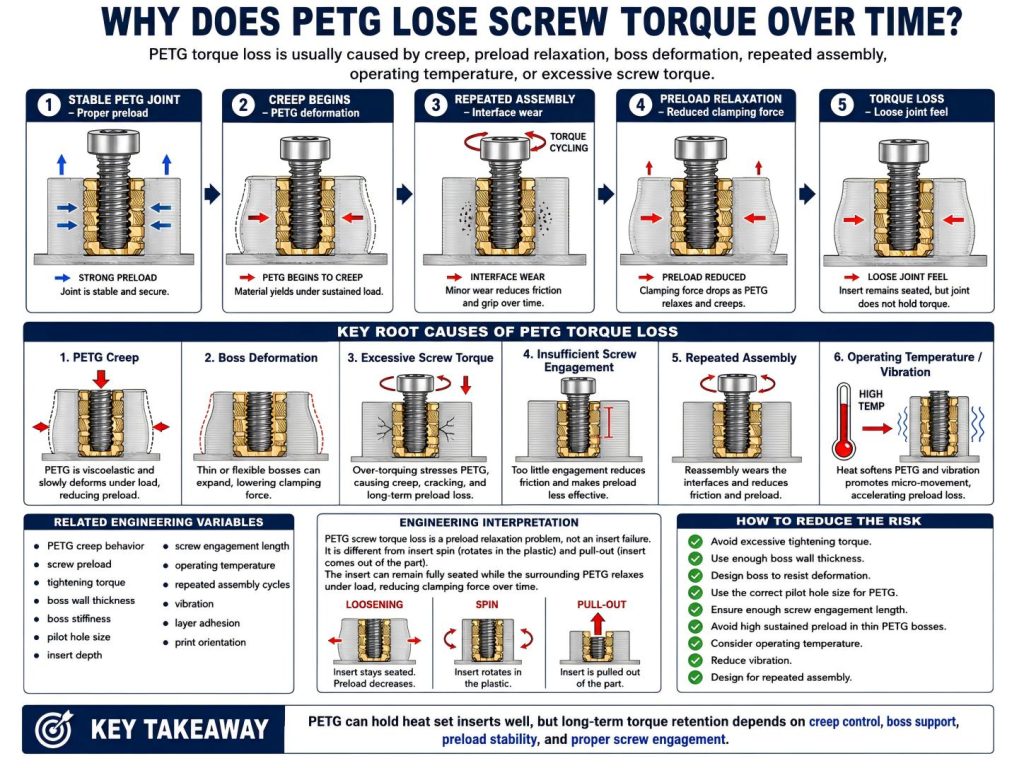
Root Causes
PETG Creep Under Preload
PETG can slowly deform when it is held under continuous clamping force.
When a screw is tightened into a heat set insert, the joint creates preload. That preload compresses the printed plastic around the boss and insert. Over time, PETG may relax under this stress, especially if the boss is thin, the screw is over-tightened, or the part is exposed to heat.
As the plastic creeps, the clamping force drops. The screw may not back out visibly, but the joint feels less tight because preload has been reduced.
Boss Deformation
The boss around the heat set insert must resist both radial support and clamping force.
If the boss wall is thin or unsupported, it may deform slowly under screw load. PETG may bend, compress, or relax rather than crack immediately. This can reduce the pressure that keeps the insert and screw joint stable.
Boss deformation is one reason a PETG joint can feel reliable after assembly but become loose after use.
Excessive Tightening Torque
Over-tightening a screw can make a PETG joint less reliable over time.
High screw torque may create high preload at first, but it can also overstress the surrounding plastic. In PETG, this may lead to slow deformation instead of immediate cracking.
More torque is not always better. If the printed boss cannot support the load, higher torque can accelerate preload loss.
Insufficient Screw Engagement
Screw engagement length affects how load is distributed through the insert.
If the screw engages too few threads, the load is concentrated in a smaller region. This can increase local stress on the insert, boss, and surrounding PETG.
Poor screw engagement can make torque retention less stable, especially in parts that are repeatedly assembled or exposed to vibration.
Repeated Assembly Cycles
Repeated screw tightening and removal can reduce torque retention.
Each assembly cycle applies torque and local stress to the insert-to-plastic interface. In PETG, small amounts of deformation may accumulate over time. The result is a joint that still works, but no longer feels as tight or consistent as it did when new.
This is common in serviceable enclosures, robotics parts, Voron-style printer parts, fixtures, and RC components.
Operating Temperature
PETG is more heat resistant than PLA, but heat still affects its long-term stiffness.
If a PETG insert joint is used near motors, electronics, batteries, enclosed printer chambers, or warm environments, creep and preload relaxation may increase.
Temperature does not need to melt the part to matter. Even moderate heat can reduce the safety margin of a joint under sustained clamping load.
Vibration and Cyclic Loading
Vibration can expose preload loss in PETG joints.
If the joint has already lost some clamping force due to creep or boss deformation, vibration can make the screw feel loose sooner. Cyclic loading may also cause small movements at the interface, reducing joint stability over time.
Vibration is rarely the only cause. It usually works together with material creep, poor boss support, excessive torque, or repeated assembly.
Related Engineering Variables
PETG screw torque retention depends on several connected variables:
- PETG creep behavior
- Screw preload
- Tightening torque
- Boss wall thickness
- Boss stiffness
- Heat set insert fit
- Pilot hole size
- Insert depth
- Screw engagement length
- Operating temperature
- Repeated assembly cycles
- Vibration
- Layer adhesion
- Print orientation
These variables should be considered together. PETG may hold torque well in a thick, supported boss with moderate preload, but lose torque in a thin boss under high clamping force.
The question is not only whether PETG can hold a heat set insert. The question is whether the whole joint can maintain preload over time.
Engineering Interpretation
PETG screw torque loss is a preload relaxation problem.
It is related to loose inserts, but it is more specific.
A heat set insert can remain seated in the part while the screw joint loses preload. In that case, the insert has not necessarily pulled out or spun. Instead, the clamping force in the joint has decreased because the surrounding PETG structure has relaxed or deformed.
This is different from insert spin, which is rotational failure.
It is also different from pull-out failure, where the insert is physically pulled out of the part.
Torque loss in PETG is usually a long-term joint stability issue involving creep, boss support, screw load, and temperature.
How to Reduce the Risk
To reduce screw torque loss in PETG parts:
- Avoid excessive screw tightening torque.
- Use enough boss wall thickness around the insert.
- Design the boss to resist deformation, not only cracking.
- Use the correct pilot hole size for PETG.
- Ensure enough screw engagement length.
- Avoid high sustained preload in thin PETG bosses.
- Consider operating temperature near motors, batteries, electronics, or enclosed chambers.
- Reduce vibration where possible.
- Design serviceable parts for repeated assembly.
- Improve the printed structure before simply increasing screw torque.
In most cases, PETG torque loss is reduced by improving preload stability, not by tightening the screw harder.
A stronger joint comes from the relationship between material behavior, boss geometry, insert fit, screw engagement, and load conditions.
Related InsertGuide Pages
- Heat Set Insert Torque Resistance in PETG vs PLA Parts
- Why Do Heat Set Inserts Fail in PETG Parts?
- Why Do Heat Set Inserts Become Loose Over Time?
- PLA vs PETG Fastening Behavior for Heat Set Inserts
- PLA vs PETG vs ABS for Threaded Inserts
- Heat Set Inserts for Repeated Assembly in 3D Printed Parts
- Screw Engagement Length for Heat Set Inserts in 3D Printed Parts
- How to Design Bosses for Heat Set Inserts
FAQ
Why does a PETG screw joint feel loose after a while?
A PETG screw joint can feel loose after a while because the plastic may creep or relax under sustained clamping load. As preload drops, the screw may feel less tight even if the insert remains seated in the part.
Does PETG lose torque faster than PLA?
PETG may lose preload through creep more easily than PLA in some sustained-load joints, while PLA may be more likely to crack because it is stiffer and more brittle. The result depends on boss design, torque, temperature, screw engagement, and load conditions.
Can tightening the screw more prevent PETG torque loss?
Not usually. Over-tightening can increase stress and accelerate PETG deformation. It is better to improve boss support, use proper screw engagement, control torque, and design the joint for long-term preload stability.
Related Decision Resources
For insert selection, tool choice, and supplier comparison, use these decision-focused references after the engineering requirements are defined.