
Short Engineering Answer
Heat set inserts become loose over time when the plastic around the insert can no longer maintain stable mechanical engagement, screw preload, or boss support.
This can happen because of material creep, repeated screw installation, excessive screw torque, weak boss geometry, vibration, poor screw engagement, or an oversized pilot hole.
In many cases, the metal insert itself is not the weak point. The real problem is the printed plastic structure around the insert. If the surrounding material deforms, relaxes, cracks, or loses grip, the insert may begin to feel loose even if it was installed correctly at first.
A loose heat set insert is usually a long-term joint reliability problem, not only an insert selection problem.
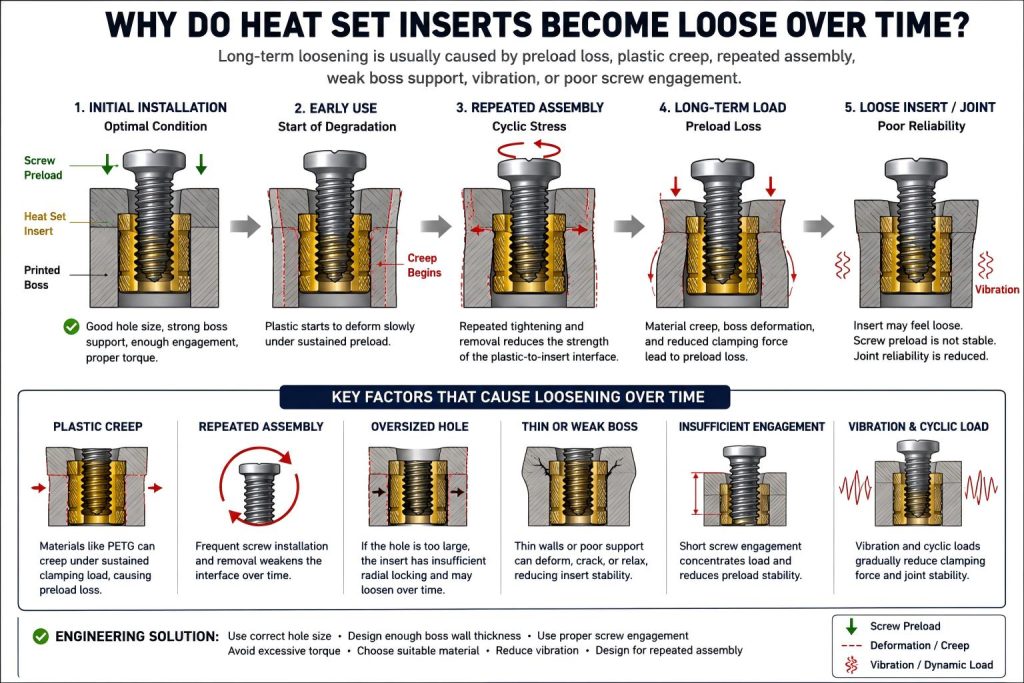
Root Causes
Plastic Creep Under Clamping Load
Some printed plastics can slowly deform when they are held under continuous screw preload. PETG is a common example because it can creep under sustained clamping load, especially when the boss is thin, the screw is over-tightened, or the part is exposed to heat.
As the plastic relaxes, the screw preload drops. The insert may still be inside the boss, but the surrounding material no longer holds it with the same pressure.
This is why a joint can feel tight after installation but become loose after days, weeks, or repeated use.
Repeated Screw Installation and Removal
Every time a screw is tightened or removed, the insert-to-plastic interface experiences torque and local stress.
In repeated assembly structures, the insert may not fail immediately. Instead, the plastic around the insert gradually loses its ability to resist movement. Small amounts of deformation can accumulate until the insert feels loose or the screw no longer holds preload reliably.
This is common in serviceable 3D printed parts, robotics assemblies, fixtures, Voron-style printer parts, RC parts, and enclosures that are opened many times.
Oversized or Weak Pilot Hole Fit
If the pilot hole is too large, the insert cannot displace enough plastic during installation. The knurled surface may not be fully surrounded by softened material.
The insert may look seated, but the mechanical lock is weak from the beginning. Over time, screw torque, vibration, and assembly cycles can make this weak interface worse.
An oversized hole often leads to loose inserts, insert spin, reduced pull-out strength, or inconsistent fastening behavior.
Thin or Deforming Boss Walls
The boss around the insert must act as a supporting structure. If the boss wall is too thin, too close to an edge, or poorly supported, it may deform under installation force or screw load.
When the boss wall expands, cracks, relaxes, or bends, the insert loses radial support. This can make the insert feel loose even if the hole size was close to correct.
A correct hole size cannot fully compensate for a weak boss.
Insufficient Screw Engagement
Screw engagement length affects how load is transferred into the insert.
If the screw does not engage enough thread length, the load becomes more concentrated. This can increase local stress on the insert and the surrounding printed plastic.
Poor screw engagement can also reduce preload stability. In repeated assembly, this may accelerate loosening because the joint depends on a smaller thread contact area.
Vibration and Cyclic Loading
Vibration can reduce joint stability when preload is already weak.
In drone parts, robotics systems, RC cars, motor mounts, brackets, and functional fixtures, repeated vibration or cyclic loading can gradually reduce clamping force. If the printed boss is not stiff enough or the material creeps under load, the insert may become loose over time.
Vibration does not always cause failure by itself. It usually exposes weaknesses in hole size, boss design, material behavior, screw torque, or preload control.
Related Engineering Variables
Several connected variables affect whether a heat set insert stays tight over time:
- Hole size
- Boss wall thickness
- Insert outer diameter
- Screw engagement length
- Tightening torque
- Material creep
- Installation temperature
- Vibration
- Repeated assembly cycles
- Layer adhesion
- Print orientation
These variables should not be treated separately. A heat set insert can become loose even when the insert itself is not damaged. The real failure may be the printed structure losing support around the insert.
For example, a PETG part with a thin boss, high screw preload, and repeated screw removal is more likely to lose fastening stability than a thicker boss designed for service access.
Engineering Interpretation
Loosening is usually a preload and interface stability problem.
It is related to insert spin and pull-out failure, but it is not the same failure mode.
Insert spin is a rotational failure. The insert rotates when the plastic-to-insert interface cannot resist screw torque.
Pull-out is an axial failure. The insert is pulled out of the printed part along its axis.
A loose insert or loose joint often means the structure has lost preload, radial support, or stable engagement over time. The insert may still be in place, but the fastening system no longer behaves like a reliable threaded joint.
This is why long-term fastening reliability depends on more than the insert. It depends on the relationship between material behavior, boss geometry, screw load, hole size, and how often the part is assembled or serviced.
How to Reduce the Risk
To reduce the risk of heat set inserts becoming loose over time:
- Use the correct pilot hole size for the insert and printed material.
- Design enough boss wall thickness around the insert.
- Avoid excessive screw torque.
- Use enough screw engagement length.
- Choose material based on long-term load, not only printing convenience.
- Avoid relying on PETG parts for high sustained preload unless the boss geometry supports it.
- Reduce vibration exposure where possible.
- Use repeated assembly design rules for parts that will be serviced often.
- Improve the printed structure before simply changing insert type.
In most cases, preventing loosening requires improving the relationship between material behavior, boss geometry, screw load, and assembly frequency.
A different insert may help in some cases, but it cannot fix a weak boss, an oversized hole, poor screw engagement, or a material that is creeping under sustained load.
Related Root Cause Guides
Long-term insert loosening is usually connected to screw preload loss, material creep, repeated screw cycles, vibration, and weak surrounding boss support. For the main design variables, see Screw Engagement Length for Heat Set Inserts in 3D Printed Parts, why screw preload drops in 3D printed insert joints, and why threaded inserts loosen after repeated screw removal.
Related InsertGuide Pages
- Heat Set Inserts for Repeated Assembly in 3D Printed Parts
- Heat Set Insert Failure Modes in Repeated Assembly Structures
- Heat Set Insert Torque Resistance in PETG vs PLA Parts
- Screw Engagement Length for Heat Set Inserts in 3D Printed Parts
- PLA vs PETG Fastening Behavior for Heat Set Inserts
- Heat Set Insert Hole Size Guide
- How to Design Bosses for Heat Set Inserts
- Why Heat Set Inserts Fail in 3D Printed Parts
FAQ
Why does a heat set insert feel loose after repeated assembly?
A heat set insert can feel loose after repeated assembly because each screw tightening cycle applies torque and stress to the plastic-to-insert interface. Over time, the surrounding plastic may deform, relax, or lose preload, especially if boss support, screw engagement, or material behavior is not controlled.
Is PETG more likely to loosen around heat set inserts?
PETG can creep under sustained clamping load, which may reduce screw preload over time. However, PETG does not automatically fail. Loosening depends on boss design, hole size, screw torque, installation temperature, load conditions, and assembly frequency.
Is insert loosening the same as insert pull-out?
No. Insert loosening is usually related to preload loss or plastic interface degradation. Pull-out is an axial failure where the insert is pulled out of the printed part. A loose insert may still remain in place, while a pulled-out insert has lost axial retention.