
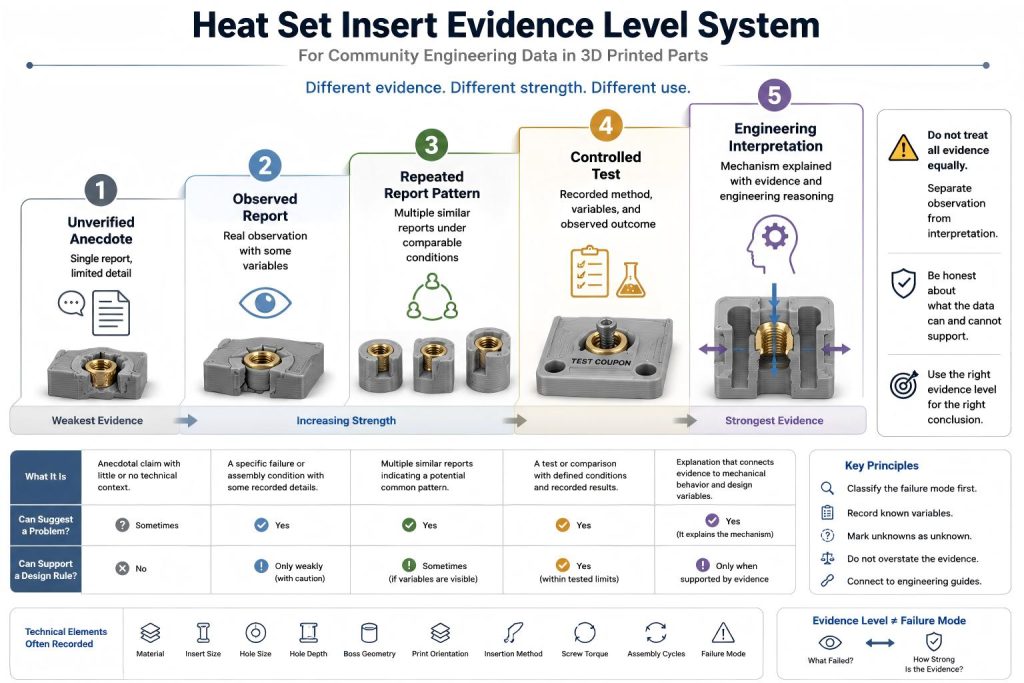
Heat Set Insert Evidence Level System for Community Engineering Data defines how InsertGuide separates unverified anecdotes, observed reports, repeated report patterns, controlled tests, and engineering interpretation when documenting heat set insert behavior in 3D printed parts.
This page does not present verified test results. It does not claim that a specific material, hole size, insert size, or boss geometry has already been proven by community data. Instead, it defines the evidence levels used to evaluate future Community Data entries.
The purpose of this system is to prevent weak observations from being overstated while still preserving useful real-world fastening information.
Why Evidence Levels Matter
Community engineering data can be valuable, but not all observations have the same strength. A single forum comment, a workshop repair note, a repeated failure pattern, and a controlled test coupon should not be treated as equal evidence.
Heat set insert behavior depends on many interacting variables, including material, insert size, pilot hole diameter, hole depth, boss geometry, print orientation, insertion method, screw torque, and repeated assembly cycles.
Without evidence levels, a casual observation can easily be mistaken for a design rule. InsertGuide uses evidence levels to keep observations, patterns, tests, and interpretations separate.
The Five Evidence Levels
Future Community Data entries should assign one primary evidence level. When a report includes both observation and interpretation, those parts should remain clearly separated.
| Evidence Level | Definition | How It Should Be Used |
|---|---|---|
| Unverified Anecdote | A single report with limited technical detail and no independent confirmation. | Useful as a possible clue, but not as design evidence. |
| Observed Report | A specific failure or assembly condition with some recorded technical variables. | Useful for diagnosis and future pattern tracking. |
| Repeated Report Pattern | Multiple similar observations under broadly comparable conditions. | Useful for identifying likely risk factors, but still not equivalent to a controlled test. |
| Controlled Test | A test or comparison with recorded material, geometry, method, and observed outcome. | Useful as stronger evidence within the tested conditions. |
| Engineering Interpretation | A reasoned explanation connecting observations to mechanical behavior, material response, or design variables. | Useful when the difference between fact and interpretation remains clear. |
Level 1: Unverified Anecdote
An unverified anecdote is a single report that mentions a heat set insert issue but does not provide enough technical context to support an engineering conclusion.
This type of report may still be worth recording as a signal, especially if similar reports appear later. However, it should not be used to define hole size, torque limits, material suitability, or boss geometry recommendations.
Typical Characteristics
- The report mentions that an insert failed but gives few measurements.
- The material, insert size, or hole size may be missing.
- The failure mode may be described loosely.
- The source may be a short comment, informal post, or unsupported claim.
- The cause is often guessed rather than demonstrated.
How InsertGuide Should Treat It
- Record it only as a weak signal.
- Do not convert it into a design rule.
- Mark missing variables as unknown.
- Do not assume the cause.
- Use it mainly to guide future observation or testing.
Level 2: Observed Report
An observed report describes a real failure, repair, assembly issue, or service condition with enough technical detail to be useful for diagnosis.
This level is stronger than an anecdote because some variables are recorded. However, an observed report is still not a controlled test unless the conditions were intentionally measured and compared.
Typical Characteristics
- The material is known.
- The insert size is known.
- The observed failure mode is identified.
- Some geometry or assembly details are available.
- The report describes what happened rather than only giving an opinion.
How InsertGuide Should Treat It
- Use it as a structured failure observation.
- Connect it to relevant design variables.
- Keep missing values visible.
- Separate observed facts from possible root causes.
- Do not claim that the same result will occur in all similar parts.
Level 3: Repeated Report Pattern
A repeated report pattern appears when multiple independent observations describe similar heat set insert behavior under broadly comparable conditions.
This level is useful because repeated observations may reveal a common risk factor. For example, repeated reports of insert loosening in serviceable PETG covers may suggest that creep, assembly cycles, or clamp load should be reviewed.
However, repeated reports are still not the same as controlled test data. The reports may come from different printers, insert types, hole sizes, screw torques, or use conditions.
Typical Characteristics
- Multiple similar reports exist.
- The same failure mode appears repeatedly.
- Some shared variables can be identified.
- The pattern points toward a likely design risk.
- Important variables may still be inconsistent or unknown.
How InsertGuide Should Treat It
- Use it to identify possible risk patterns.
- Describe the repeated observation carefully.
- List the shared variables and unknown variables.
- Avoid presenting the pattern as a universal rule.
- Connect the pattern to guide-level engineering concepts.
Level 4: Controlled Test
A controlled test records a heat set insert behavior under defined conditions. It may involve test coupons, measured hole sizes, known insert sizes, controlled material selection, repeated assembly cycles, pull-out comparison, torque comparison, or documented seating behavior.
This evidence level is stronger because the variables are intentionally recorded. However, even controlled tests have limits. A result from one material, one insert geometry, one printer, or one test coupon shape should not automatically become a universal design rule.
Typical Characteristics
- Material is recorded.
- Insert size and type are recorded.
- Hole size and hole depth are recorded.
- Boss geometry or test coupon geometry is recorded.
- Assembly method is described.
- Measured or repeatable observations are included.
- The test condition is narrow enough to understand.
How InsertGuide Should Treat It
- Use it as stronger evidence within its tested limits.
- Keep the test conditions visible.
- Do not extend the result beyond the tested material or geometry.
- Separate measured outcomes from interpretation.
- Link the result to relevant guides and reference pages.
Level 5: Engineering Interpretation
Engineering interpretation is not the raw data itself. It is the explanation that connects observations to possible mechanical causes, material behavior, or design variables.
Interpretation is necessary because raw observations do not explain themselves. However, interpretation must remain clearly labeled so that the reader can distinguish what was observed from what was inferred.
Typical Characteristics
- It explains why a failure may have occurred.
- It connects the failure mode to design variables.
- It may compare the observation with known fastening principles.
- It states uncertainty when variables are missing.
- It avoids claiming more than the evidence supports.
How InsertGuide Should Treat It
- Use it to connect data with engineering reasoning.
- Label it as interpretation, not raw evidence.
- State which variables support the interpretation.
- State which variables remain unknown.
- Do not use interpretation to hide missing data.
Evidence Level Decision Table
The following table can be used when assigning an evidence level to a future Community Data entry.
| Question | If Yes | Likely Evidence Level |
|---|---|---|
| Is it a single informal claim with few technical details? | Yes | Unverified Anecdote |
| Does it describe a real failure with material, insert size, or failure mode information? | Yes | Observed Report |
| Do multiple similar reports describe the same failure mode under comparable conditions? | Yes | Repeated Report Pattern |
| Were variables such as material, hole size, insert size, geometry, and method recorded intentionally? | Yes | Controlled Test |
| Is the statement explaining why the result may have occurred? | Yes | Engineering Interpretation |
Required Labels for Community Data Entries
Each future Community Data entry should include a visible evidence label. The label should appear near the beginning of the entry so readers understand how strongly the report can support engineering decisions.
| Label | Use When |
|---|---|
| Evidence Level: Unverified Anecdote | The report is incomplete and cannot support a design conclusion. |
| Evidence Level: Observed Report | The report describes a real observation with some useful variables. |
| Evidence Level: Repeated Report Pattern | Several similar observations suggest a recurring issue. |
| Evidence Level: Controlled Test | The report includes defined test conditions and recorded variables. |
| Evidence Level: Engineering Interpretation | The section explains likely causes based on evidence and fastening mechanics. |
What Evidence Levels Can and Cannot Prove
Evidence levels do not turn weak data into strong data. They help readers understand the limits of each report.
| Evidence Level | Can Suggest a Problem? | Can Support a Design Rule? |
|---|---|---|
| Unverified Anecdote | Sometimes | No |
| Observed Report | Yes | Only weakly and with caution |
| Repeated Report Pattern | Yes | Sometimes, if variables are visible |
| Controlled Test | Yes | Yes, within tested conditions |
| Engineering Interpretation | It can explain the mechanism | Only when supported by evidence |
How to Avoid Evidence Overstatement
The most important rule is simple: do not make the evidence stronger than it is.
- Do not describe a single anecdote as a proven failure pattern.
- Do not describe repeated observations as controlled testing.
- Do not present interpretation as raw data.
- Do not hide missing variables.
- Do not treat all materials, insert sizes, and boss geometries as interchangeable.
- Do not turn a repair note into a universal design recommendation.
- Do not claim a root cause unless the evidence supports it.
How Evidence Levels Connect to Failure Modes
Evidence level and failure mode are different parts of the report.
Failure mode describes what failed: pull-out, spin-out, boss cracking, insert tilt, creep loosening, seating failure, or thread engagement failure.
Evidence level describes how strongly the report supports an engineering conclusion.
A report may correctly identify boss cracking but still remain an unverified anecdote if it lacks material, hole size, boss geometry, or insertion method details. Another report may describe the same boss cracking failure as a controlled test if all variables and test conditions were recorded.
How Evidence Levels Connect to Design Guidance
InsertGuide uses Community Data to support engineering understanding, not to replace design guides. Stronger evidence may help reinforce guide-level concepts, while weaker evidence may help identify areas that need further observation.
For example, a repeated report pattern of spin-out failure may point toward torque resistance and hole fit. A controlled test may help compare a narrow set of hole sizes or boss geometries. Engineering interpretation connects these observations to design guidance while keeping uncertainty visible.
Related Community Data Standards
- Community Engineering Data Collection Standard for Heat Set Inserts
- Heat Set Insert Failure Observation Report Template
- Heat Set Insert Failure Mode Classification Guide for Community Reports
Related Engineering Guides
- Heat Set Insert Hole Size Guide
- How to Design Bosses for Heat Set Inserts
- Pull-Out Strength of Heat Set Inserts in 3D Printed Parts
- Torque Resistance of Heat Set Inserts in 3D Printed Parts
- Screw Engagement Length for Heat Set Inserts in 3D Printed Parts
- PLA vs PETG vs ABS for Threaded Inserts
Conclusion
The Heat Set Insert Evidence Level System gives InsertGuide a consistent way to evaluate community engineering data without overstating weak evidence.
By separating unverified anecdotes, observed reports, repeated patterns, controlled tests, and engineering interpretation, future Community Data entries can remain technically honest, comparable, and useful for real 3D printed fastening analysis.