
Community Engineering Data Collection Standard for Heat Set Inserts defines how InsertGuide collects, classifies, and interprets community engineering data related to heat set insert failures, fastening behavior, repeated assembly, printed boss geometry, and material-specific insert performance.
This page does not present verified test results yet. It does not treat anecdotal reports as universal rules. Instead, it establishes the evidence structure used for future community data entries on InsertGuide.
The goal is to separate observed reports, repeated patterns, controlled tests, and engineering interpretation so that community-based fastening knowledge can be useful without being overstated.
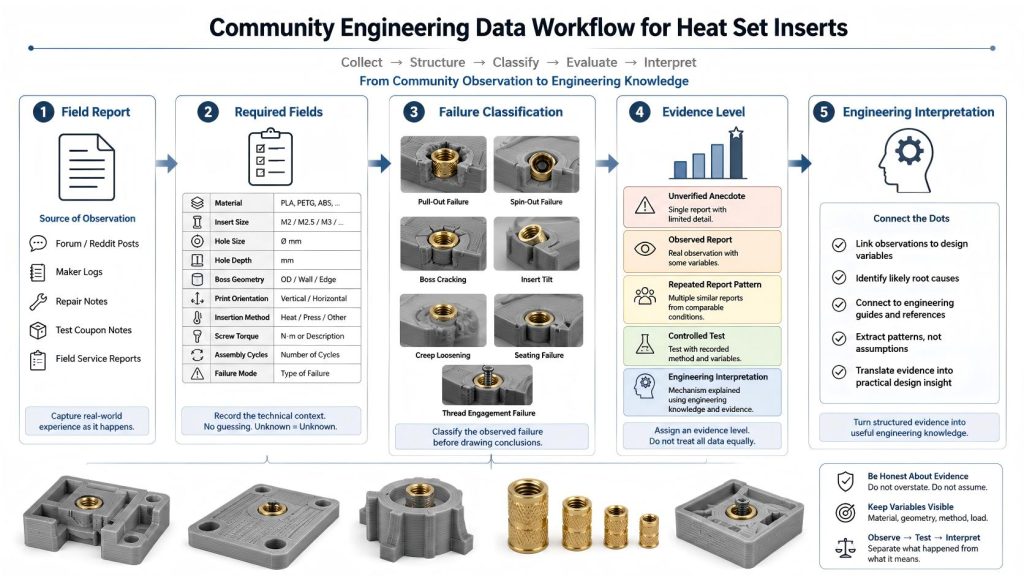
Why Community Engineering Data Needs a Standard
Heat set inserts in 3D printed parts are often discussed through forum posts, repair notes, workshop observations, Reddit threads, maker logs, and field experience. These reports can be valuable because they capture real failure conditions that may not appear in simplified design charts.
However, community reports are not automatically engineering proof. A single failed insert may be caused by many variables at the same time, including hole size, insert geometry, soldering iron temperature, insertion depth, boss wall thickness, print orientation, material creep, screw torque, or repeated service cycles.
For this reason, InsertGuide treats community engineering data as structured evidence, not as casual opinion.
What Counts as Community Engineering Data
For InsertGuide, community engineering data may include observations from real printed assemblies, repair cases, test coupons, workshop notes, field service records, or repeated user reports involving heat set inserts and threaded inserts in 3D printed parts.
A useful community data entry should describe a fastening condition clearly enough that another engineer, maker, or technician can understand what happened and what variables may have contributed to the result.
Accepted Community Data Types
- Observed heat set insert failures in printed parts
- Repeated assembly or screw cycling observations
- Field repair notes involving loose, spinning, or pulled-out inserts
- Test coupon observations with recorded material and hole size
- Forum or Reddit patterns that repeat across multiple similar reports
- Before-and-after design changes that improved insert behavior
- Measured pull-out or torque observations when test conditions are described
- Material-specific observations, such as PETG creep or PLA boss cracking
What Does Not Count as Reliable Data
Some reports may be useful as clues but should not be treated as reliable engineering evidence. InsertGuide does not classify vague or unsupported claims as engineering data.
- General statements without material, insert size, or hole size information
- Claims that do not describe the actual failure mode
- Single anecdotes presented as universal rules
- Reports without enough context to identify the likely cause
- Unverified numbers copied from unrelated products or materials
- Marketing claims from product listings without test method details
- Forum comments that cannot be separated from speculation
Unverified reports may still be recorded as observations, but they must remain separate from tested results and engineering interpretation.
Evidence Levels Used by InsertGuide
Each future Community Data entry should identify its evidence level. This prevents a field observation from being mistaken for a controlled test result.
| Evidence Level | Meaning | How It Should Be Used |
|---|---|---|
| Unverified Anecdote | A single report with limited technical detail. | Useful only as a possible clue, not as a design rule. |
| Observed Report | A real failure or assembly condition with some recorded variables. | Useful for failure diagnosis and pattern tracking. |
| Repeated Report Pattern | Multiple similar observations from comparable conditions. | Useful for identifying common risk factors. |
| Controlled Test | A test with recorded material, geometry, insert size, hole size, and method. | Useful as stronger evidence, but still limited to the tested conditions. |
| Engineering Interpretation | A reasoned explanation based on geometry, material behavior, and fastening mechanics. | Useful for connecting observations to design guidance. |
Required Fields for a Community Data Entry
Future Community Data entries should record enough information to make the observation technically useful. Missing fields should be marked as unknown rather than guessed.
| Field | Required Detail | Why It Matters |
|---|---|---|
| Material | PLA, PETG, ABS, ASA, nylon, PC, or other material. | Material behavior affects creep, cracking, softening, and long-term retention. |
| Insert Size | M2, M2.5, M3, M4, M5, or another thread size. | Insert diameter and length affect heat flow, boss size, and fastening load. |
| Hole Size | Printed pilot hole diameter if known. | Hole size strongly affects insertion pressure, plastic displacement, and retention. |
| Hole Depth | Blind hole depth or through-hole condition. | Insufficient depth can prevent proper seating or create bottoming pressure. |
| Boss Geometry | Boss outside diameter, wall thickness, edge distance, or surrounding structure. | Geometry controls cracking risk, torque resistance, and load distribution. |
| Print Orientation | Layer direction relative to screw load or insert axis. | Layer orientation affects splitting, pull-out behavior, and local stiffness. |
| Insertion Method | Heat source, insertion temperature if known, press method, or installation notes. | Installation method can create overheating, tilt, voids, or poor seating. |
| Screw Torque | Measured torque or qualitative tightening description. | Over-tightening can cause spin-out, boss cracking, or plastic creep. |
| Assembly Cycles | Number of screw removal and reinstallation cycles if known. | Repeated assembly can reveal wear, creep, or progressive thread loosening. |
| Failure Mode | Pull-out, spin-out, boss cracking, insert tilt, creep loosening, or seating failure. | Failure classification helps connect the report to design variables. |
Failure Modes Used for Classification
Community reports should classify the observed failure mode before drawing conclusions. A pulled-out insert, a spinning insert, and a cracked boss are not the same failure.
- Pull-out failure: the insert is removed from the printed part under axial load.
- Spin-out failure: the insert rotates inside the plastic when screw torque is applied.
- Boss cracking: the surrounding printed boss splits during insertion, tightening, or service.
- Insert tilt: the insert seats at an angle and causes poor screw alignment.
- Creep loosening: the joint loses preload over time due to material deformation.
- Seating failure: the insert does not fully seat flush or stops before reaching proper depth.
- Thread engagement failure: the screw does not achieve enough engagement length or bottoms out.
Each failure mode should be linked to possible causes, not reduced to a single assumption.
How Forum, Reddit, and Maker Reports Should Be Treated
Forum and Reddit reports can be useful because they often show practical failure conditions: real printers, real parts, real service loads, and real repair decisions. But these reports usually lack controlled variables.
InsertGuide treats these reports as community observations unless they include enough detail to support a stronger classification.
A Reddit comment saying that an insert failed in PETG is not enough to create a rule about PETG. A more useful report would include the insert size, hole diameter, boss wall thickness, screw size, tightening behavior, number of cycles, and the exact failure mode.
Observed Reports vs. Controlled Tests
Observed reports and controlled tests should never be mixed together as if they have the same evidence strength.
An observed report may tell us that a failure happened. A controlled test may help explain how a specific variable affected the result. An engineering interpretation may connect both to a design recommendation.
Future InsertGuide Community Data entries should make this separation visible.
| Data Type | Can It Show a Real Problem? | Can It Support a Design Rule? |
|---|---|---|
| Unverified Anecdote | Sometimes | No |
| Observed Report | Yes | Only as a weak indicator |
| Repeated Report Pattern | Yes | Sometimes, with caution |
| Controlled Test | Yes | Yes, within the tested limits |
| Engineering Interpretation | It explains the mechanism | Yes, when supported by geometry and evidence |
How InsertGuide Avoids Overstating Evidence
InsertGuide does not convert individual observations into universal rules. A field failure may suggest a risk factor, but it does not automatically define the correct hole size, boss diameter, torque range, or material choice for every printed part.
To avoid overstating evidence, future Community Data entries should follow these rules:
- State whether the source is an observation, repeated pattern, controlled test, or interpretation.
- Mark missing variables as unknown instead of guessing them.
- Separate what was observed from what is inferred.
- Avoid presenting a single case as a general rule.
- Connect observations to existing engineering guides when the mechanism is clear.
- Keep material, geometry, and loading conditions visible.
How Community Data Connects to Engineering Guides
Community engineering data is not meant to replace design guides. It adds real-world context to them.
For example, a report of boss cracking may connect to boss outside diameter, edge distance, hole tolerance, material brittleness, or insertion heat. A report of insert spin-out may connect to torque resistance, hole size, insert knurl geometry, or insufficient plastic displacement.
This is why Community Data entries should link back to relevant engineering guides and references instead of standing alone as isolated stories.
Related Engineering Guides
- Heat Set Insert Hole Size Guide
- How to Design Bosses for Heat Set Inserts
- Pull-Out Strength of Heat Set Inserts in 3D Printed Parts
- Torque Resistance of Heat Set Inserts in 3D Printed Parts
- Screw Engagement Length for Heat Set Inserts in 3D Printed Parts
- PLA vs PETG vs ABS for Threaded Inserts
Related Engineering References
- Heat Set Insert Torque Range Reference
- Heat Set Insert Edge Distance Reference
- Heat Set Insert Minimum Wall Thickness Reference
- Heat Set Insert Pilot Hole Tolerance Reference
- Heat Set Insert Seating Depth Reference
- Heat Set Insert Assembly Stack-Up Reference
Conclusion
This standard establishes how InsertGuide will handle future Community Data entries for heat set inserts in 3D printed parts. The purpose is not to create artificial certainty. The purpose is to make community observations readable, traceable, and technically honest.
Community engineering data becomes valuable only when the evidence level is clear, the variables are visible, and the interpretation does not go beyond what the data can support.