
Community Data Entry Format for Heat Set Insert Observations defines the standard page structure used by InsertGuide when publishing future heat set insert observation entries in 3D printed parts.
This page does not present test results, failure claims, or community statistics. It defines the publishing format that future Community Data entries should follow when documenting observed reports, repeated patterns, controlled tests, or engineering interpretation.
The purpose of this format is to keep community engineering observations structured, transparent, and technically honest.
Why a Standard Entry Format Is Needed
Community engineering data can become difficult to use if every entry follows a different structure. One report may start with a story, another may start with a conclusion, and another may mix observation, speculation, and design advice in the same paragraph.
For heat set inserts in 3D printed parts, this creates a serious problem. Insert failures often involve many overlapping variables, including material, hole size, boss geometry, print orientation, screw torque, insertion depth, assembly cycles, and load condition.
A standard entry format makes each observation easier to read, compare, classify, and connect to engineering guidance.
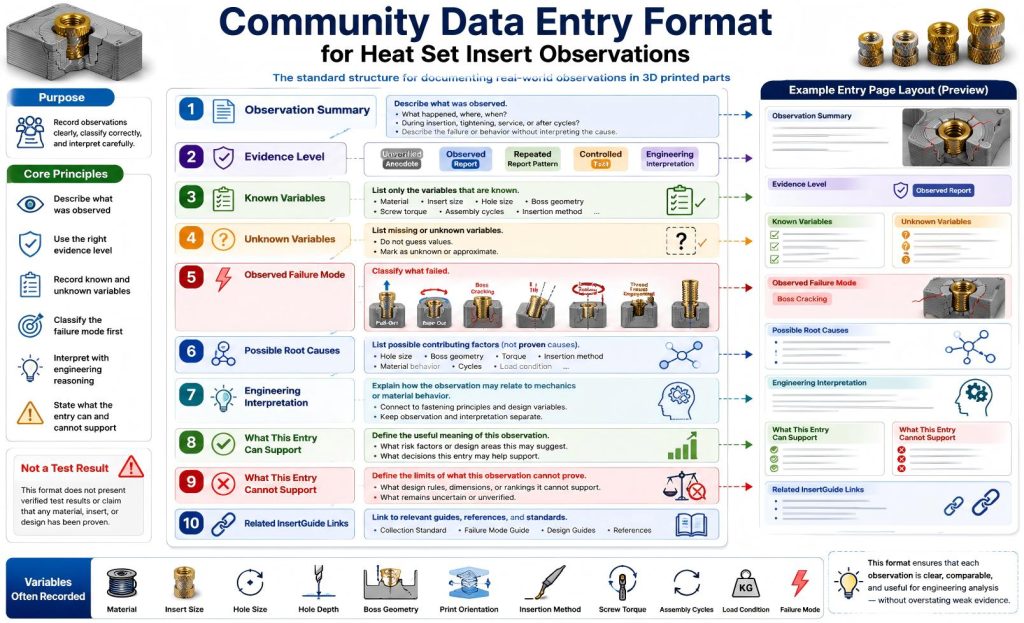
Standard Community Data Entry Structure
Each future heat set insert observation entry should follow this structure unless there is a clear reason to add an extra section.
| Section | Purpose | Required? |
|---|---|---|
| Observation Summary | States what was observed without interpreting the cause too early. | Yes |
| Evidence Level | Identifies whether the entry is an anecdote, observed report, repeated pattern, controlled test, or interpretation. | Yes |
| Known Variables | Lists the variables that are actually known. | Yes |
| Unknown Variables | Lists missing variables instead of guessing them. | Yes |
| Observed Failure Mode | Classifies the failure before discussing possible causes. | Yes |
| Possible Root Causes | Lists possible contributing factors with cautious language. | Yes |
| Engineering Interpretation | Connects the observation to fastening mechanics or material behavior. | Yes |
| What This Entry Can Support | Defines the useful meaning of the observation. | Yes |
| What This Entry Cannot Support | Prevents the observation from being overstated. | Yes |
| Related InsertGuide Links | Connects the entry to relevant guides, references, or standards. | Yes |
1. Observation Summary
The observation summary should describe what happened in plain technical language. It should not begin with a conclusion.
A good summary should answer:
- What was observed?
- Where did the failure or behavior occur?
- When did it happen: during insertion, tightening, removal, service, vibration, or repeated assembly?
- Was the insert pulled out, spun, tilted, loosened, poorly seated, or surrounded by cracked plastic?
The summary should avoid claims such as “PETG failed” or “the hole was too large” unless the evidence directly supports that conclusion.
2. Evidence Level
Each Community Data entry should show its evidence level near the top of the page. This tells the reader how strongly the entry can support an engineering conclusion.
Use one of the following labels:
- Evidence Level: Unverified Anecdote
- Evidence Level: Observed Report
- Evidence Level: Repeated Report Pattern
- Evidence Level: Controlled Test
- Evidence Level: Engineering Interpretation
The evidence level should match the available detail. A single report with missing hole size, torque, material, and geometry should not be labeled as a controlled test.
3. Known Variables
The known variables section should list only information that is actually available. This section is important because heat set insert behavior depends on the interaction of multiple conditions.
Common known variables may include:
- Material
- Insert size
- Insert type
- Hole size
- Hole depth
- Boss outside diameter
- Boss wall thickness
- Edge distance
- Print orientation
- Insertion method
- Insertion temperature
- Screw size
- Screw engagement length
- Tightening torque
- Assembly cycles
- Load condition
If a value is approximate, it should be marked as approximate. If it is measured, the method should be noted when possible.
4. Unknown Variables
The unknown variables section is as important as the known variables section. Missing information should remain visible.
Unknown variables may include:
- Exact pilot hole diameter
- Actual printed hole after shrinkage
- Insert length
- Insert knurl type
- Boss wall thickness
- Installed insert depth
- Actual tightening torque
- Number of previous assembly cycles
- Service temperature
- Load direction
Unknown values should not be silently filled in. Guessing missing variables makes the entry appear stronger than it is.
5. Observed Failure Mode
The observed failure mode should be classified before possible causes are discussed.
Use the standard InsertGuide failure mode categories:
- Pull-out failure
- Spin-out failure
- Boss cracking
- Insert tilt
- Creep loosening
- Seating failure
- Thread engagement failure
Some reports may include more than one failure mode. For example, a boss may crack during insertion and later show poor torque resistance. In that case, the primary and secondary failure modes should be separated.
6. Possible Root Causes
The possible root causes section should list contributing variables that may explain the observation. This section should use cautious language unless the evidence is strong.
Possible root causes may include:
- Pilot hole too small or too large
- Insufficient boss wall thickness
- Low edge distance
- Overheating during insertion
- Insert tilt during installation
- Insufficient hole depth
- Excessive screw torque
- Insufficient screw engagement
- Material creep under sustained load
- Repeated assembly cycles
- Print orientation creating a weak split path
This section should not present possible causes as proven causes unless the entry is supported by controlled test conditions or strong repeated evidence.
7. Engineering Interpretation
The engineering interpretation section connects the observation to mechanical behavior, material behavior, or fastening design principles.
This section may explain how a failure mode relates to design variables. For example, spin-out failure may relate to torque resistance, knurl engagement, plastic displacement, boss support, or excessive screw torque. Boss cracking may relate to wall thickness, edge distance, hole fit, material brittleness, or insertion pressure.
The interpretation should remain separate from the observation. The reader should be able to tell which details were observed and which details were inferred.
8. What This Entry Can Support
This section defines the useful value of the entry.
Depending on evidence strength, a Community Data entry may support:
- A possible risk factor worth watching
- A repeated failure pattern across similar reports
- A design variable that should be checked
- A narrow test result under defined conditions
- A practical warning for similar applications
- A connection between a failure mode and an engineering guide
This section should be honest about the limits of the data.
9. What This Entry Cannot Support
This section prevents overstatement. It should clearly state what the entry does not prove.
A Community Data entry usually cannot support:
- A universal hole size recommendation
- A universal material hierarchy
- A claim that one insert brand is always better
- A conclusion that one material always fails
- A torque limit for all printed parts
- A boss geometry rule outside the observed condition
- A controlled-test conclusion if no controlled test was performed
This section is especially important for entries based on field reports, repair notes, forum summaries, or repeated anecdotal patterns.
10. Related InsertGuide Links
Each Community Data entry should connect back to the relevant engineering structure. This helps readers move from observation to design understanding.
Relevant links may include:
- Collection standards
- Failure observation templates
- Failure mode classification pages
- Evidence level standards
- Hole size guides
- Boss design guides
- Pull-out strength guides
- Torque resistance guides
- Material comparison guides
- Engineering reference pages
Recommended HTML Structure for Future Entries
The following outline can be reused as the base structure for future Community Data observation entries.
<h2>Observation Summary</h2>

<h2>Evidence Level</h2>

<h2>Known Variables</h2>

<h2>Unknown Variables</h2>

<h2>Observed Failure Mode</h2>

<h2>Possible Root Causes</h2>

<h2>Engineering Interpretation</h2>

<h2>What This Entry Can Support</h2>

<h2>What This Entry Cannot Support</h2>

<h2>Related InsertGuide Links</h2>
Example Entry Field Table
The table below shows how a future Community Data entry can present known and unknown variables without overstating the report.
| Field | Entry | Status |
|---|---|---|
| Material | Known material or unknown | Known / Unknown / Approximate |
| Insert Size | M2, M2.5, M3, M4, M5, or unknown | Known / Unknown |
| Hole Size | Measured, nominal, estimated, or unknown | Measured / Approximate / Unknown |
| Boss Geometry | Boss OD, wall thickness, edge distance, or unknown | Known / Partial / Unknown |
| Screw Torque | Measured torque, hand-tight, or unknown | Measured / Qualitative / Unknown |
| Assembly Cycles | Known count or unknown | Known / Approximate / Unknown |
| Failure Mode | Pull-out, spin-out, boss cracking, insert tilt, creep loosening, seating failure, or thread engagement failure | Classified / Unclear |
| Evidence Level | Anecdote, observed report, repeated pattern, controlled test, or interpretation | Assigned |
Common Formatting Mistakes to Avoid
- Starting with a conclusion before describing the observation.
- Mixing known and unknown variables in the same paragraph.
- Using a single anecdote as a universal design rule.
- Calling a repeated report pattern a controlled test.
- Presenting possible root causes as proven causes.
- Leaving out the failure mode classification.
- Leaving out what the entry cannot support.
- Hiding missing values because they weaken the entry.
How This Format Supports the Engineering Knowledge Map
A consistent Community Data entry format helps InsertGuide build a stronger engineering knowledge system. Each observation can connect to failure modes, evidence levels, design variables, application conditions, and guide-level explanations.
This makes the Community Data layer useful without pretending that every observation is a laboratory result.
Related Community Data Standards
- Community Engineering Data Collection Standard for Heat Set Inserts
- Heat Set Insert Failure Observation Report Template
- Heat Set Insert Failure Mode Classification Guide for Community Reports
- Heat Set Insert Evidence Level System for Community Engineering Data
Related Engineering Guides
- Heat Set Insert Hole Size Guide
- How to Design Bosses for Heat Set Inserts
- Pull-Out Strength of Heat Set Inserts in 3D Printed Parts
- Torque Resistance of Heat Set Inserts in 3D Printed Parts
- Screw Engagement Length for Heat Set Inserts in 3D Printed Parts
- PLA vs PETG vs ABS for Threaded Inserts
Conclusion
The Community Data Entry Format for Heat Set Insert Observations gives future observation pages a consistent structure. It keeps summaries, evidence levels, known variables, unknown variables, failure modes, possible root causes, and engineering interpretation separate.
This format helps InsertGuide publish community engineering observations without overstating weak evidence or turning incomplete reports into universal design rules.