
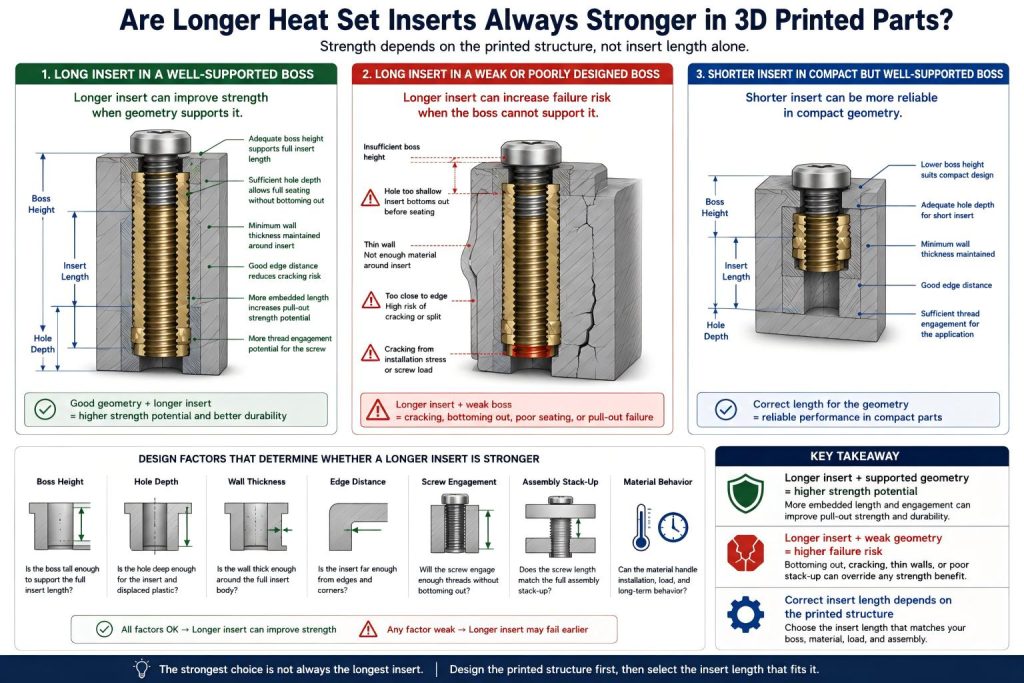
Are longer heat set inserts always stronger in 3D printed parts? Not always. A longer heat set insert can increase strength potential, but only when the printed part has enough boss height, hole depth, wall thickness, edge distance, screw engagement, and material support to use that extra length effectively.
In many 3D printed assemblies, a longer insert is useful. It can provide more embedded length, more thread engagement potential, and better pull-out resistance. But if the printed boss is too short, too thin, too close to an edge, or made from a material that cracks or creeps under load, the longer insert can create new failure risks instead of improving strength.
The better question is not whether a longer insert is stronger. The better question is whether the printed structure can support the longer insert.
Short Answer
A longer heat set insert is stronger only when the surrounding printed plastic can support the extra embedded length. If the boss height, wall thickness, hole depth, and assembly stack-up are not designed for the longer insert, it may crack the part, bottom out, reduce seating quality, or fail under screw load.
Why Longer Inserts Can Be Stronger
A longer heat set insert can improve joint performance because more of the insert body is embedded in the printed part. This can increase the contact area between the knurled brass insert and the surrounding plastic.
When the geometry is well supported, a longer insert may improve:
- pull-out resistance
- screw engagement margin
- load distribution along the boss height
- repeated assembly durability
- resistance to insert movement under axial load
This is why longer inserts are often considered for service panels, fixtures, robotics parts, brackets, and assemblies that are opened and closed many times.
For the full insert type comparison, see Short vs Long Heat Set Inserts for 3D Printed Parts.
Why Longer Inserts Are Not Automatically Better
A longer insert also needs more printed structure around it. If that support is missing, the extra length can become a problem.
A longer insert may fail when:
- the boss is not tall enough
- the pilot hole is too shallow
- the surrounding wall is too thin
- the insert is too close to an edge or corner
- the material cracks during installation
- the screw bottoms out before clamping the assembly
- the longer insert is forced into weak geometry
In these cases, a shorter insert with better support may perform more reliably than a longer insert placed in a weak boss.
The Printed Boss Must Support the Insert Length
The boss is the plastic structure that carries the insert load. A longer insert needs support along more of its body. If the boss only supports the upper portion of the insert, or if the lower part of the boss becomes thin or unsupported, the insert may not gain the expected strength benefit.
Boss height, boss outside diameter, and wall thickness should all be checked before using a longer insert.
For boss design, see How to Design Bosses for Heat Set Inserts and Boss OD Ratio for Heat Set Inserts in 3D Printed Parts.
Hole Depth Must Match Insert Length
A longer insert requires a deeper pilot hole. The hole also needs enough extra depth for displaced plastic during heat installation. If the hole is too shallow, the insert can bottom out before it seats correctly.
Bottoming out can make the insert appear installed, but the seating may be incomplete. The insert may sit proud, tilt, block thread access, or create stress at the bottom of the hole.
For hole depth design, see Heat Set Insert Hole Depth Chart for 3D Printed Parts.
Wall Thickness and Edge Distance Still Matter
Longer inserts do not remove the need for wall thickness and edge distance. In fact, they often make these checks more important. A longer insert applies installation pressure and load transfer over a larger vertical area. If the surrounding plastic is thin or close to an edge, cracks may form along the boss or toward the nearest boundary.
A longer insert near a weak edge can increase the chance of:
- edge cracking
- boss splitting
- insert tilt
- uneven seating
- pull-out through the weak side
For geometry limits, see Heat Set Insert Edge Distance Reference for 3D Printed Parts and Heat Set Insert Minimum Wall Thickness Reference for 3D Printed Parts.
Longer Inserts Need Correct Screw Engagement
A longer insert can allow more screw engagement, but only if the screw length and assembly stack-up allow it. If the screw is too short, the lower thread area of the longer insert may never be used. If the screw is too long, it may bottom out before the joint is clamped.
This means a longer insert must be checked together with screw length, mating part thickness, washer use, seating depth, and bottom clearance.
For thread engagement, see Screw Engagement Length for Heat Set Inserts in 3D Printed Parts. For full assembly stack-up, see Heat Set Insert Assembly Stack-Up Reference for 3D Printed Parts.
Material Behavior Changes the Answer
The same longer insert may behave differently in PLA, PETG, ABS, ASA, nylon, or fiber-filled materials.
| Material | Long Insert Benefit | Long Insert Risk |
|---|---|---|
| PLA | Can improve engagement in a strong boss | Brittle cracking if the boss is thin or installation pressure is high |
| PETG | Can improve retention in repeated assembly | Preload loss and creep if clamp load is not controlled |
| ABS | Can work well with enough boss support | Layer splitting or warping-related fit variation |
| ASA | Useful for exposed or outdoor parts | Still needs enough wall support and seating control |
| Nylon | Can improve embedded retention | Flexible movement and preload relaxation |
| Fiber-filled materials | Can provide strong support when geometry is good | Local brittleness and installation cracking |
For material comparison, see PLA vs PETG vs ABS for Threaded Inserts.
When a Longer Insert Is a Good Choice
A longer heat set insert is usually a good choice when the printed structure has enough support and the assembly needs more strength or durability.
Use a longer insert when:
- the boss is tall enough
- the hole depth is sufficient
- the wall thickness is adequate
- the insert is not too close to an edge
- the screw engagement length can use the extra thread depth
- the part is repeatedly assembled and disassembled
- pull-out resistance matters
- the assembly stack-up has been checked
When a Shorter Insert May Be Better
A shorter insert may be better when the part is compact, the boss is shallow, or the assembly load is modest. A short insert can be more reliable than a long insert if the longer insert would require weak geometry or create bottoming out risk.
Use a shorter insert when:
- the boss height is limited
- the wall thickness is thin
- the insert is near an edge or corner
- the screw load is light
- the assembly does not need high pull-out strength
- the part cannot support a deeper hole
- compact geometry matters more than maximum strength
Common Misunderstanding
The common mistake is treating insert length as a strength upgrade by itself. In a metal part, more thread engagement may often be useful. In a 3D printed plastic part, the plastic structure is usually the limiting factor.
If the surrounding plastic cannot support the longer insert, the longer insert does not solve the problem. It can simply move the failure into the boss, wall, edge, or bottom of the hole.
Practical Design Check
Before choosing a longer insert, check these items:
- Does the boss have enough height for the full insert length?
- Is the hole deep enough for the insert and displaced plastic?
- Is there enough wall thickness around the insert body?
- Is the insert far enough from edges and corners?
- Will the insert seat flush or at the intended depth?
- Will the screw engage enough thread without bottoming out?
- Will the material tolerate installation pressure?
- Will the assembly be opened repeatedly?
- Can the design be validated with test coupons?
Answer Summary
Longer heat set inserts are not always stronger in 3D printed parts. They can provide better strength potential when the printed geometry supports them. But if the boss, hole depth, wall thickness, edge distance, material, screw length, or stack-up is not designed correctly, a longer insert can fail earlier than a shorter insert.
The strongest choice is not always the longest insert. It is the insert length that matches the printed structure and assembly conditions.
Related Guides
- Short vs Long Heat Set Inserts for 3D Printed Parts
- M3 Brass Heat Set Inserts for 3D Printed Parts
- Heat Set Insert Hole Depth Chart for 3D Printed Parts
- Screw Engagement Length for Heat Set Inserts in 3D Printed Parts
- Pull-Out Strength of Heat Set Inserts in 3D Printed Parts
- Heat Set Insert Minimum Wall Thickness Reference for 3D Printed Parts
- Heat Set Insert Assembly Stack-Up Reference for 3D Printed Parts
- PLA vs PETG vs ABS for Threaded Inserts