
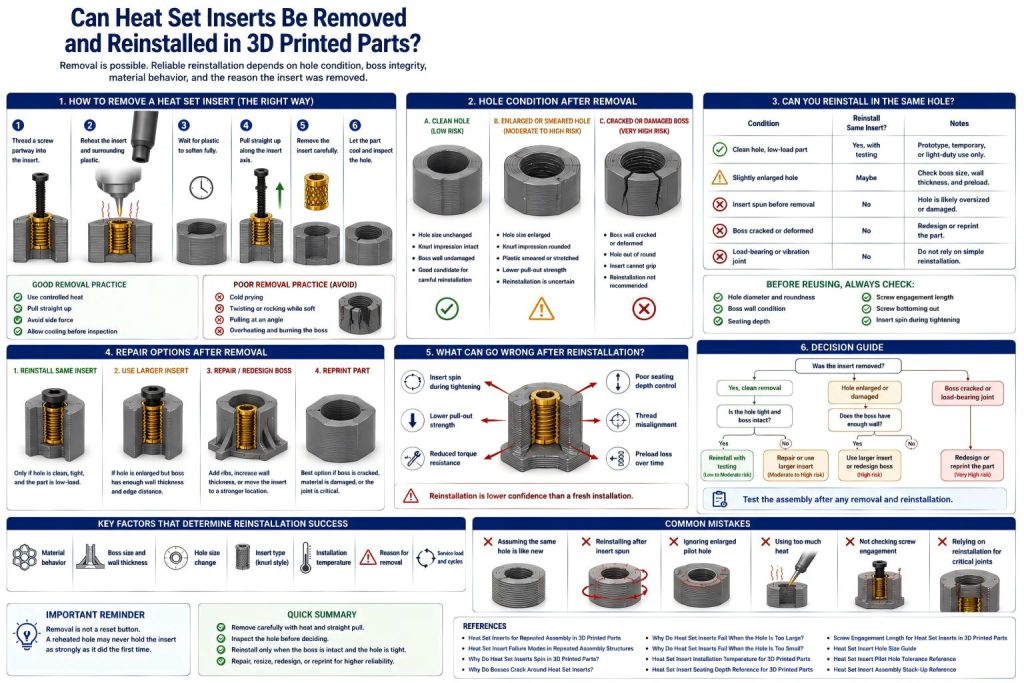
Can heat set inserts be removed and reinstalled in 3D printed parts? Yes, heat set inserts can usually be removed from 3D printed parts by reheating the insert and pulling it out carefully. However, reinstalling the same insert into the same hole is not always reliable because the plastic around the insert may be enlarged, softened, damaged, or no longer able to grip the insert knurls properly.
Removal is possible. Reliable reinstallation is the harder question.
The insert may come out cleanly, but the printed boss often changes during removal. The original hole may become oversized, the surrounding wall may deform, and the knurl impression may no longer provide enough mechanical grip. Whether the insert can be reused depends on the material, boss geometry, hole condition, insert style, and the reason the insert was removed in the first place.
Short Answer
You can remove a heat set insert, but you should not assume the same hole will hold the same insert with the same strength after reinstallation. For low-load prototypes, reinstalling may be acceptable. For functional parts, repeated assembly, vibration, or load-bearing joints, the hole should be inspected carefully and often repaired or redesigned.
| Situation | Reinstallation Risk | Recommended Decision |
|---|---|---|
| Clean removal, low-load prototype | Low to moderate | Reinstall carefully and test. |
| Hole slightly enlarged | Moderate to high | Consider larger insert, repair method, or redesigned boss. |
| Insert spun before removal | High | Do not reinstall the same insert without repairing the hole. |
| Boss cracked or deformed | Very high | Redesign or reprint the part. |
| Load-bearing or vibration joint | High | Avoid simple reinstallation; validate with testing. |
What Happens When a Heat Set Insert Is Removed?
A heat set insert is installed by softening the surrounding plastic so the insert can sink into the boss. As the plastic cools, it locks around the knurl pattern. When the insert is reheated and removed, the plastic softens again and the knurl impression may be disturbed.
Common changes after removal include:
- the pilot hole becomes larger
- the knurl impression becomes rounded or smeared
- the boss wall softens and deforms
- the insert cavity becomes oval or uneven
- plastic is pulled out with the insert
- the top surface becomes distorted
- the insert seating depth becomes less controlled
- the boss may crack if the insert is pulled at an angle
The hole may still look usable, but the grip may be weaker. This is why removal is not the same as resetting the part to its original condition.
When Reinstallation May Be Acceptable
Reinstalling a heat set insert into the same hole may be acceptable for low-load prototypes, temporary fixtures, cosmetic covers, or parts that do not rely on high pull-out strength or torque resistance.
Reinstallation is more reasonable when:
- the insert was removed cleanly
- the boss is not cracked
- the hole has not become visibly oversized
- the insert was not spinning before removal
- the part is not load-bearing
- the screw only applies light clamp force
- the part will not see high vibration or repeated service cycles
- the insert can be tested after reinstallation
Even in these cases, the reinstalled insert should be treated as lower confidence than a fresh insert installed into a properly sized hole.
When Reinstallation Is Not Recommended
Reinstallation is risky when the original joint already failed. If the insert spun, pulled out, loosened, or cracked the boss, reinstalling the same insert into the same hole usually repeats the original problem. The plastic has already shown that it cannot hold the insert under those conditions.
Reinstallation is not recommended when:
- the insert spun during screw tightening
- the boss cracked during installation or use
- the hole is visibly enlarged
- the insert pulled out under load
- the boss wall is thin or deformed
- the insert sits close to an edge or corner
- the joint must resist vibration
- the part needs reliable screw preload
- the part is structural or safety-related
- the same hole has already been reheated multiple times
For insert spinning behavior, see Why Do Heat Set Inserts Spin in 3D Printed Parts?. For boss cracking behavior, see Why Do Bosses Crack Around Heat Set Inserts?.
Why the Same Hole May Not Grip Again
A heat set insert depends on plastic flow around the knurled outer surface. The knurls need surrounding plastic to deform, fill the surface texture, and cool into a mechanical lock.
After removal, the hole may already contain a negative impression of the old knurl pattern. Reheating the same insert into that hole may not create a fresh grip. Instead, the insert may settle into the old damaged cavity with less interference and less plastic contact.
This can cause:
- reduced pull-out strength
- lower torque resistance
- insert spin during screw tightening
- preload loss after assembly
- poor seating depth control
- tilted insert alignment
- thread misalignment with the screw
For strength behavior, see Pull-Out Strength of Heat Set Inserts in 3D Printed Parts and Torque Resistance of Heat Set Inserts in 3D Printed Parts.
Material Behavior During Removal
Different 3D printing materials react differently when an insert is reheated and removed. The material affects whether the boss softens cleanly, cracks, stretches, or loses preload after reinstallation.
| Material | Removal Behavior | Reinstallation Concern |
|---|---|---|
| PLA | Softens quickly and can deform or crack around the boss | Boss cracking, distorted seating surface, brittle wall damage |
| PETG | Softens and may smear or stretch around the insert cavity | Oversized hole, preload loss, reduced torque resistance |
| ABS | Can tolerate heat better, but still depends on print quality | Layer adhesion, boss distortion, inconsistent grip after reheating |
| ASA | Similar to ABS with better outdoor suitability | Boss support and heat control still matter |
| Nylon | Tough but may deform and relax under preload | Creep, loose threads, lower clamp stability after reuse |
| Fiber-filled materials | Stiffer, but may concentrate stress around the insert cavity | Cracking, layer separation, poor repair tolerance |
For material comparison, see PLA vs PETG vs ABS for Threaded Inserts and Layer Adhesion and Heat Set Insert Strength in 3D Printed Parts.
How to Remove a Heat Set Insert Carefully
Removal should be controlled and slow. The goal is to soften the plastic enough to release the insert without tearing the boss apart.
A careful removal process usually includes:
- threading a screw partway into the insert
- heating the insert through the screw or insert body
- waiting for the surrounding plastic to soften
- pulling straight upward along the insert axis
- avoiding side force or twisting while the boss is soft
- allowing the boss to cool before inspection
- checking the hole size, wall condition, and seating surface
The insert should not be pried out cold. Cold removal can tear plastic, crack the boss, or pull out a chunk of the printed part.
For installation heat behavior, see Heat Set Insert Installation Temperature for 3D Printed Parts.
Repair Options After Removal
If the hole is damaged, simple reinstallation may not be enough. The right repair depends on the amount of damage and the required joint reliability.
| Problem | Possible Repair | Risk Level |
|---|---|---|
| Hole only slightly enlarged | Reinstall carefully with testing | Moderate |
| Hole oversized but boss intact | Use a larger insert if boss geometry allows | Moderate to high |
| Insert spun in place | Redesign boss or use larger insert after validating wall thickness | High |
| Boss cracked | Reprint or redesign the part | Very high |
| Thin wall damaged | Redesign with more wall thickness or move the insert | Very high |
Using a larger insert can work only if the boss has enough remaining material. If the larger insert leaves too little wall thickness, the repair may create a new crack waiting backstage with a tiny hammer.
For hole-size failure behavior, see Why Do Heat Set Inserts Fail When the Hole Is Too Large? and Why Do Heat Set Inserts Fail When the Hole Is Too Small?.
Should You Reuse the Same Insert?
The metal insert itself may be reusable if the threads are not damaged and the outer knurl profile is still clean. However, the bigger question is not whether the brass insert survives. It is whether the plastic hole can grip it again.
The same insert may be reused when:
- the threads are clean
- the insert is not deformed
- the outer knurls are not packed with plastic
- the hole remains tight enough for controlled reinstallation
- the part is low-load and testable
A new insert is usually better when the original insert spun, overheated, or pulled plastic out with it. If the knurls are filled with old plastic, the insert may not bond well during reinstallation.
Reinstalling Into the Same Hole vs Using a Larger Insert
Reinstalling into the same hole is simplest, but it has the lowest design margin if the hole was damaged. Using a larger insert may restore interference, but only if the boss can support the larger diameter and screw size.
| Option | Benefit | Main Risk |
|---|---|---|
| Same insert, same hole | Fastest repair | Weak grip if hole is enlarged or smeared |
| New insert, same hole | Cleaner threads and knurls | Still depends on damaged hole geometry |
| Larger insert | Can restore interference in some cases | May leave too little wall thickness |
| Redesigned boss | Best long-term fix | Requires model change and reprint |
| Reprint part | Restores original geometry | More time and material |
For boss sizing, see How to Design Bosses for Heat Set Inserts, Boss OD Ratio for Heat Set Inserts in 3D Printed Parts, and Heat Set Insert Minimum Wall Thickness Reference for 3D Printed Parts.
Check Screw Engagement After Reinstallation
After reinstallation, the insert seating depth may change. If the insert sits too deep, the screw may not engage as intended. If the insert sits too high, the mating part may not sit flat. If the screw is too long, it may bottom out before clamping the assembly.
After any removal and reinstallation, check:
- insert seating depth
- screw engagement length
- whether the screw bottoms out
- whether the mating part sits flat
- whether the insert spins under tightening
- whether the joint holds preload after service
For seating and stack-up planning, see Heat Set Insert Seating Depth Reference for 3D Printed Parts, Screw Engagement Length for Heat Set Inserts in 3D Printed Parts, and Heat Set Insert Assembly Stack-Up Reference for 3D Printed Parts.
Practical Decision Rule
Use this simple rule:
- Remove carefully if the insert must be replaced or the part needs repair.
- Reinstall only after inspection if the hole remains tight, round, and undamaged.
- Do not trust the same hole if the insert spun, pulled out, cracked the boss, or enlarged the cavity.
- Use a larger insert only if the boss still has enough wall thickness.
- Redesign or reprint when the joint is functional, load-bearing, or vibration-sensitive.
A removed insert is not a reset button. It is more like reopening a melted footprint in plastic: sometimes the shoe fits again, sometimes the floor remembers too much.
Related Engineering Guides
- How to Choose Heat Set Inserts for 3D Printed Parts
- Heat Set Insert Hole Size Guide
- How to Design Bosses for Heat Set Inserts
- Heat Set Insert Installation Temperature for 3D Printed Parts
- Screw Engagement Length for Heat Set Inserts in 3D Printed Parts
- Torque Resistance of Heat Set Inserts in 3D Printed Parts
Related Repeated Assembly References
- Heat Set Inserts for Repeated Assembly in 3D Printed Parts
- Heat Set Insert Failure Modes in Repeated Assembly Structures
- Recommended Fastening Structure for Repeated Assembly PETG Parts
Related Failure Questions
- Why Do Heat Set Inserts Spin in 3D Printed Parts?
- Why Do Bosses Crack Around Heat Set Inserts?
- Why Do Heat Set Inserts Fail When the Hole Is Too Large?
- Why Do Heat Set Inserts Fail When the Hole Is Too Small?
- Why Does Screw Preload Drop in 3D Printed Insert Joints?
Related References
- Heat Set Insert Pilot Hole Tolerance Reference for 3D Printed Parts
- Heat Set Insert Seating Depth Reference for 3D Printed Parts
- Heat Set Insert Assembly Stack-Up Reference for 3D Printed Parts
- Heat Set Insert Minimum Wall Thickness Reference for 3D Printed Parts
FAQ
Can I remove a heat set insert from a 3D printed part?
Yes. A heat set insert can usually be removed by reheating it and pulling it out carefully along the insert axis. Cold prying is not recommended because it can crack the boss or tear out plastic.
Can I reinstall the same insert into the same hole?
Sometimes, but it is less reliable than a fresh installation. The hole may be enlarged or damaged after removal, so the insert may have lower pull-out strength and lower torque resistance.
What should I do if the insert spun before removal?
If the insert spun, the hole is likely oversized or damaged. Reinstalling the same insert into the same hole is not recommended unless the hole is repaired or the boss is redesigned.
Can I use a larger insert after removing a damaged one?
Yes, but only if the boss has enough wall thickness and edge distance for the larger insert. If the larger insert leaves too little plastic around it, the repair can cause cracking or edge breakout.
When should I reprint the part instead of reinstalling the insert?
Reprint or redesign the part when the boss is cracked, the hole is badly enlarged, the joint is load-bearing, the part sees vibration, or the insert must provide reliable screw preload over repeated service cycles.