
Do heat set inserts need adhesive or glue in 3D printed parts? In most properly designed 3D printed parts, heat set inserts should not need adhesive or glue. A reliable heat set insert joint should come from the correct pilot hole size, controlled installation temperature, plastic flow around the knurled insert body, enough boss wall thickness, and a supported load path.
Adhesive can sometimes help with low-load repairs or temporary prototypes, but it should not be treated as the main method for holding a heat set insert in place. If an insert needs glue to stop spinning, pulling out, or loosening, the printed geometry or installation process usually needs to be corrected.
In a good design, glue is optional at best. In a bad design, glue often becomes a small sticky bandage over a much larger engineering problem.
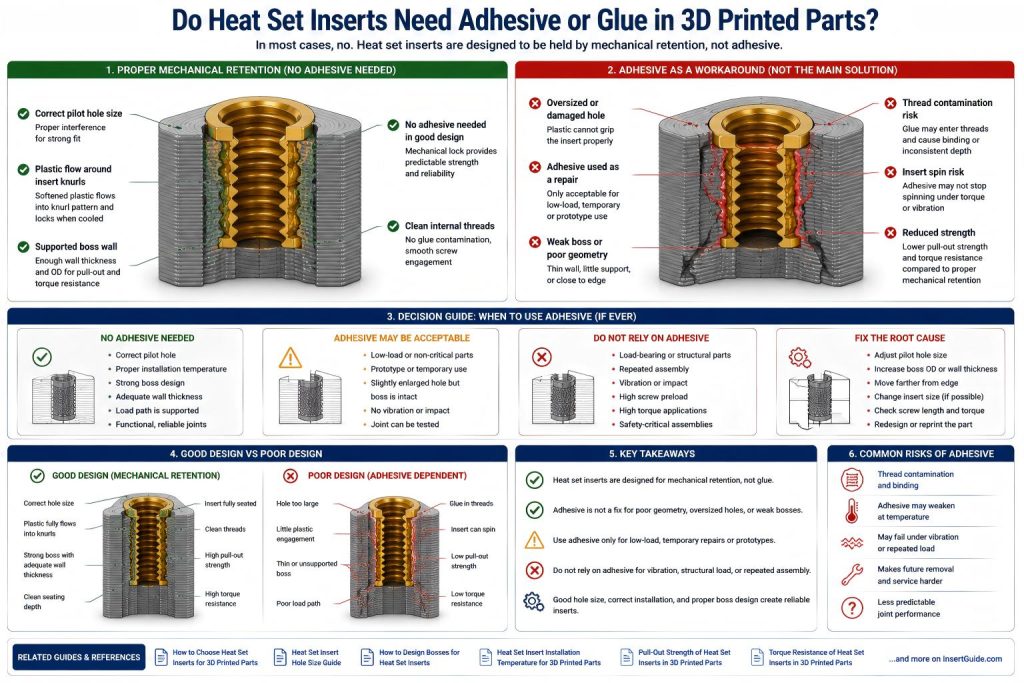
Short Answer
No, heat set inserts do not normally need adhesive in 3D printed parts. They are designed to be mechanically retained by softened plastic flowing around the insert’s outer knurl pattern during installation.
| Situation | Should You Use Adhesive? | Better Engineering Action |
|---|---|---|
| Correct pilot hole and strong boss | No | Install the insert properly and test the joint. |
| Insert spins during tightening | Usually no | Fix hole size, boss support, or insert selection. |
| Hole is slightly oversized in a prototype | Maybe, for low-load use only | Reprint or resize the hole for functional parts. |
| Boss is cracked or thin | No | Redesign or reprint the part. |
| Load-bearing or vibration-sensitive joint | No | Use proper geometry and validate mechanically. |
How Heat Set Inserts Are Supposed to Hold
A heat set insert works by heating the metal insert and pressing it into a printed pilot hole. The surrounding plastic softens, flows around the knurled or textured outer surface, and then cools into a mechanical lock.
This mechanical retention depends on:
- pilot hole diameter
- insert outer geometry
- installation temperature
- seating depth
- boss wall thickness
- material flow behavior
- print orientation
- layer adhesion
- load direction
- screw torque and preload
When these factors are correct, adhesive is not needed. The plastic and insert geometry do the work.
For general selection and installation logic, see How to Choose Heat Set Inserts for 3D Printed Parts, Heat Set Insert Hole Size Guide, and Heat Set Insert Installation Temperature for 3D Printed Parts.
Why Adhesive Is Usually Not the Right Fix
Glue may seem like an easy way to improve insert retention, but it usually does not solve the real cause of insert failure. If the insert hole is too large, the boss is too thin, the insert was overheated, or the screw torque is too high, adhesive does not restore the missing plastic support.
Adhesive can also create new problems:
- glue may enter the internal thread
- the insert may sit at the wrong depth
- the mating part may not sit flat
- future removal may become harder
- adhesive may weaken at temperature
- some adhesives may not bond well to the printed plastic
- adhesive may hide a poor pilot hole fit
- joint strength becomes less predictable
In functional parts, predictable mechanical retention is better than uncertain chemical bonding.
When Adhesive Might Be Acceptable
Adhesive may be acceptable in low-load, non-critical, temporary, or prototype situations where the insert only needs to hold a light cover or small internal component.
Adhesive may be reasonable when:
- the part is a prototype
- the load is very light
- the insert is only used for a cosmetic cover
- the screw will not be removed often
- the part does not see vibration
- the boss is intact but the hole is slightly loose
- failure would not damage the assembly
- the joint can be tested before use
Even then, adhesive should be treated as a repair or workaround, not the preferred design method.
When Adhesive Should Not Be Used as the Main Solution
Adhesive should not be used to compensate for weak geometry in functional or load-bearing parts. If the insert must resist pull-out, torque, vibration, repeated assembly, or screw preload, the printed structure should be corrected instead.
Adhesive is not recommended when:
- the insert carries structural load
- the part sees vibration or impact
- the screw will be removed repeatedly
- the insert already spins under tightening
- the boss is cracked or deformed
- the hole is clearly oversized
- the insert is close to an edge or thin wall
- the assembly needs reliable screw preload
- the material will see heat or chemical exposure
- the joint is difficult to inspect after assembly
For related failure behavior, see Why Do Heat Set Inserts Spin in 3D Printed Parts?, Why Do Heat Set Inserts Fail When the Hole Is Too Large?, and Why Do Bosses Crack Around Heat Set Inserts?.
Adhesive vs Mechanical Retention
The main difference is predictability. A properly installed heat set insert creates mechanical retention through geometry. Adhesive depends on surface preparation, material compatibility, glue thickness, cure quality, temperature, and load direction.
| Retention Method | How It Works | Best Use | Main Risk |
|---|---|---|---|
| Mechanical retention | Plastic flows around insert knurls and cools into shape | Normal heat set insert installation | Requires correct hole size and boss design |
| Adhesive retention | Glue bonds insert to surrounding plastic | Low-load repair or prototype workaround | Less predictable, may fail under heat, torque, or vibration |
| Oversized insert repair | Larger insert restores interference in a damaged hole | Some repair cases with enough wall thickness | Can crack boss if geometry is too small |
| Redesigned boss | Geometry is corrected for proper insert support | Functional and load-bearing parts | Requires model change and reprint |
If reliability matters, the joint should rely on geometry first.
What Glue Cannot Fix
Glue cannot turn a weak boss into a strong boss. It also cannot fully restore plastic that has been overheated, cracked, thinned, or enlarged around the insert.
Adhesive cannot reliably fix:
- too little wall thickness
- poor edge distance
- a cracked boss
- wrong insert size
- wrong screw length
- excessive tightening torque
- weak layer adhesion
- poor load path
- screw bottoming out before clamping
- material creep under preload
For geometry planning, see How to Design Bosses for Heat Set Inserts, Heat Set Insert Minimum Wall Thickness Reference for 3D Printed Parts, and Heat Set Insert Edge Distance Reference for 3D Printed Parts.
Adhesive and Thread Contamination
One practical risk is thread contamination. If adhesive flows into the insert thread, the screw may bind, cross-thread, or bottom out before clamping the part. This can make the joint feel tight while the assembly has poor preload.
This is especially risky with small inserts such as M2, M2.5, and M3, where the thread opening is small and a tiny amount of glue can cause trouble.
After adhesive repair, always check:
- whether the screw threads smoothly
- whether the screw reaches the expected depth
- whether the screw bottoms out
- whether the mating part sits flat
- whether the insert spins under tightening
- whether the joint holds preload after service
For screw depth and assembly behavior, see Screw Engagement Length for Heat Set Inserts in 3D Printed Parts and Heat Set Insert Assembly Stack-Up Reference for 3D Printed Parts.
Material Compatibility Matters
Different 3D printing materials behave differently with both heat set inserts and adhesives. Some adhesives bond poorly to certain plastics. Some materials soften, creep, or deform under heat and preload.
| Material | Adhesive Concern | Better Design Focus |
|---|---|---|
| PLA | May bond in some cases, but heat and brittleness remain concerns | Avoid cracking, use correct hole size and gentle installation heat |
| PETG | Can be difficult for some adhesives to bond reliably | Control pilot hole fit and watch preload relaxation |
| ABS | Some solvent-based repairs are possible, but geometry still matters | Ensure boss support and layer adhesion |
| ASA | Similar to ABS, but outdoor exposure may affect adhesive choice | Use enough wall thickness and stable load paths |
| Nylon | Often difficult to bond and can creep under preload | Use mechanical retention and avoid relying on glue |
| Fiber-filled materials | Stiff but may concentrate stress near the insert cavity | Use fillets, ribs, and tested pilot hole dimensions |
For material behavior, see PLA vs PETG vs ABS for Threaded Inserts and Layer Adhesion and Heat Set Insert Strength in 3D Printed Parts.
What to Do Instead of Using Glue
If the insert feels loose, spins, or pulls out, the better solution is usually to correct the fastening design.
Better options include:
- adjusting the pilot hole size
- using the correct insert length
- increasing boss outside diameter
- adding wall thickness around the insert
- moving the insert farther from edges
- adding ribs or fillets around the boss
- changing print orientation
- using a larger insert only if the boss can support it
- checking screw length and avoiding bottoming out
- reducing screw torque
- reprinting the part when the boss is damaged
For repair-related decisions, see Can Heat Set Inserts Be Removed and Reinstalled in 3D Printed Parts?.
When a Larger Insert Is Better Than Adhesive
If a hole is slightly oversized, a larger insert may sometimes be better than glue, but only when the boss has enough remaining wall thickness and edge distance. Upsizing an insert inside a weak boss can create a fresh failure.
A larger insert may be reasonable when:
- the boss is intact
- there is enough wall thickness
- edge distance remains acceptable
- the screw size change is acceptable
- the load path still makes sense
- the repaired joint can be tested
A larger insert is not reasonable when the boss is already cracked, thin, near an edge, or too small for the new insert size.
For insert size references, see M2 Heat Set Insert Dimensions Reference for 3D Printed Parts, M2.5 Heat Set Insert Dimensions Reference for 3D Printed Parts, and M3 Heat Set Insert Dimensions Reference.
Practical Decision Rule
Use this simple rule:
- Do not use adhesive when the insert can be installed correctly with proper geometry.
- Use adhesive only as a low-load repair or prototype workaround.
- Do not rely on adhesive for vibration, structural load, repeated assembly, or high preload.
- Fix the hole, boss, screw length, or insert size if the insert spins or pulls out.
- Redesign or reprint when the boss is cracked, thin, or poorly supported.
If a heat set insert needs glue to behave, the joint is whispering that the geometry needs attention. Glue may quiet the whisper for a while, but it does not change the load path.
Related Engineering Guides
- How to Choose Heat Set Inserts for 3D Printed Parts
- Heat Set Insert Hole Size Guide
- How to Design Bosses for Heat Set Inserts
- Heat Set Insert Installation Temperature for 3D Printed Parts
- Pull-Out Strength of Heat Set Inserts in 3D Printed Parts
- Torque Resistance of Heat Set Inserts in 3D Printed Parts
Related Failure Questions
- Why Do Heat Set Inserts Spin in 3D Printed Parts?
- Why Do Heat Set Inserts Fail When the Hole Is Too Large?
- Why Do Heat Set Inserts Fail When the Hole Is Too Small?
- Why Do Bosses Crack Around Heat Set Inserts?
- Why Does Screw Preload Drop in 3D Printed Insert Joints?
Related References
- Heat Set Insert Pilot Hole Tolerance Reference for 3D Printed Parts
- Heat Set Insert Minimum Wall Thickness Reference for 3D Printed Parts
- Heat Set Insert Edge Distance Reference for 3D Printed Parts
- Heat Set Insert Seating Depth Reference for 3D Printed Parts
- Heat Set Insert Assembly Stack-Up Reference for 3D Printed Parts
FAQ
Should I glue heat set inserts into 3D printed parts?
Usually no. A properly installed heat set insert should be held by mechanical retention from melted plastic flowing around the insert knurls. Glue should only be considered for low-load repair or temporary prototype use.
Can glue stop a heat set insert from spinning?
Glue may temporarily reduce spinning in a low-load part, but it does not fix the root cause. Insert spin usually comes from an oversized hole, weak boss, poor plastic flow, excessive torque, or insufficient wall thickness.
Is epoxy good for heat set inserts?
Epoxy can sometimes help in low-load repairs, but it should not replace correct insert geometry. It may also contaminate threads, make future removal harder, and behave unpredictably under heat, vibration, or screw torque.
What should I do if the insert hole is too large?
For a functional part, redesign or reprint the boss if possible. A larger insert may work only if there is enough remaining wall thickness and edge distance. Glue alone is usually not a reliable structural fix.
Do heat set inserts need threadlocker?
Threadlocker is different from adhesive for holding the insert body. Threadlocker may be used on the screw in some vibration-sensitive assemblies, but it should not be used to compensate for a loose insert or weak boss.