
Should I use M2.5 or M3 heat set inserts in 3D printed parts? Use M2.5 heat set inserts when space is limited, the load is light, and the printed boss can still provide enough wall thickness. Use M3 heat set inserts when the part has enough room and the joint needs better assembly margin, stronger screw preload, more service durability, or easier sourcing.
M2.5 and M3 inserts are close in size, but they are not interchangeable from a design point of view. The difference affects boss diameter, wall thickness, pilot hole tolerance, screw torque, thread engagement, and how much margin the printed plastic has around the insert.
The best choice is not the smaller insert or the larger insert. The best choice is the insert size that matches the available printed geometry and the mechanical load.
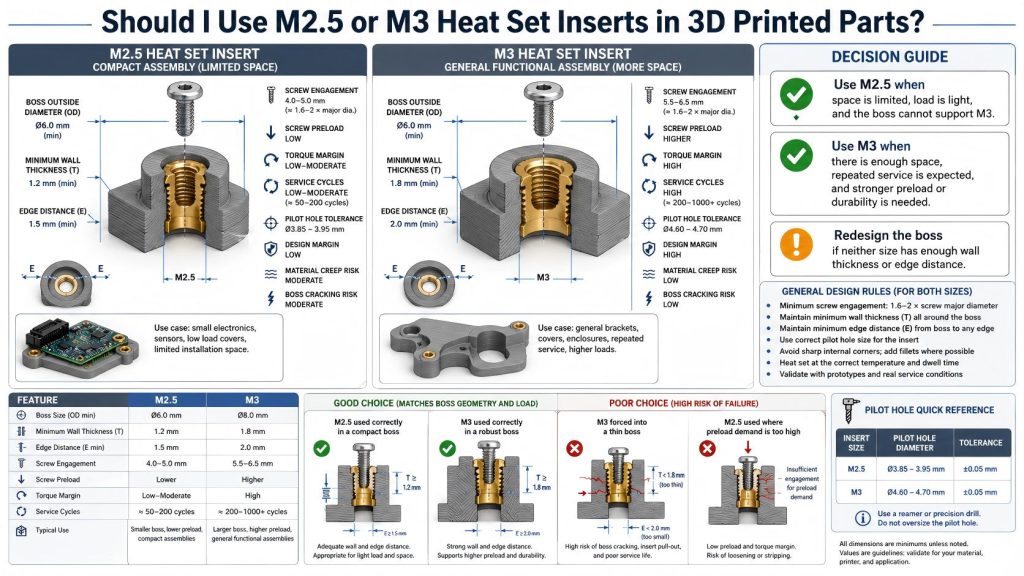
Short Answer
Choose M2.5 when the part is compact and the screw only carries light-duty fastening load. Choose M3 when the part can support a larger boss and the joint needs more strength, preload, or repeated assembly reliability.
| Choice | Best For | Main Risk |
|---|---|---|
| M2.5 heat set insert | Compact electronics, small sensors, thin covers, lightweight brackets | Lower design margin, smaller boss, more sensitive hole tolerance |
| M3 heat set insert | General functional parts, brackets, covers, fixtures, serviceable assemblies | Needs more space, larger boss, more wall thickness |
Why the Choice Matters
M2.5 and M3 inserts may look close, but the printed plastic around them behaves differently. A slightly larger insert needs more boss diameter, more wall thickness, more edge distance, and more heat during installation. A smaller insert saves space, but gives less thread engagement and less torque margin.
In a small printed part, this difference can decide whether the boss survives repeated screw installation or cracks like a tiny plastic walnut under a heavy boot.
The decision should be based on:
- available boss outside diameter
- minimum wall thickness around the insert
- distance from edges and corners
- screw preload required by the assembly
- how often the screw will be removed
- whether the part sees vibration or impact
- material behavior, especially creep and brittleness
- print orientation and layer adhesion
- availability of matching screws and hardware
When M2.5 Is the Better Choice
M2.5 heat set inserts are useful when the printed part is too small for a comfortable M3 boss but still needs a reusable machine screw thread.
M2.5 may be the better choice when:
- the part is compact and space is limited
- the screw holds a small PCB, sensor, cover, or light bracket
- the load is low and mostly clamping-based
- the boss cannot grow large enough for M3
- the part needs a smaller screw head for clearance or appearance
- the assembly does not require high tightening torque
- the insert can still be placed in a supported boss
Typical M2.5 applications include small electronics enclosures, sensor modules, compact covers, miniature brackets, low-load switch mounts, and lightweight internal mounting points.
For small insert sizing context, see M2.5 Heat Set Insert Dimensions Reference for 3D Printed Parts.
When M3 Is the Better Choice
M3 heat set inserts are often the safer default for functional 3D printed parts. They usually provide more thread engagement, better screw availability, more torque margin, and more assembly tolerance than M2.5 inserts.
M3 may be the better choice when:
- the part has enough space for a larger boss
- the joint will be opened and closed many times
- the screw needs stronger preload
- the part may see vibration or repeated handling
- the bracket carries more than light-duty load
- the boss can maintain enough wall thickness and edge distance
- the design needs more forgiving assembly behavior
- hardware sourcing and standardization matter
For many general-purpose printed brackets, covers, fixtures, and service panels, M3 is a more practical and robust choice than M2.5.
For M3-specific context, see M3 Brass Heat Set Inserts for 3D Printed Parts and M3 Heat Set Insert Dimensions Reference.
M2.5 vs M3 Design Comparison
| Design Factor | M2.5 Insert | M3 Insert |
|---|---|---|
| Space requirement | Lower | Higher |
| Boss size requirement | Smaller boss possible | Larger boss needed |
| Thread engagement margin | Lower | Higher |
| Screw preload margin | Lower | Higher |
| Torque tolerance | More sensitive | More forgiving |
| Best use | Compact, low-load assemblies | General functional assemblies |
| Main risk | Thin boss, insert spin, low preload margin | Needs more geometry and may be oversized for small parts |
Boss Size Is Usually the Deciding Factor
The most important question is not “M2.5 or M3?” It is “How much plastic can the part provide around the insert?”
If an M3 insert forces the boss too close to an edge, slot, corner, or thin wall, M2.5 may be safer. If the part can support a proper M3 boss, M3 often gives better assembly reliability.
A good boss should provide:
- enough outside diameter around the insert
- enough wall thickness between the insert and boss edge
- enough depth for insert seating and screw engagement
- enough edge distance from external part boundaries
- support ribs or a broad base when the boss is tall
- a print orientation that does not split easily along layer lines
For boss geometry, see How to Design Bosses for Heat Set Inserts, Boss OD Ratio for Heat Set Inserts in 3D Printed Parts, and Heat Set Insert Minimum Wall Thickness Reference for 3D Printed Parts.
Wall Thickness and Edge Distance
M3 inserts usually need more wall thickness and edge distance than M2.5 inserts. If a design has limited space near a corner, thin wall, or small mounting ear, M2.5 may reduce cracking risk.
However, downsizing to M2.5 also reduces screw strength and preload capacity. It should not be used to hide a weak load path. If the part is structurally important, the better solution may be to redesign the boss or bracket rather than simply choosing a smaller insert.
For edge planning, see Heat Set Insert Edge Distance Reference for 3D Printed Parts.
Screw Preload and Service Cycles
M3 screws can usually create more clamp force than M2.5 screws. This is helpful when the part needs to stay tight after repeated assembly, vibration, or handling.
M2.5 screws are useful for small components, but they should not be overtightened. In small bosses, too much torque can spin the insert, crack the boss, or deform the printed wall.
If the part will be opened repeatedly, M3 may be better unless space is truly limited. If the part is a small internal cover, sensor board, or lightweight electronics mount, M2.5 may be enough.
For screw engagement behavior, see Screw Engagement Length for Heat Set Inserts in 3D Printed Parts. For tightening behavior, see Heat Set Insert Torque Range Reference for 3D Printed Parts.
Material Choice Can Change the Answer
Material behavior affects whether M2.5 or M3 is safer. PLA may hold shape well but can crack around small bosses. PETG is tougher but may relax under screw preload. Nylon can handle impact but may creep. Fiber-filled materials may be stiff but less forgiving around thin walls.
| Material | M2.5 Consideration | M3 Consideration |
|---|---|---|
| PLA | Useful for small rigid parts, but watch boss cracking | More preload margin, but needs enough wall thickness |
| PETG | Good for light-duty compact parts, but preload may relax | Better service margin, but still check creep |
| ABS / ASA | Can work well in compact functional parts | Good for stronger serviceable assemblies if layer adhesion is reliable |
| Nylon | Useful for compact tough parts, but may creep | Better fastening margin, but preload still needs testing |
| Fiber-filled materials | Can be stiff but sensitive in small bosses | Works well when the boss has enough volume and fillets |
For material comparison, see PLA vs PETG vs ABS for Threaded Inserts and Layer Adhesion and Heat Set Insert Strength in 3D Printed Parts.
Common Mistakes
- choosing M2.5 only because the part looks small
- choosing M3 only because it feels stronger
- using M3 when the boss does not have enough wall thickness
- using M2.5 for a joint that needs too much preload
- placing either insert too close to an edge or slot
- overtightening small screws
- forgetting that screw length can bottom out before clamping
- ignoring material creep in PETG or nylon
- not printing a test coupon for small insert holes
- assuming insert size alone determines strength
For related failure behavior, see Why Do Heat Set Inserts Spin in 3D Printed Parts?, Why Do Bosses Crack Around Heat Set Inserts?, and Why Does Screw Preload Drop in 3D Printed Insert Joints?.
Practical Decision Rule
Use this simple rule:
- Use M2.5 when the assembly is compact, lightly loaded, and cannot support a proper M3 boss.
- Use M3 when the assembly has enough space and needs stronger, more forgiving, serviceable fastening.
- Redesign the boss if neither size has enough wall thickness, edge distance, or load path support.
If the part is small and delicate, M2.5 may be the neat little key. If the part is functional and serviceable, M3 is often the sturdier door hinge. But if the printed geometry is weak, neither key opens the castle.
Related Engineering Guides
- How to Choose Heat Set Inserts for 3D Printed Parts
- Heat Set Insert Hole Size Guide
- How to Design Bosses for Heat Set Inserts
- Screw Engagement Length for Heat Set Inserts in 3D Printed Parts
- Torque Resistance of Heat Set Inserts in 3D Printed Parts
- PLA vs PETG vs ABS for Threaded Inserts
Related Insert Type References
- M3 Brass Heat Set Inserts for 3D Printed Parts
- M2 Brass Heat Set Inserts for 3D Printed Parts
- M4 Brass Heat Set Inserts for 3D Printed Parts
Related References
- M2.5 Heat Set Insert Dimensions Reference for 3D Printed Parts
- M3 Heat Set Insert Dimensions Reference
- Heat Set Insert Pilot Hole Tolerance Reference for 3D Printed Parts
- Heat Set Insert Minimum Wall Thickness Reference for 3D Printed Parts
- Heat Set Insert Edge Distance Reference for 3D Printed Parts
FAQ
Is M2.5 stronger than M2 for 3D printed parts?
M2.5 usually gives more screw and insert margin than M2, but it still needs enough boss support. It can be a useful middle size for compact parts that need slightly more strength than M2 but cannot fit a proper M3 boss.
Is M3 always better than M2.5?
No. M3 is usually stronger and more forgiving, but it needs more printed material. If the part cannot provide enough boss diameter, wall thickness, or edge distance, M2.5 may be safer.
Should I use M2.5 or M3 for PCB mounting?
Use M2.5 when the PCB and enclosure are compact and the load is light. Use M3 when the board, cover, or enclosure is larger and repeated service or stronger screw preload is expected.
Which size is better for sensor brackets?
M2.5 can work for small sensor boards and low-load mounts. M3 is usually better when the sensor bracket needs more alignment stability, vibration resistance, or repeated adjustment.
What is the biggest risk when choosing between M2.5 and M3?
The biggest risk is choosing by screw size alone. The printed boss, wall thickness, edge distance, material behavior, screw preload, and service cycles are what determine whether the insert will remain reliable.