
Should I use short or long heat set inserts in 3D printed parts? Use short heat set inserts when the printed boss is shallow, the load is light to moderate, or the part has limited wall thickness. Use long heat set inserts when the boss is deep enough, the joint needs more screw engagement, and the printed structure can support the extra insert length without cracking, melting through, or weakening the surrounding geometry.
A longer insert can improve thread engagement and pull-out resistance, but only when the printed boss has enough depth, wall thickness, and load path support. A long insert placed into a shallow or thin boss can create more problems than it solves.
The best insert length is not the longest available insert. It is the insert length that matches the printed part geometry, screw length, and real load.
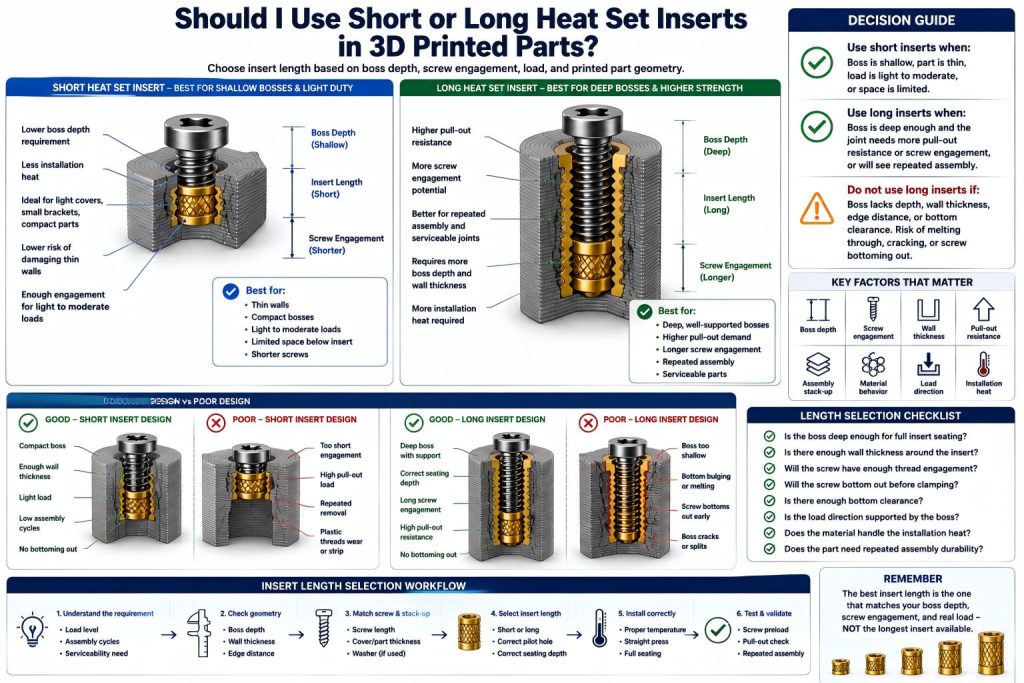
Short Answer
Choose short heat set inserts for compact, shallow, light-duty parts. Choose long heat set inserts when the boss is deep enough and the joint needs higher pull-out resistance, longer screw engagement, or more durable repeated assembly.
| Insert Length | Best For | Main Risk |
|---|---|---|
| Short heat set insert | Thin parts, compact bosses, light covers, small brackets, low to moderate loads | Less thread engagement and lower pull-out margin |
| Long heat set insert | Deep bosses, stronger brackets, repeated assembly, higher pull-out demand | Needs enough boss depth, wall thickness, and correct screw stack-up |
Why Insert Length Matters
Insert length affects how much surface area the insert has inside the plastic, how much screw thread can engage, and how deeply the load is transferred into the printed boss.
A longer insert may provide more contact area with the surrounding plastic. It may also allow more screw engagement. Both can improve joint reliability when the printed part supports the insert properly.
But length also increases installation risk. A longer insert needs more heat, more seating depth, and more printed material around it. If the boss is shallow, thin, or close to other features, the longer insert may weaken the part.
Insert length should be selected together with:
- boss depth
- boss outside diameter
- wall thickness around the insert
- pilot hole depth
- screw length
- screw engagement requirement
- insert seating depth
- assembly stack-up
- load direction
- material behavior
When Short Heat Set Inserts Are the Better Choice
Short heat set inserts are useful when the printed part has limited thickness or the joint does not need maximum strength. They are often easier to install, require less heat, and reduce the risk of melting through the bottom of a boss.
Short inserts may be better when:
- the boss is shallow
- the part is thin or compact
- the load is light to moderate
- the screw mainly holds a cover or small bracket
- the part does not need high pull-out resistance
- the assembly is not heavily vibration-loaded
- there is limited space below the insert
- the screw length is short
- the boss cannot safely support a deeper insert
Typical use cases include small covers, electronics lids, sensor brackets, light service panels, compact enclosures, and prototype parts where space is limited.
When Long Heat Set Inserts Are the Better Choice
Long heat set inserts are useful when the boss is deep enough and the joint needs more thread engagement, more pull-out resistance, or better durability under repeated assembly.
Long inserts may be better when:
- the boss has enough depth for full insert seating
- the boss has enough wall thickness around the insert
- the joint needs higher pull-out resistance
- the screw will be removed and reinstalled many times
- the assembly sees moderate vibration or handling
- the screw needs more thread engagement
- the load path is supported by the printed body
- the material can tolerate installation heat and clamp load
Typical use cases include fixtures, jigs, serviceable machine panels, stronger brackets, mounting blocks, larger enclosures, and repeated assembly structures.
For repeated assembly behavior, see Heat Set Inserts for Repeated Assembly in 3D Printed Parts.
Short vs Long Insert Comparison
| Design Factor | Short Insert | Long Insert |
|---|---|---|
| Boss depth required | Lower | Higher |
| Installation heat | Lower | Higher |
| Screw engagement potential | Lower | Higher |
| Pull-out margin | Lower | Higher if boss geometry supports it |
| Risk in thin parts | Lower | Higher |
| Best use | Compact, light-duty assemblies | Deeper bosses and stronger serviceable joints |
Longer Inserts Are Not Automatically Stronger
A longer insert can only help when the printed boss has enough material to support it. If the insert is longer than the available boss depth, the bottom of the hole may soften, bulge, or break through. If the boss wall is too thin, the longer insert can increase cracking risk. If the screw length is wrong, the screw may bottom out before clamping the part.
A long insert becomes useful when the surrounding plastic supports the full insert length. Without that support, the extra length is just extra heat and extra stress inside the boss.
For this specific misconception, see Are Longer Heat Set Inserts Always Stronger in 3D Printed Parts?.
Boss Depth Is Usually the Deciding Factor
The most important question is whether the boss is deep enough for the insert. The hole should allow the insert to sit at the correct seating depth without breaking through the bottom, pushing molten plastic into a thin wall, or changing the screw stack-up.
A good boss for a longer insert should provide:
- enough vertical depth for the insert body
- enough plastic below or around the insert when needed
- enough wall thickness around the insert
- enough boss outside diameter
- a stable seating surface
- a load path into the main printed body
- room for screw engagement without bottoming out
For depth planning, see Heat Set Insert Hole Depth Chart for 3D Printed Parts and Heat Set Insert Seating Depth Reference for 3D Printed Parts.
Screw Engagement and Insert Length
Insert length and screw engagement are related, but they are not the same thing. A long insert can allow more screw engagement, but only if the screw length, cover thickness, washer thickness, and insert depth all work together.
If the screw is too short, the longer insert may not be fully used. If the screw is too long, it may bottom out before clamping the assembly. If the insert sits too deep, the screw may have less usable engagement than expected.
Always check the final stack-up:
- screw head
- washer if used
- mating part thickness
- printed boss depth
- insert seating depth
- available thread engagement
- bottom clearance
For screw engagement behavior, see Screw Engagement Length for Heat Set Inserts in 3D Printed Parts. For stack-up planning, see Heat Set Insert Assembly Stack-Up Reference for 3D Printed Parts.
Pull-Out Strength and Insert Length
Longer inserts can improve pull-out strength because they may provide more contact area between the insert and the surrounding plastic. However, pull-out strength also depends on the boss diameter, wall thickness, material, print orientation, layer adhesion, pilot hole size, and load direction.
A longer insert in a weak boss may still pull out or split the surrounding plastic. A shorter insert in a well-supported boss may outperform a longer insert in a thin, edge-adjacent boss.
Pull-out strength should be treated as a system:
- insert length
- insert outer texture
- pilot hole fit
- boss wall thickness
- boss outside diameter
- edge distance
- material creep
- layer adhesion
- load direction
- installation quality
For strength behavior, see Pull-Out Strength of Heat Set Inserts in 3D Printed Parts and Layer Adhesion and Heat Set Insert Strength in 3D Printed Parts.
Installation Risk With Longer Inserts
Longer inserts usually need more heat and more controlled pressure during installation. More heat can soften a larger region of the printed boss. If the boss is narrow, the wall may deform. If the hole is too shallow, the bottom may bulge. If the insert is pushed too deep, the mating part may not sit correctly.
Common installation risks with longer inserts include:
- insert sits too proud
- insert is pushed too deep
- bottom of boss deforms
- plastic bulges into nearby features
- hole wall softens unevenly
- insert tilts during installation
- boss cracks from excessive heat or pressure
- screw stack-up changes after seating
For installation control, see Heat Set Insert Installation Temperature for 3D Printed Parts.
Material Choice Can Change the Answer
Material behavior affects whether a short or long insert is safer. Some materials tolerate deeper heated inserts better than others. Some materials are stiff but brittle. Others are tough but may relax under screw preload.
| Material | Short Insert Behavior | Long Insert Behavior |
|---|---|---|
| PLA | Good for compact bosses, but can crack if overtightened | May crack if the boss is thin or installation heat is excessive |
| PETG | Useful for light to moderate joints, but may relax under preload | Can work if boss is supported, but check creep and preload loss |
| ABS / ASA | Good for functional parts with enough layer adhesion | Can support longer inserts if geometry and installation are controlled |
| Nylon | Tough but may creep under clamp load | Needs testing for preload retention and long-term stability |
| Fiber-filled materials | Stiff, but may be less forgiving around thin bosses | Can work well with strong boss geometry and fillets |
For material comparison, see PLA vs PETG vs ABS for Threaded Inserts.
Common Mistakes
- choosing the longest insert available without checking boss depth
- using a long insert in a shallow boss
- forgetting that screw length may bottom out
- using a short insert where repeated assembly needs more thread engagement
- placing long inserts too close to edges or cutouts
- not checking seating depth after installation
- overheating the boss during long insert installation
- assuming insert length alone determines pull-out strength
- ignoring wall thickness around the insert
- not testing with the final screw and mating part
For related failure behavior, see Why Do Heat Set Inserts Fail When the Hole Is Too Large?, Why Do Heat Set Inserts Fail When the Hole Is Too Small?, and Why Do Bosses Crack Around Heat Set Inserts?.
Practical Decision Rule
Use this simple rule:
- Use short inserts when the part is compact, shallow, lightly loaded, or space-limited.
- Use long inserts when the boss is deep enough and the joint needs more pull-out strength, thread engagement, or service durability.
- Do not use long inserts if the boss cannot provide enough depth, wall thickness, edge distance, and bottom clearance.
- Check screw stack-up before assuming a longer insert improves the joint.
- Test the final material and geometry when the joint is functional or repeated-service.
A long insert is not a magic root that makes every boss stronger. It only grows strength when the printed part gives it enough soil.
Related Engineering Guides
- How to Choose Heat Set Inserts for 3D Printed Parts
- Heat Set Insert Hole Size Guide
- How to Design Bosses for Heat Set Inserts
- Screw Engagement Length for Heat Set Inserts in 3D Printed Parts
- Pull-Out Strength of Heat Set Inserts in 3D Printed Parts
- Layer Adhesion and Heat Set Insert Strength in 3D Printed Parts
Related Insert Type References
When the top surface also carries clamp load, compare insert length with flanged heat set inserts.
- Short vs Long Heat Set Inserts for 3D Printed Parts
- M3 Brass Heat Set Inserts for 3D Printed Parts
- M4 Brass Heat Set Inserts for 3D Printed Parts
Related Selection Questions
- Are Longer Heat Set Inserts Always Stronger in 3D Printed Parts?
- Should Heat Set Inserts Sit Flush or Below the Surface?
- Can Heat Set Inserts Be Removed and Reinstalled in 3D Printed Parts?
Related References
- Heat Set Insert Hole Depth Chart for 3D Printed Parts
- Heat Set Insert Seating Depth Reference for 3D Printed Parts
- Heat Set Insert Assembly Stack-Up Reference for 3D Printed Parts
- Heat Set Insert Minimum Wall Thickness Reference for 3D Printed Parts
FAQ
Are long heat set inserts stronger than short inserts?
Long inserts can be stronger when the boss has enough depth, wall thickness, and load path support. They are not automatically stronger in shallow or weak printed bosses.
When should I use short heat set inserts?
Use short inserts for compact parts, thin bosses, light covers, small brackets, and low to moderate load joints where the part cannot safely support a deeper insert.
When should I use long heat set inserts?
Use long inserts when the boss is deep enough and the joint needs more screw engagement, higher pull-out resistance, or better durability under repeated assembly.
Can a long insert damage a 3D printed part?
Yes. A long insert can damage the part if the hole is too shallow, the boss is too thin, the insert is overheated, or the screw bottoms out before clamping the assembly.
How do I choose insert length?
Choose insert length based on boss depth, screw engagement, seating depth, stack-up, wall thickness, load direction, and material behavior. Do not choose length by size alone.