
Should I use through-bolts instead of heat set inserts in 3D printed parts? Use through-bolts when the joint must carry higher load, resist impact, spread force through the full part thickness, or avoid relying on a small printed boss. Use heat set inserts when the part needs reusable metal threads, serviceable assembly, and the printed boss has enough wall thickness, edge distance, and load path support.
Heat set inserts and through-bolts solve different fastening problems. A heat set insert creates a durable internal thread inside the printed part. A through-bolt passes through the part and clamps the assembly with a nut, washer, backing plate, or mating component on the opposite side.
The choice is not about which fastener is stronger in isolation. The real question is how the load moves through the printed part.
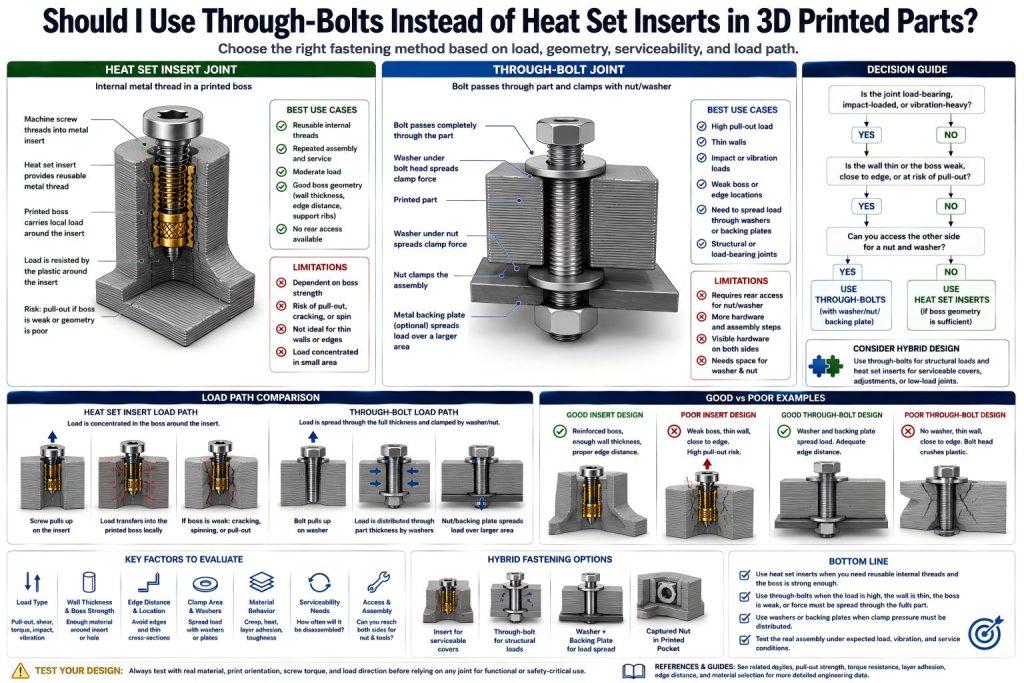
Short Answer
Use heat set inserts when the joint is serviceable, moderately loaded, and supported by a strong boss. Use through-bolts when the joint is load-bearing, impact-loaded, vibration-sensitive, thin-walled, edge-adjacent, or when the printed boss cannot safely carry pull-out or torque loads.
| Fastening Method | Best For | Main Risk |
|---|---|---|
| Heat set insert | Reusable threads, serviceable covers, brackets, fixtures, repeated assembly | Boss can crack, spin, pull out, or lose preload if geometry is weak |
| Through-bolt | Higher load, structural clamp, thin walls, vibration, impact, weak bosses | Needs rear access, washer/nut space, proper clamping area, and stack-up control |
How Heat Set Inserts Carry Load
A heat set insert carries screw load through the printed boss around the insert. The screw threads into the metal insert, but the insert itself is held by the surrounding plastic.
This means the strength of the joint depends on:
- pilot hole size
- insert length and outer texture
- boss outside diameter
- wall thickness around the insert
- edge distance
- material behavior
- print orientation
- layer adhesion
- screw torque
- load direction
Heat set inserts are excellent when the boss is properly designed. They are weaker when the boss is thin, unsupported, close to an edge, or loaded in pull-out without enough plastic behind it.
For insert design fundamentals, see How to Choose Heat Set Inserts for 3D Printed Parts and How to Design Bosses for Heat Set Inserts.
How Through-Bolts Carry Load
A through-bolt passes completely through the printed part. Instead of relying only on a local insert boss, the joint can clamp across the part thickness using a nut, washer, metal plate, or mating component.
This can spread load over a larger area and reduce the risk of a small insert boss pulling out.
A through-bolt can help when:
- the printed wall is too thin for a strong insert boss
- the insert would be too close to an edge
- the joint carries high pull-out load
- the assembly sees impact or vibration
- the part needs stronger clamp force
- there is access to both sides of the part
- a washer or backing plate can spread load
- a nut can be captured or accessed during assembly
A through-bolt does not make weak geometry disappear, but it can move load away from a fragile local boss and into a broader clamping structure.
When Heat Set Inserts Are the Better Choice
Heat set inserts are often better when the part needs clean internal threads and repeated service, but the load is not so high that a through-bolt is necessary.
Use heat set inserts when:
- the part needs reusable machine screw threads
- the assembly will be opened and closed repeatedly
- rear access for a nut is not available
- the boss has enough diameter and wall thickness
- the insert is far enough from edges and corners
- the load is light to moderate
- the screw mainly provides clamping, not structural suspension
- the part needs a clean exterior surface
- the insert can be installed and tested properly
Typical examples include electronics lids, robot service panels, adjustable sensor mounts, light fixtures, small brackets, and removable covers.
For repeated assembly behavior, see Heat Set Inserts for Repeated Assembly in 3D Printed Parts.
When Through-Bolts Are the Better Choice
Through-bolts are often better when the load is high, the boss would be weak, or the joint needs to clamp across a larger structure.
Use through-bolts when:
- the joint is load-bearing
- the part sees impact or shock
- the assembly sees strong vibration
- the insert would be in a thin wall
- the insert would be too close to an edge or corner
- the boss cannot provide enough wall thickness
- the screw load pulls directly out of the printed boss
- the joint needs a washer or backing plate to spread load
- the part is safety-sensitive or difficult to inspect
- physical testing shows insert pull-out or boss cracking
A through-bolt is often the safer choice when the printed boss would otherwise become the only thing standing between the load and failure.
Comparison Table
| Design Factor | Heat Set Insert | Through-Bolt |
|---|---|---|
| Thread type | Metal internal thread inside printed part | Bolt passes through part and clamps with nut or mating thread |
| Rear access needed | No | Usually yes |
| Repeated service | Good | Good if nut access is available |
| Pull-out resistance | Depends heavily on boss geometry | Usually better when load is spread with washer or backing plate |
| Thin-wall suitability | Risky without reinforcement | Often better with washers or backing plates |
| Edge/corner use | Risky if edge distance is low | Can still be risky, but load can be spread more effectively |
| Installation complexity | Requires heat-set installation | Requires access, nut, washer, or backing hardware |
| Best use | Serviceable threaded joints with supported bosses | Higher load or weak-boss situations where clamping area matters |
Pull-Out Load: The Main Difference
Pull-out load is one of the clearest reasons to choose a through-bolt. In a heat set insert joint, pull-out load tries to extract the insert from the printed boss. If the boss is too small or poorly supported, the insert can pull out even though the metal thread remains intact.
In a through-bolt joint, the load can be resisted by a nut, washer, backing plate, or larger clamped surface on the opposite side. This can spread the force over more plastic and reduce local boss failure.
For pull-out behavior in insert joints, see Pull-Out Strength of Heat Set Inserts in 3D Printed Parts.
Thin Walls and Through-Bolts
Thin-wall printed parts are often poor candidates for heat set inserts unless the insert area is reinforced with a boss, pad, rib, or local thickening. A through-bolt with washers or backing plates may be safer because it does not depend on a small local insert cavity to hold the thread.
Through-bolts can help in thin-wall parts when:
- the wall cannot support a heat set insert boss
- the screw load needs to spread over a wider area
- both sides of the part are accessible
- washers or plates can be added
- the design can tolerate visible hardware
For thin-wall insert decisions, see Should I Use Heat Set Inserts in Thin-Wall 3D Printed Parts?.
Edges, Corners, and Through-Bolts
Heat set inserts near edges or corners need enough plastic around the insert. If the insert is too close to the edge, screw load may break through the shortest wall path.
A through-bolt can sometimes reduce the risk by spreading clamp force with washers or a backing plate. However, the edge can still fail if the hole is too close to the boundary or the load pulls toward the edge.
Use through-bolts near edges only when:
- there is enough edge distance for the hole
- washer pressure will not crush the edge
- the load path does not tear through a thin wall
- the part has enough material around the through-hole
- the joint has been tested under real load
For edge/corner insert decisions, see Should Heat Set Inserts Be Used Near Edges or Corners in 3D Printed Parts? and Heat Set Insert Edge Distance Reference for 3D Printed Parts.
Vibration and Repeated Loading
Vibration can loosen both heat set insert joints and through-bolt joints. The difference is where the failure tends to begin.
In a heat set insert joint, vibration can reduce screw preload, spin the insert, crack the boss, or cause creep in the surrounding plastic. In a through-bolt joint, vibration can still loosen the nut, but the load is not concentrated only in the insert boss.
For vibration-heavy assemblies, through-bolts with washers, locknuts, threadlocker, or metal backing can be more reliable than inserts alone.
For vibration-related insert failure, see Why Do Heat Set Inserts Fail Under Vibration?.
When a Hybrid Design Works Better
Sometimes the best answer is not heat set insert or through-bolt alone. A hybrid fastening structure can use the strengths of both approaches.
Hybrid options include:
- heat set inserts for serviceable covers and low-load screws
- through-bolts for structural load paths
- washers to spread screw head pressure
- metal backing plates behind printed brackets
- captured nuts in printed pockets
- locating shoulders to carry shear load
- dowels or pins for alignment
- printed ribs to support fastening zones
A well-designed fastener system often separates functions: threads provide assembly, geometry carries load, and washers or plates spread pressure.
Washer and Backing Plate Effects
Through-bolts become much more useful when paired with washers or backing plates. These parts spread clamp force over a larger area and reduce local crushing of the printed plastic.
Washers and backing plates help when:
- the printed material is soft or creep-prone
- the part is thin
- the load is high
- the joint sees vibration
- the bolt head or nut would otherwise crush the surface
- the hole is near a flexible region
- the assembly needs stable preload
Without washers or plates, a through-bolt can still concentrate load around a small hole. The bolt passes through the part, but the printed structure still needs enough clamping area.
Material Choice Matters
The choice between through-bolts and heat set inserts depends partly on material behavior. Some materials crack around inserts. Some creep under clamp load. Some tolerate vibration better but may still lose preload.
| Material | Heat Set Insert Concern | Through-Bolt Concern |
|---|---|---|
| PLA | Boss cracking and brittle pull-out near stress concentrations | Washer pressure can crack or crush thin areas if overtightened |
| PETG | Preload loss and creep around insert boss | Clamp force may relax; use washers or backing plates |
| ABS / ASA | Depends on layer adhesion and boss design | Can work well if clamp area is broad and load path is supported |
| Nylon | Creep and preload loss around insert | Through-bolts help, but washers and preload checks are important |
| Fiber-filled materials | Stress concentration around insert cavity | Good stiffness, but avoid sharp holes and unsupported edges |
For material comparison, see PLA vs PETG vs ABS for Threaded Inserts and Layer Adhesion and Heat Set Insert Strength in 3D Printed Parts.
Design Checklist for Through-Bolts
If you choose through-bolts, the printed part still needs proper design. A through-bolt can fail if the hole is poorly placed, the washer crushes the surface, or the load path tears through the part.
- Use enough hole edge distance.
- Use washers or backing plates when the plastic is thin or soft.
- Check whether both sides of the joint are accessible.
- Confirm nut clearance and tool access.
- Avoid placing through-holes in weak corners or thin tabs.
- Use broad clamp surfaces where possible.
- Check that bolt preload does not crush the printed part.
- Use locknuts or threadlocker for vibration when appropriate.
- Test the joint under real load and service conditions.
Common Mistakes
- using heat set inserts where a through-bolt is needed
- using a through-bolt without washers in soft or thin plastic
- placing a through-hole too close to an edge
- assuming a through-bolt automatically fixes weak geometry
- using inserts for high pull-out load without testing
- ignoring rear access for nuts or tools
- over-tightening through-bolts and crushing printed plastic
- not using backing plates in high-load joints
- relying on screw friction to carry shear load
- not testing vibration, creep, or repeated service
Practical Decision Rule
Use this simple rule:
- Use heat set inserts when you need serviceable internal threads and the printed boss is strong enough.
- Use through-bolts when the joint needs higher load capacity, broader clamp force, or the boss cannot safely hold an insert.
- Use washers or backing plates when the plastic is thin, soft, creep-prone, or highly loaded.
- Use hybrid structures when the design needs both serviceability and stronger load transfer.
- Test the real assembly when load, vibration, or safety matters.
A heat set insert is a good threaded anchor. A through-bolt is a bridge through the part. Use the anchor when the local ground is strong; use the bridge when the load needs to cross the whole structure.
Related Engineering Guides
- How to Choose Heat Set Inserts for 3D Printed Parts
- Pull-Out Strength of Heat Set Inserts in 3D Printed Parts
- Torque Resistance of Heat Set Inserts in 3D Printed Parts
- How to Design Bosses for Heat Set Inserts
- Screw Engagement Length for Heat Set Inserts in 3D Printed Parts
- Layer Adhesion and Heat Set Insert Strength in 3D Printed Parts
Related Selection Questions
- Should I Use Heat Set Inserts in Load-Bearing 3D Printed Parts?
- Should I Use Heat Set Inserts in Thin-Wall 3D Printed Parts?
- Should Heat Set Inserts Be Used Near Edges or Corners in 3D Printed Parts?
- Should I Use Heat Set Inserts or Self-Tapping Screws in 3D Printed Parts?
Related Failure Questions
- Why Do Heat Set Inserts Pull Out of 3D Printed Parts?
- Why Do Heat Set Inserts Fail Under Vibration?
- Why Do Bosses Crack Around Heat Set Inserts?
- Why Does Screw Preload Drop in 3D Printed Insert Joints?
Related Applications
- Heat Set Inserts for High-Vibration Motor Mounting Brackets
- Heat Set Inserts in 3D Printed Industrial Fixtures
- Heat Set Inserts in 3D Printed CNC Fixture Plates
- Heat Set Inserts in Modular Robotics Systems
FAQ
Are through-bolts stronger than heat set inserts?
Through-bolts can be stronger in high-load situations because they can spread load through the full part thickness using nuts, washers, or backing plates. Heat set inserts are strong when the printed boss is properly designed, but they still depend on local plastic support.
When should I use heat set inserts instead of through-bolts?
Use heat set inserts when you need reusable internal threads, clean assembly, repeated service, and the printed boss has enough material to support the insert.
When should I use through-bolts instead of heat set inserts?
Use through-bolts when the load is high, the part is thin, the boss is weak, the insert would be too close to an edge, or the joint needs washers or backing plates to spread load.
Can I use both heat set inserts and through-bolts in the same design?
Yes. Many functional assemblies use heat set inserts for serviceable covers and through-bolts for structural load paths. This hybrid approach can be stronger than forcing one fastening method everywhere.
Do through-bolts need washers in 3D printed parts?
Often yes. Washers or backing plates help spread clamp force and reduce crushing, creep, or local cracking in printed plastic, especially in thin or soft materials.